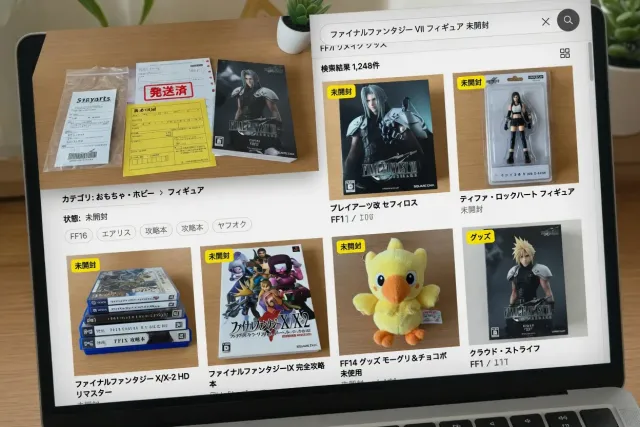
To search Japanese Final Fantasy listings effectively, combine the English title with Japanese franchise names, character names, product categories, and condition terms. Search broad terms first, then narrow results with words such as フィギュア (figure), グッズ (goods), 攻略本 (strategy guide), or 未開封 (unopened). Checking alternate titles, roman numerals, and Japanese-only character spellings can reveal listings that an English search misses.
Start with the Japanese Final Fantasy franchise name
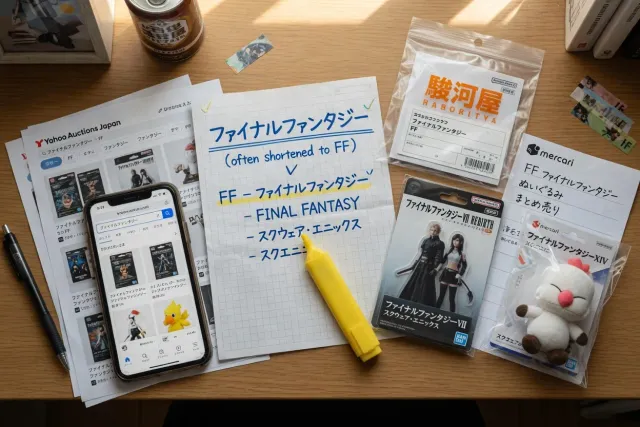
The most useful first search term is ファイナルファンタジー, the standard Japanese rendering of ·Final Fantasy.· It is often shortened to FF, particularly in casual Mercari-style listings, auction titles, bundle descriptions, and older merchandise listings. Search both versions because sellers do not always use the full franchise name.
Useful starting searches include:
- ファイナルファンタジー · Final Fantasy
- FF · common abbreviation; broad and sometimes noisy
- FINAL FANTASY · English branding used on official products
- スクウェア・エニックス · Square Enix, useful for official-branded merchandise
- スクエニ · casual abbreviation for Square Enix
Begin with ファイナルファンタジー when you want a wide overview of available Japanese items. Then add one or two qualifiers rather than placing every possible word into a single search. Japanese listings can have short titles, incomplete metadata, or mixed Japanese and English text, so a series of targeted searches generally works better than one overly narrow phrase.
If you are unfamiliar with official series naming, check the publisher’s branding at Square Enix. Official spelling is especially helpful when searching newer titles, crossover products, soundtrack releases, and limited promotional goods.
Search by game title, number, and alternate Japanese title
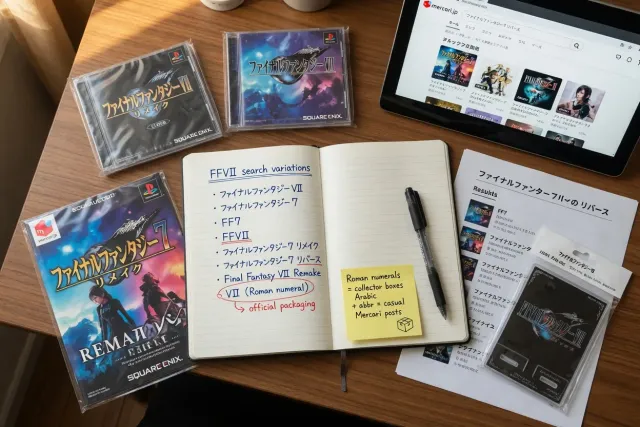
Numbered Final Fantasy titles can appear in several formats. A seller may use Roman numerals, Arabic numerals, a Japanese number, an abbreviation, or only a subtitle. Search variations separately, particularly for games with remakes, remasters, sequels, and related media.
Use more than one numeral format
For Final Fantasy VII, for example, search all of the following:
- ファイナルファンタジーVII
- ファイナルファンタジー7
- FF7
- FFVII
- ファイナルファンタジー7 リメイク · Final Fantasy VII Remake
- ファイナルファンタジー7 リバース · Final Fantasy VII Rebirth
Roman numeral searches often find official packaging and collector-oriented listings, while Arabic numbers and abbreviations can uncover more casually written listings. For older games, a seller might list only ·FF7,· ·FFⅦ,· or a character name. For newer releases, the Japanese subtitle is usually important because it separates remake-era items from original-game merchandise.
Use the same approach for other entries: FF10 / FFX / ファイナルファンタジーX, FF14 / FFXIV / ファイナルファンタジー14, or FF16 / FFXVI / ファイナルファンタジー16. Do not assume the digit form is universal. Japanese item titles may use the Japanese full-width character Ⅶ, standard VII, or simply 7.
When browsing the Final Fantasy collection, use the product images and naming conventions you see as prompts for additional Japanese searches. A single official product line, event name, or character costume can become a useful keyword that leads to related listings.
Add Japanese product-category keywords to focus results
Adding a category word is the fastest way to turn a broad franchise search into a useful listing search. Japanese sellers frequently classify items by what they are rather than by detailed franchise information. If a title says only ·クラウド フィギュア,· for instance, the item may not repeat Final Fantasy in the listing title.
Common Final Fantasy product keywords include:
- フィギュア · figure
- ぬいぐるみ · plush or stuffed toy
- アクリルスタンド / アクスタ · acrylic stand
- 缶バッジ · button badge or can badge
- キーホルダー · key holder/keychain
- クリアファイル · clear file folder
- ポスター · poster
- タペストリー · fabric wall scroll/tapestry
- カード · card
- トレーディングカード · trading card
- サウンドトラック / OST · soundtrack
- 攻略本 · strategy guide
- 設定資料集 · setting materials book
- 画集 · art book
- ゲームソフト · game software
Combine terms in a natural order: ファイナルファンタジー フィギュア, FF7 クラウド アクスタ, or FFX サウンドトラック. If results are still too broad, add a character, product line, store bonus name, or event term. If they are too limited, remove the franchise title and search the character plus category instead.
Some merchandise is distributed as blind-box or random items. Search ランダム (random), トレーディング (trading), 単品 (single item), or コンプリート (complete set) when relevant. These words describe how an item was issued or grouped and can substantially change the results you see.
Use Japanese character names and world-specific terms
Character names are among the best ways to find Japanese Final Fantasy listings that lack a full franchise title. Many sellers assume the character is recognizable and write only the name plus item type. Search the Japanese spelling, the English spelling, and abbreviations where appropriate.
Examples include:
- クラウド · Cloud
- セフィロス · Sephiroth
- ティファ · Tifa
- エアリス · Aerith
- ザックス · Zack
- ユウナ · Yuna
- ティーダ · Tidus
- ライトニング · Lightning
- ノクティス · Noctis
- クライヴ · Clive
Pair the character with a series marker when the name might create unrelated results. For example, クラウド FF7 is more focused than クラウド alone, while セフィロス フィギュア may already be specific enough. Japanese names can also differ from fan-used English forms, so it is worth checking the spelling displayed on official Japanese packaging or product photos.
World, group, and item names can be equally valuable. Searches for terms such as チョコボ (Chocobo), モーグリ (Moogle), 召喚獣 (summon), クリスタル (crystal), or エオルゼア (Eorzea) can surface items that a simple Final Fantasy query overlooks. Add a game number if a term appears across multiple entries.
Search official product lines, events, and store bonuses
Japanese Final Fantasy merchandise is often easier to locate through the name of its product line than through a general category. Official lines may be printed prominently on packaging but omitted from translated search results. Learning a few recurring terms helps distinguish items with similar artwork or characters.
Useful terms to try include PLAY ARTS, BRING ARTS, STATIC ARTS, and マスターライン where applicable. Search the line name with the character or title: ·BRING ARTS クラウド· is usually more precise than a generic ·Cloud figure· query. Keep spelling flexible, as listings may use spaces, all caps, or partial product-line names.
Event and retail keywords can also identify exclusive artwork or campaign items. Common words include:
- 限定 · limited/exclusive
- 特典 · bonus benefit
- 購入特典 · purchase bonus
- 店舗特典 · store bonus
- 予約特典 · preorder bonus
- イベント · event
- コラボ · collaboration
- カフェ · caf·, useful for themed caf· merchandise
These keywords should be used carefully. 限定 does not explain what the limitation was, and 特典 may refer to a small included bonus rather than the main product. Read the listing title, photos, and description together to determine whether the searched item is the primary product, a bonus item, or a mixed bundle.
Read Japanese listing language before narrowing your search
Search results become much more reliable when you recognize a small set of listing terms. Auto-translation is helpful, but Japanese condition and bundle language can be concise, so knowing the original wording helps you interpret the item correctly.
- 未開封 · unopened
- 美品 · described as being in very good condition
- 初版 · first printing/first edition, often relevant to books
- 中古 · used/pre-owned
- 現状品 · sold in current condition
- ジャンク · junk; may be incomplete, damaged, or untested
- 箱なし · no box
- 付属品なし · accessories not included
- まとめ売り · lot/bundle sale
- バラ売り不可 · not available separately
- 即購入可 · immediate purchase accepted
For searching, terms such as 未開封, 箱なし, and まとめ売り are useful modifiers. For example, FF7 フィギュア 未開封 narrows toward unopened figures, while ファイナルファンタジー グッズ まとめ売り focuses on mixed lots. However, do not rely on a single word alone: photos and the complete description remain important because sellers may use broad condition labels for items with different levels of wear.
Watch for exclusions in listing text. 画像のものが全て means ·everything shown in the photos is included,· while 写真をご確認ください asks you to check the photographs. These phrases often matter more than a translated title, especially for older game software, figures with optional parts, and sets that may have missing inserts.
Adapt your search to the Japanese listing source
Different Japanese sources tend to reward different search habits. Marketplace-style listings may use casual abbreviations and character-only titles. Auction-style listings can include longer descriptions, collections, older promotional material, and lots. Retail inventory sources are often more standardized and may respond well to catalog names, product numbers, or formal item titles.
On broad peer-to-peer listings, start with short queries such as FF9 ビビ or ティファ 缶バッジ. On auction listings, try adding terms such as まとめ (lot), 当時物 (period/original-era item), or 非売品 (not for sale) when looking for older promotional pieces. On more catalog-based sources, use official line names and full title spellings.
A practical workflow is to run the same concept in three forms: franchise plus category, game plus character, and character plus product line. For instance: ファイナルファンタジー アクリルスタンド, FF7 ティファ, and ティファ コラボ. Compare the results rather than assuming one query is complete.
JPFinds brings together live Japanese listings and provides automatic translation, making it easier to compare terminology across sources. Start your search through the Final Fantasy hub on JPFinds, then refine with the Japanese terms that best match the specific title, character, and item format you want.
Build a repeatable search checklist
A strong Final Fantasy search is iterative. Save a short list of keyword combinations and revisit them with small changes rather than restarting from scratch every time. This is particularly useful for characters with many releases and for products that are listed inconsistently.
- Search the full Japanese franchise name: ファイナルファンタジー.
- Repeat with FF, FF plus a number, and Roman-numeral variants.
- Add the Japanese game title or subtitle.
- Add a character name in Japanese.
- Add a product type such as フィギュア, ぬいぐるみ, アクスタ, or 攻略本.
- Try official product-line, event, collaboration, or bonus terms.
- Use condition and bundle words only after identifying the right item category.
- Review photos and Japanese description details before treating a result as an exact match.
The key is not to search more words at once; it is to search the right variations. Japanese Final Fantasy listings can be indexed under a title, a character, an item line, a collaboration, or an abbreviation. Using several focused queries gives you a far more complete view than relying on the English franchise name alone.
Related guides: explore the Final Fantasy hub for franchise-focused Japanese shopping searches.