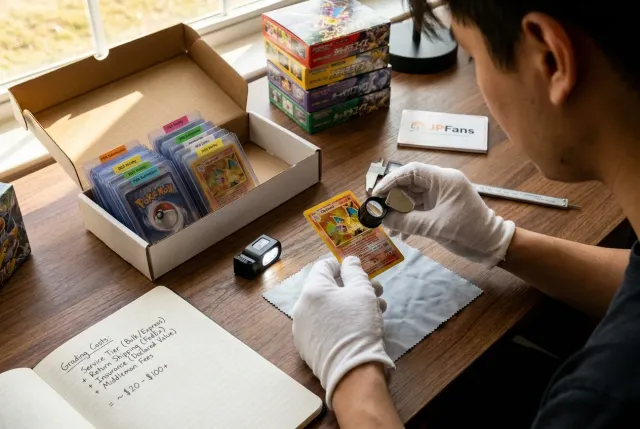
To grade Pokémon cards, first evaluate centering, corners, edges, surface, authenticity, and any print defects, then submit suitable cards to a professional grading company. Total grading cost usually includes the service tier, return shipping, insurance, possible declared-value charges, and any middleman fees. A realistic budget can range from roughly US$20 per card for slower bulk-style submissions to well over US$100 for premium, high-value, or expedited service.
What Pokémon card grading means
Professional card grading is a third-party assessment of a trading card’s authenticity and physical condition. After review, the grader seals the card in a tamper-evident holder — often called a slab — with a label showing the card identification, certification number, and numerical grade.
Most major grading scales use numbers from 1 to 10. While wording varies by company, a simplified interpretation looks like this:
- 10 Gem Mint: Exceptional condition, with very strong centering and little to no visible wear.
- 9 Mint: Near-perfect overall, but may have a small flaw such as slightly imperfect centering or a tiny edge issue.
- 8 Near Mint — Mint: Attractive card with minor visible imperfections.
- 7 Near Mint: Light wear may be present, including small whitening, minor scratches, or modest centering issues.
- 6 and below: Increasing levels of wear, dents, creases, surface damage, stains, or other significant flaws.
A grade is not simply a statement that a card is ·good· or ·bad.· It is a standardized opinion about condition at the time of evaluation. Two cards that appear similar in a binder can receive different grades if one has a tiny dent, surface indentation, print line, or corner compression visible under close examination.
Grading can also authenticate a card, but collectors should understand that grading is not a guarantee that every possible manufacturing or print variation will be treated the same way. Review the chosen company’s published standards before submitting. For example, PSA, CGC Cards, and Beckett Grading Services (BGS), known for its Black Label 10, publish information about their services, holders, and submission options.
Decide whether a card is worth grading
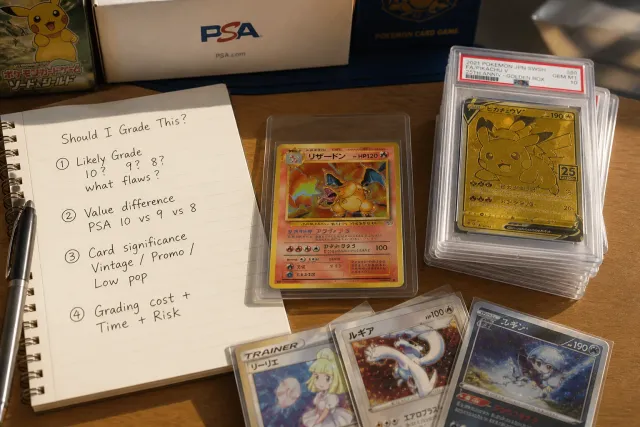
The right question is not only ·Is this card valuable?· It is also ·Will the likely grade justify the total cost and effort?· A card can be rare, nostalgic, or visually striking and still be a poor grading candidate if it has visible wear or if the grading fee is high relative to its likely graded demand.
Before submitting, consider these four factors:
- Likely grade: Be conservative. If you think a card is a 10, ask what flaws could make it a 9 or 8 instead.
- Value difference by grade: Some cards have a major premium at a 10 but relatively modest gains at 8 or 9. Others remain desirable across several grades.
- Card significance: Vintage holographics, tournament cards, Japanese promos, early printings, and scarce promotional releases may be collected even in mid-grade condition.
- Personal collecting goals: A favorite card may be worth grading for preservation and display even when the financial case is limited.
For Japanese Pokémon cards, carefully identify the exact version before estimating a grade or value. Small differences in set number, holographic pattern, promo marking, language, or release can matter. The official card name alone may not be enough to distinguish one printing from another. If you are building a collection around Japanese releases, browse the latest Pokémon collectibles from Japan to compare card artwork, editions, and release formats.
Japanese cards can be appealing grading candidates because collectors value their distinct print runs, holofoil treatments, and exclusive promo releases. As with any card, condition remains the key factor, so review raw-card photos carefully before buying.
Do not grade a card solely because online listings describe it as ·mint.· Sellers and collectors often use condition language differently. A professional 10 is a high threshold, especially for older cards and cards with glossy holofoil surfaces.
How to pre-grade Pokémon cards at home
Pre-grading is your own careful condition review before you pay for a submission. It cannot predict a result perfectly, but it helps remove cards with obvious flaws and sets realistic expectations. Work on a clean, dry, uncluttered surface, and avoid touching the card face whenever possible.
Check centering
Centering refers to the balance of the printed borders on the front and back. Compare the top, bottom, left, and right borders. A card can look centered at a glance yet be noticeably off under measurement. Use a centering tool, ruler, or high-resolution scan to compare border widths.
Centering standards differ among graders and may differ between front and back. A card with excellent surfaces but visibly uneven borders may miss the top grade. Do not rely only on front centering; the reverse matters as well.
Inspect corners and edges
Use bright indirect light and examine each corner from more than one angle. Look for whitening, softening, fraying, compression, lifting layers, and tiny bends. Then inspect the edges for small chips, rough cuts, silvering, and whitening. Older Japanese holo cards can show edge wear that is easy to miss until viewed against a dark background.
A single pinprick of whitening may not ruin a card’s overall appeal, but it can matter significantly when pursuing a top grade. Corners that look sharp from above can still show compression when viewed from the side.
Inspect the surface under angled light
Surface condition is where many submissions disappoint. Hold the card at a shallow angle beneath a bright lamp and slowly rotate it. Check both front and back for:
- Fine scratches and scuffs
- Holofoil scratches or print lines
- Dents, dimples, pressure marks, and indentations
- Fingerprints, residue, stains, or water damage
- Print defects, roller marks, or ink issues
- Creases, even very light ones
A dent may be difficult to photograph and nearly invisible when the card lies flat, but it can have a large effect on the final grade. Never try to press, flatten, recolor, trim, polish, or otherwise alter a card to improve its appearance. Alteration can lead to a rejected submission, an ·altered· designation, or damage that permanently reduces the card’s appeal.
Confirm the card is authentic and correctly identified
Before grading, compare the card with reliable reference images and check the set symbol, card number, language, foil pattern, texture, fonts, back design, and dimensions. A grading company may decline a card it cannot authenticate or classify. For unusual Japanese promos or older releases, accurate identification is especially important because the label description may depend on the precise issue.
Choose a grading company and service level
Choose a grader based on your goal, the card type, your location, turnaround preferences, holder style, and the market that matters to you. Some collectors prefer a particular company for registry sets; others choose based on price, available submission partners, or how their preferred cards are commonly traded.
When comparing services, focus on the complete terms rather than the headline fee:
- Declared-value limit: Each tier usually has a maximum value. A card valued above that limit may require a higher tier.
- Authentication and grading scope: Confirm that the company accepts Pokémon cards, Japanese-language cards, and the category of card you plan to submit.
- Minimum submission quantity: Some routes are economical only when submitting several cards together.
- Return shipping and insurance: These can materially change the per-card cost, especially for small submissions.
- Service speed: Faster tiers usually cost more. Published estimates can change with submission volume, so treat them as estimates rather than guarantees.
- Upcharges: If the grader determines that a card’s value exceeds your selected tier, additional fees may apply.
Collectors outside the United States often use an authorized dealer or submission middleman. This can simplify international paperwork and allow multiple cards to share shipping costs, but it adds another fee layer. Ask for a written breakdown of service fees, return shipping, insurance, taxes where applicable, and the policy for declared-value adjustments. JPFinds is a shopping-proxy platform for purchasing Japanese cards and does not provide card inspection or grading submission services.
How much it costs to grade a Pokémon card
When people ask, ·How much does it cost to grade a Pokémon card?·, the most accurate answer is that it depends on the card’s declared value, the grading company, submission quantity, service speed, and shipping route. The grading fee alone is not the full cost.
Use this budgeting framework:
- Economy or bulk-style service: Often around US$15·$30 per card before shipping and other charges, usually with slower processing and submission minimums.
- Standard service: Often around US$30·$75 per card, commonly used for cards with moderate declared values.
- Express or premium service: Frequently US$75·$200+ per card, intended for higher-value cards or collectors seeking faster handling.
- High-value tiers: Can cost several hundred dollars per card when the declared value is substantial.
These are planning ranges, not fixed price lists. Grading companies revise fees and tier names, and international submissions can add meaningful transport costs. Always confirm current pricing directly with your chosen grader or submission partner before sending cards.
Estimate your all-in grading cost
A useful formula is:
Total cost per card = grading fee + share of outbound shipping + share of return shipping + insurance + submission partner fee + possible tax/customs charges + possible upcharge.
For example, imagine sending 10 cards through a grouped submission. If the grading tier is US$25 per card, shared shipping and insurance add US$8 per card, and the submission partner charges US$5 per card, your working estimate is US$38 per card. If one card is reassigned to a higher value tier, its final total could be higher than the rest.
For a single-card submission, shipping and insurance can make the all-in cost much higher than the advertised grading fee. Grouping cards can lower the shipping portion per card, but only submit cards you would still be comfortable grading if the result is one grade lower than hoped.
Prepare and submit cards safely
Once you have chosen cards and a grading route, follow the grader’s current packaging instructions exactly. Requirements vary, but the general goal is to protect the card without making it difficult for the receiving team to remove safely.
- Place each card in a clean soft sleeve.
- Use the semi-rigid holder, card saver, or other holder specified by the grading company.
- Avoid taping directly onto the card sleeve opening where adhesive could contact the card.
- Use pull tabs or the grader’s recommended method for safe removal.
- Package holders between firm cardboard layers so they cannot shift inside the parcel.
- Document each card with clear photographs and record its identifying details before shipping.
- Declare values honestly and retain submission forms, tracking details, and receipts.
Do not clean cards with liquids, household products, or abrasive cloths. Even gentle-looking cleaning attempts can create scratches or alter the surface. If you notice dust on a sleeve or holder, replace the sleeve rather than attempting to rub the card itself.
For collectors sourcing Japanese cards for a future grading project, the JPFinds Pokémon hub is a useful starting point for exploring listings across Japanese marketplaces. Keep condition expectations realistic: listing photos can help you screen a card, but detailed pre-grading at home remains essential after it arrives.
Understand grades, labels, and the final result
When your cards return, compare each grade with your original notes. This helps improve future submissions. If a card graded lower than expected, revisit your pre-grading photos and inspect it under angled light. The cause may be a flaw you did not notice, such as a small indentation, print defect, or back-edge whitening.
Grades are opinions made under a company’s standards, so results can vary between companies and even over time as grading practices evolve. Resubmitting a card is a personal decision, not an automatic solution. It involves another fee, another shipping cycle, and no guarantee of a higher outcome.
A graded card can be rewarding as a protected collectible, a display piece, or part of a carefully organized set. The best submissions are usually cards chosen with clear expectations: you understand the likely condition range, the full cost, and why the card matters to your collection.
Ready to find your next grading candidate? Browse Japanese Pokémon cards on JPFinds to source original items from Mercari, Yahoo Auctions, and Surugaya.
How do I grade Pokémon cards?
Evaluate the card’s centering, corners, edges, surface, and authenticity; choose a grading company and service tier; complete its submission process; and package the card according to its instructions. Include shipping, insurance, and potential declared-value adjustments in your budget.
How much does it cost to grade a Pokémon card?
Many economy-style submissions begin around US$15·$30 per card before shipping and related charges. Standard and premium services can cost substantially more. Your true per-card total depends on service tier, declared value, shipment size, insurance, and whether you use a submission partner.
What condition should a Pokémon card be in before grading?
Top-grade candidates should have strong centering, sharp corners, clean edges, and a scratch-free, dent-free surface. Cards with light wear can still be worth grading for preservation or collecting purposes, but they are less likely to receive top grades.
Can I grade Japanese Pokémon cards?
Yes, major grading companies generally accept Japanese Pokémon cards, including many vintage cards and promos. Check the company’s current submission rules and confirm that it can identify the exact card category before submitting unusual releases.
Do grading companies charge more if my card is valuable?
They may. Most companies set declared-value limits for each service level. If your card exceeds the limit, the submission can be moved to a higher-priced tier or receive an upcharge after grading.
Should I submit one card or wait for a group submission?
A group submission can reduce the shipping and insurance share per card, making it more economical. A single-card submission may make sense for an especially important card, but calculate the all-in cost first.