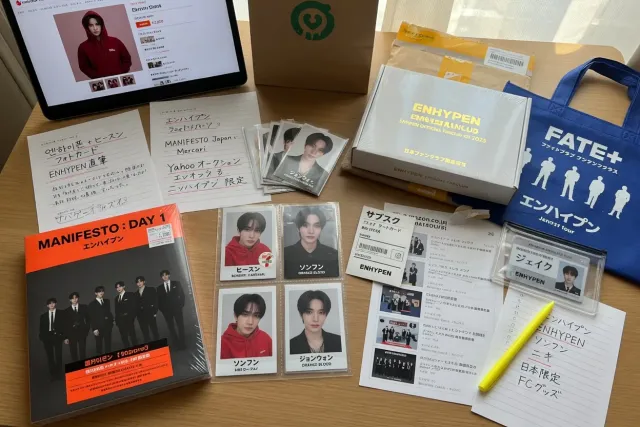
To find ENHYPEN items in Japan, search using both English and Japanese terms across major Japanese resale and retail sources. Combining searches for ENHYPEN, エンハイプン, member names in Japanese, and specific product terms such as トレカ (photocard) or アクスタ (acrylic stand) makes it much easier to uncover albums, event goods, fan-club releases, and individual member items.
Start with the Japanese name for ENHYPEN
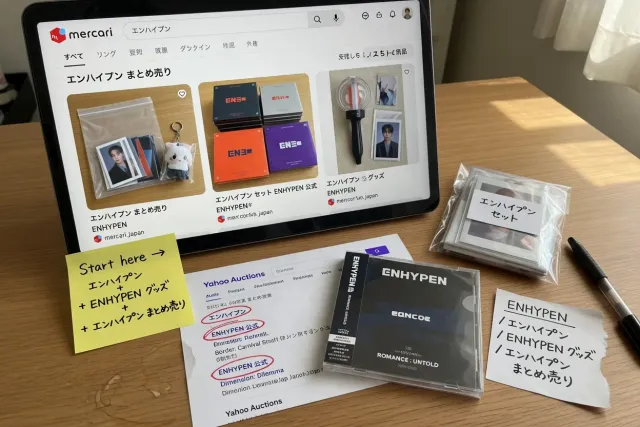
The most important search term for Japanese listings is エンハイプン, the Japanese rendering of ENHYPEN. While many Japanese sellers also use the English group name, listings are often titled only in Japanese. Searching both versions catches more results and is especially useful for older items, small bundles, and casually listed merchandise.
Use these core terms first:
- ENHYPEN · common for official albums, recent releases, and internationally branded goods.
- エンハイプン · essential for Japanese resale listings and local retailer terminology.
- ENHYPEN グッズ · ENHYPEN goods or merchandise.
- ENHYPEN 公式 · official ENHYPEN merchandise.
- エンハイプン まとめ売り · multiple items sold together as a bundle.
- エンハイプン セット · a set of ENHYPEN items.
Japanese listing titles can be brief, so do not rely on a single exact phrase. Search the group name alone first, then add a product category, member name, release title, or event name. A broad search may reveal items whose titles do not mention every included product.
For a ready-made starting point, browse the ENHYPEN collection on JPFinds, where live listings from Japanese shopping sources can be explored in one place.
Search by member name in English and Japanese
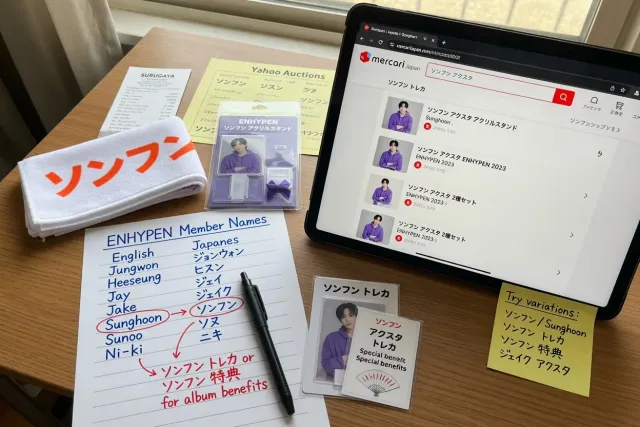
Searching by member is one of the best ways to find photocards, fan-sign benefits, slogan towels, acrylic stands, pickets, and other individual goods. Japanese sellers may write a member’s name in Roman letters, katakana, or a combination of both. Try several forms when results appear limited.
Useful member-name search variations
- Jungwon / ジョンウォン
- Heeseung / ヒスン
- Jay / ジェイ
- Jake / ジェイク
- Sunghoon / ソンフン
- Sunoo / ソヌ
- Ni-ki / ニキ
For example, someone looking for a Sunghoon album benefit could try ソンフン トレカ, ソンフン 特典, or ENHYPEN SUNGHOON photocard. For an acrylic stand, use ソンフン アクスタ. If a listing contains several members, the seller may list only the names of the most prominent members, so a group-level search remains worthwhile too.
Be aware that ニキ can produce unrelated results because it is a general Japanese name. Narrow it with the group name: ENHYPEN ニキ or エンハイプン ニキ. The same approach helps when a short English name such as Jay creates broad search results.
Use Japanese product words to find the right type of item
Japanese product vocabulary is the difference between an unfocused search and a useful one. Add one or two category terms after the group or member name, rather than searching only for ·merch.· This is particularly effective on resale platforms where sellers describe products in the language used on Japanese packaging or official store pages.
Album, music, and printed-item terms
- アルバム · album.
- CD · CD; commonly used alongside a release title.
- 初回限定盤 · limited first-edition release.
- 通常盤 · regular edition.
- ソロジャケット · individual member cover edition.
- ポスター · poster.
- ブックレット · booklet.
Photocard and purchase-benefit terms
- トレカ · trading card, widely used for photocards.
- フォトカード · photocard.
- 特典 · purchase benefit, bonus, or retailer exclusive.
- 店舗特典 · store purchase benefit.
- ラキドロ · lucky draw item or lucky draw photocard.
- ヨントン · video-call event, often used in descriptions of related benefits.
- 封入 · included inside an album or package.
Official merchandise terms
- アクスタ · acrylic stand.
- アクリルキーホルダー · acrylic key holder.
- うちわ · fan or concert uchiwa.
- ペンライト · light stick.
- Tシャツ · T-shirt.
- タオル · towel.
- ぬいぐるみ · plush toy.
Try combinations such as エンハイプン トレカ, ジェイク アクスタ, ENHYPEN 店舗特典, or エンハイプン ペンライト. If you know the name of a specific era, tour, Japanese single, or collaboration, include it in the query to reduce unrelated results.
Know which Japanese sources are useful for ENHYPEN goods
Different Japanese sources tend to be useful for different collecting goals. A broad product search works well for widely available albums and current merchandise, while resale listings are often the better place to locate discontinued goods, individual photocards, and items separated from original sets.
Mercari Japan is particularly useful for individual member items, opened albums, photocards, bonus inclusions, fan-made storage supplies, and bulk lots. Sellers often list one photocard at a time, but you can also find larger listings labeled まとめ売り. Read titles and photos carefully because a ·set· may refer to a set of cards, an album with selected inclusions, or several unrelated goods sold together.
JDirectItems Auction, which includes Yahoo! Auctions Japan listings, can be useful for rarer, older, or larger lots. Auction-style listings may contain complete collections, event merchandise, promotional materials, or numerous photocards in one listing. Check whether the listing is an auction or a fixed-price listing, and compare the stated contents with the photographs before deciding what to pursue.
Amazon Japan can be useful for currently stocked CDs, official releases, books, and some new merchandise. For retail listings, verify the edition, seller details, and whether stated bonuses are included. A product page can represent several editions, so make sure the selected version is the one you want.
Surugaya is worth checking for pre-owned entertainment goods, including CDs, character-style items, magazines, and older merchandise. Its inventory changes frequently, and product condition labels can be helpful when comparing similar items. Minne may have unofficial handmade accessories or display items inspired by fan collecting; these should not be confused with official ENHYPEN merchandise.
Using a service that brings together live Japanese listings can save time when you want to compare sources. The JPFinds ENHYPEN page is a useful place to search across item types while using English-language support and automatic translation.
Find Japan-exclusive releases, bonuses, and event goods
Japan is an especially valuable market for ENHYPEN collectors because Japanese releases and retail campaigns can have edition-specific inclusions. The key is to search for the item type and source of the bonus, not merely the group name. A photocard connected to an album purchase may have a different design depending on the retailer, release format, promotion period, or event.
Search terms that can help include 日本盤 (Japanese edition), 日本限定 (Japan limited), 会場限定 (venue limited), FC限定 (fan-club limited), ツアーグッズ (tour goods), and ライブグッズ (concert goods). These are useful filters for Japan-focused releases but should still be verified against official announcement information.
For official release news, product naming, and current artist information, consult BELIFT LAB’s official homepage. Official information is the best reference when you need to confirm a release title, event branding, or whether an item was sold as an official product.
When looking for retailer benefits, search for the release name plus 特典 or 店舗特典. A search such as ENHYPEN [release name] 特典 can uncover separately listed benefit cards. If the benefit came with a particular shop campaign, adding that retailer’s name may make results more precise. However, seller-written descriptions can be incomplete, so compare card images, event wording, and product details rather than relying only on the listing title.
Read listing details and condition language carefully
Japanese listings can contain useful condition information, but the meaning still depends on the seller’s description and photos. For collectible items, look beyond the headline and check whether the listing clearly states what is included. This matters most for albums with photocards, unopened merchandise, bundled products, and items that were originally sold with multiple components.
- 未開封 means unopened. It does not always guarantee a specific random inclusion unless the seller explicitly says so.
- 美品 generally means the seller considers the item to be in very good condition. It is not a standardized grade.
- 初版 means first printing or first edition, a term more often relevant to books, magazines, and certain printed releases.
- 傷あり means there is damage, scratching, or a flaw.
- やや傷や汚れあり means there are some scratches or signs of dirt/use.
- 抜けあり means something is missing from the original contents.
- トレカなし means no photocard is included.
For photocards, check both the front and back images where available. Small corner wear, surface marks, print lines, discoloration, and storage-related bends may be difficult to see in heavily edited photos. For albums, look for wording about inclusions rather than assuming that all original inserts remain. For light sticks and electronic goods, confirm whether the listing states that the item powers on or has been tested.
Translated listings are convenient, but certain fan terms may be rendered awkwardly. If a translation seems unclear, compare the original Japanese text, photos, and item category. Terms such as ·benefit,· ·random,· ·inclusion,· and ·bundle· can have collector-specific meanings that are important to the listing.
Build a smarter search routine for harder-to-find items
A systematic routine is more effective than repeatedly searching one phrase. Begin with the broadest group query, then narrow by member, product type, and release. Save several search variations because the best results may appear under unexpected wording.
A practical search sequence could look like this:
- Search エンハイプン to understand the overall inventory.
- Add a member name, such as ソヌ, for member-focused items.
- Add a product term, such as トレカ, アクスタ, or うちわ.
- Add an era, Japanese single title, tour name, or event name if you know it.
- Try both English and Japanese spellings, especially for release names and product labels.
- Search for まとめ売り when you are open to bundles, then assess whether the included items match your collection.
Compare more than one listing before choosing an item. This helps you recognize common product photos, typical contents, and pricing patterns for the same release. It is also useful when a listing has a vague title but clear photos: a visual match against other listings can help identify the edition or campaign.
Finally, remember that inventory changes constantly. A search with no result today may return an item later, particularly for photocards and tour goods. Keeping a short list of Japanese terms for your favorite members, eras, and product categories makes it easier to search efficiently whenever new listings appear.
Related guide: browse current ENHYPEN merchandise and collectible listings through JPFinds.