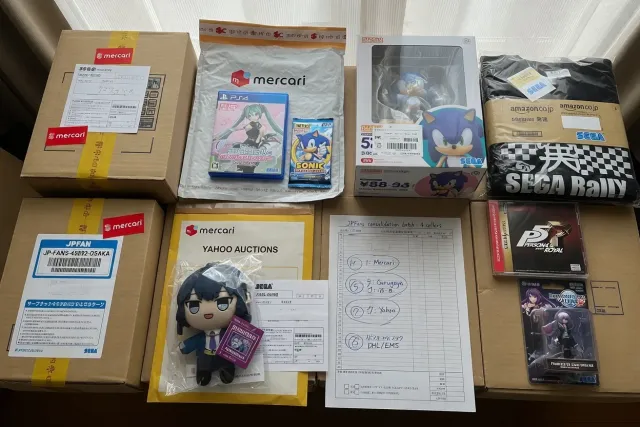
Consolidation lets you combine SEGA orders purchased from different Japanese sellers into one international shipment after they arrive at the JPFinds warehouse. Rather than sending each item separately, you can wait for your SEGA games, figures, plushies, CDs, apparel, and collectibles to arrive, select the items you want to ship together, and choose an available international delivery option.
What consolidation means for SEGA orders
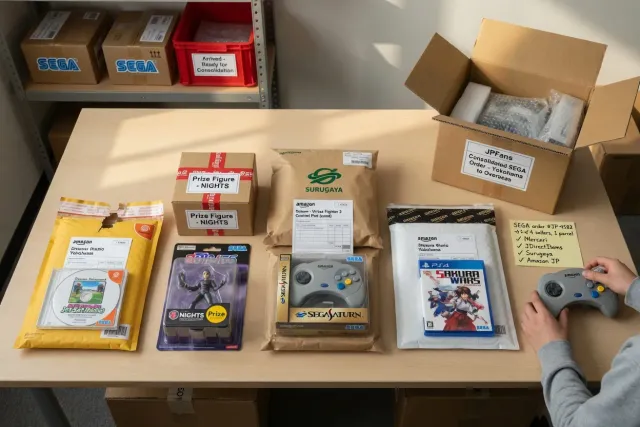
SEGA collecting often involves more than one seller. A single collection may include a Dreamcast game from Mercari, a prize figure from JDirectItems Auction, an older Saturn accessory from Surugaya, and a newly released item from Amazon Japan. Because these listings are spread across different stores and individual sellers, placing several orders does not necessarily mean receiving several international parcels.
With JPFinds, each successfully purchased item is sent by the Japanese seller or retailer to the warehouse. Once items have arrived and are available in your account, you can request consolidation for the SEGA orders you want to ship together. The warehouse then prepares those selected orders as one outgoing parcel where practical and according to the chosen shipping method.
This is particularly useful when building a themed order, such as Sonic the Hedgehog goods, Persona merchandise published by ATLUS/SEGA, classic SEGA hardware, Hatsune Miku Project DIVA items, Yakuza/Like a Dragon collectibles, or arcade-related memorabilia. You can browse the current SEGA listings on JPFinds while keeping the eventual combined shipment in mind.
Consolidation is about outbound shipping. It does not mean that separate sellers coordinate with each other, pack items together before purchase, or send one domestic parcel to Japan on your behalf. Each seller still dispatches their own order independently. The consolidation stage begins after those separate domestic deliveries reach the warehouse.
How SEGA purchases arrive from multiple sellers
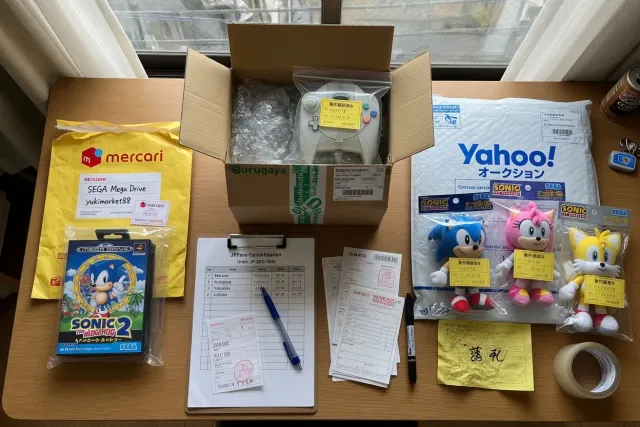
Every marketplace and seller has its own handling time, stock process, and domestic shipping arrangement. For that reason, SEGA orders placed on the same day may arrive at different times. A major retailer may dispatch an in-stock release quickly, while an individual seller may need more time to prepare a used console game or boxed figure.
Separate domestic deliveries are normal
When you buy from multiple listings, expect multiple inbound packages. For example, a collector might place these orders:
- A sealed SEGA Mega Drive title from an individual Mercari seller.
- A used Dreamcast controller from a specialist second-hand retailer.
- A set of Sonic prize plushies from a Yahoo Auctions seller.
- A current SEGA-branded accessory from Amazon Japan.
These orders may be delivered to the warehouse on different dates and in different types of packaging. This does not prevent consolidation. The key point is that each order must arrive and be recorded before it can be included in a combined international shipment.
Track readiness rather than purchase date
For consolidation planning, the most useful milestone is not the day you placed an order but the point at which the item has arrived at the warehouse and is available for shipping selection. An auction win may be paid for first but arrive later than a fixed-price listing bought afterward. If one important item is still in transit domestically, submit a shipping request only when you are comfortable sending the items that have already arrived without it.
This is why collectors often group orders by a realistic shipping window. If you are hunting several related items, it can be sensible to complete the purchases first, then wait until the expected group has arrived before creating your consolidation request.
Planning a consolidated SEGA shipment before you buy
A little planning can make a combined parcel more efficient and easier to manage. Start by deciding what belongs in the same shipment. The answer is usually based on item size, fragility, release timing, and how long you want to wait for the final order to arrive.
Group similar collection goals
Many buyers find it helpful to make one shipment around a specific category. For instance, you may combine several compact Saturn, Mega Drive, Game Gear, or Dreamcast games in one parcel, while keeping a large boxed figure or hardware item in a separate shipment. This approach can reduce the chance that one unusually large item determines the carton size for everything else.
Another practical method is to group items by event or release period. A buyer collecting merchandise from a SEGA pop-up shop, anniversary campaign, or current game launch can place several orders over a short period, then consolidate the available items once the campaign shopping is complete.
Consider dimensions, not only item count
Ten small acrylic stands may take less room than one boxed prize figure. Likewise, an empty-looking console box can occupy substantial space even when the hardware itself is not especially heavy. International shipping charges can depend on both weight and parcel dimensions, depending on the carrier and destination. Consolidating more items is often convenient, but it is not automatically the best choice if one oversized item changes the practical package size.
SEGA hardware deserves especially careful planning. Controllers, consoles, arcade sticks, boxed peripherals, and large display items can be bulky or irregularly shaped. If you are combining them with soft goods or small collectibles, consider whether the larger item will make the overall parcel less efficient than sending it separately.
Account for seller packaging and item protection
Individual sellers may use anything from a slim mailer to a large reused carton. Retailers may also use packaging that is much bigger than the item. Consolidation gives the warehouse an opportunity to prepare the selected orders for onward shipment, but the final parcel still needs to be suitable for the actual items inside. Collectible boxes, older paper inserts, and fragile plastic components need enough room for appropriate packing rather than being forced into an unrealistically small parcel.
The consolidation workflow in your JPFinds account
The exact screen labels and available delivery choices can vary, but the basic process is straightforward: purchase the items, wait for warehouse arrival, select the available orders, create a shipment request, and pay the applicable international shipping charge after the parcel is prepared.
1. Place orders from the listings you want
Use JPFinds to purchase the SEGA listings you have selected across supported Japanese marketplaces and shops. JPFinds uses a two-payment system: the first payment covers the item purchase and relevant domestic costs at the buying stage, while the second payment is requested for international shipping after the shipment is ready. Keeping this distinction in mind helps when you are budgeting for several purchases from different sellers.
2. Wait for each order to reach the warehouse
Once sellers dispatch their domestic packages, the orders will arrive individually. Check your account for the status of each item. Only orders that have arrived can be chosen for consolidation. If an order is still being processed by the seller or is in domestic transit, it cannot yet be physically included with the items already in storage.
3. Select the orders for one outgoing parcel
When the relevant SEGA orders are available, select the orders you want to ship together. Review the selection carefully. This is the stage to confirm that you have included the intended game, figure, accessory, or character merchandise and have not accidentally included an item you wanted to hold for a later shipment.
4. Choose an available shipping method
Select from the international carrier options shown for your destination and parcel. Availability can depend on destination country, package size, weight, and carrier rules. The best choice is not always identical for every shipment: a small parcel of game software may have different practical options than a larger carton containing a boxed console or several figures.
5. Complete the second payment when the shipment is prepared
After the selected orders have been packed for international dispatch, complete the second payment for the outbound shipping charge and any applicable shipping-related fees shown in your account. The parcel can then move forward through the selected shipping service.
When it makes sense to consolidate and when it may not
Consolidation is usually most useful when multiple SEGA purchases are small or medium-sized and would otherwise create several separate international shipments. It can simplify tracking, reduce the number of deliveries you receive, and allow you to build a more cohesive parcel from different Japanese sources.
Good candidates for one consolidated parcel
- Several standard-size game cases, CDs, art books, or magazines.
- Small character goods such as keychains, badges, acrylic stands, and stationery.
- Multiple plush toys that can be packed together without requiring an excessively large carton.
- Several similarly sized figures or prize items purchased from different sellers.
- Accessories such as controller cables, memory cards, straps, and small peripheral parts.
Cases where separate shipments may be more practical
A very large, heavy, fragile, or unusually shaped item can affect the parcel options for everything else. A boxed arcade controller, a large statue, a vintage console retail box, or a sizeable plush may be better treated as its own shipping project. The same can apply when some items have arrived and another seller has not yet dispatched an order you do not want to wait for.
There can also be destination-specific restrictions. Batteries, electronics, and certain materials may be subject to carrier or import rules. Before combining an older SEGA handheld, rechargeable accessory, or electronic device with other goods, review the shipping methods offered in your account and make sure the destination can accept the parcel type you are preparing.
Practical examples for SEGA collectors
Example 1: A retro game bundle. You purchase three Japanese Dreamcast games from three Mercari sellers, plus a VMU from an auction seller. Each arrives separately at the warehouse. Once all four orders are available, you select them together and request one shipment. Because the items are compact and broadly similar in size, consolidation can be a sensible way to receive the group in one parcel.
Example 2: Sonic merchandise from several sources. You find a Sonic plush on Mercari, acrylic keychains at a Japanese retailer, and a prize figure from Surugaya. The plush is the bulkiest item, but all three orders fit your planned collecting theme. You wait until they arrive, then decide whether the combined dimensions remain practical for the available carrier options. If the plush makes the package significantly larger, you can compare the benefit of including it against creating a separate shipment.
Example 3: A mixed hardware order. You buy a Sega Saturn console, two controllers, and several games. The console and controllers are likely to drive the weight and dimensions. In this case, it may be practical to consolidate the hardware together while sending the games separately, especially if you are continuing to buy additional software that will arrive later.
For more browsing ideas before building a combined parcel, visit the SEGA shopping hub to see live listings from supported Japanese sources.
Common consolidation mistakes to avoid
The most common issue is assuming that every order will arrive at the warehouse at the same time. Sellers have different dispatch habits, and marketplace purchases are not synchronized. Avoid setting a shipping plan around an item that has not yet reached the warehouse unless you are prepared to wait for it.
- Submitting too early: Make sure all the items you want in the parcel are marked as available before requesting shipment.
- Overlooking large packaging: Check whether a figure box, console box, or plush will dominate the parcel dimensions.
- Combining incompatible item types: Review carrier restrictions when electronics, batteries, or unusually shaped products are involved.
- Forgetting the second payment: Budget for international shipping separately from the initial purchase payment.
- Mixing unrelated collecting projects: Keeping retro games, large hardware, and fragile display pieces in separate groups can make shipping decisions clearer.
Consolidation works best when you treat it as the final organization step for purchases that have already arrived. Choose the orders deliberately, consider the physical size of the combined group, and select the shipping method that fits the destination and parcel.
Using consolidation as part of a long-term SEGA collecting routine
For regular collectors, consolidation can become a simple repeatable routine. Create a shortlist of desired items, buy across the Japanese marketplaces and stores where the best listings appear, monitor incoming orders, and ship a carefully selected batch when it is ready. This lets you shop from multiple sellers without having to limit every purchase to one source.
It is also useful to separate urgent purchases from patient collecting. A newly released item you want quickly may deserve its own shipment once it arrives. Older games, character goods, and duplicate accessories can remain part of a broader batch until enough orders are available to make consolidation worthwhile for your preferences.
Above all, remember that consolidation gives you control over which arrived orders travel together. It does not require every purchase in your account to ship at once. You can create a parcel around one SEGA theme today and retain other available orders for a future request, subject to the storage terms shown in your JPFinds account.