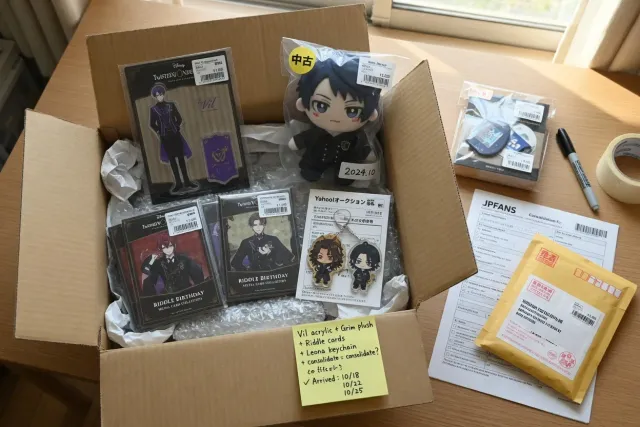
Consolidation for Twisted Wonderland orders means combining multiple purchases that arrive at the JPFinds warehouse into one international parcel. Instead of sending each acrylic stand, plush, card set, or limited item separately, you wait for your orders to arrive, choose the items to combine, and then pay the international shipping charge for the completed package. This can simplify shipping and reduce repeated parcel fees.
What consolidation means for Twisted Wonderland orders
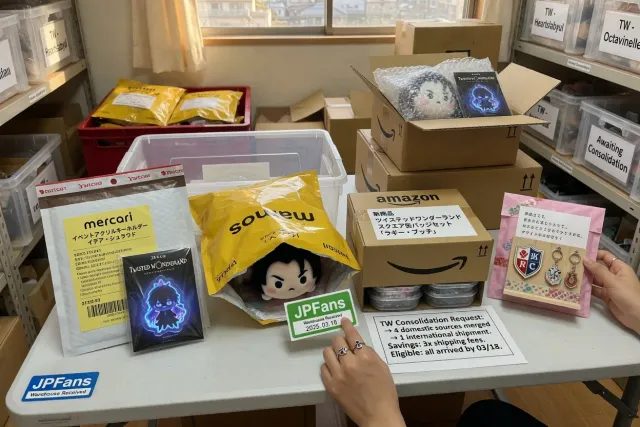
Twisted Wonderland collectibles are often released through several Japanese stores and at different times. A fan may find an event acrylic keychain on Mercari, a prize plush on Yahoo Auctions, a newly released item on Amazon Japan, and handmade display accessories on Minne. Consolidation is the step that brings those separate domestic purchases together before they leave Japan.
With JPFinds, each order is purchased separately through the relevant Japanese source. Once the seller or store dispatches it, the item is delivered to the JPFinds warehouse. When multiple eligible orders have arrived, you can request that they be packed into a single outbound shipment.
This is especially useful for collectors browsing the Twisted Wonderland shopping hub, where listings can vary widely in release period, condition, seller location, and availability. Consolidation does not mean the purchases become one order at the Japanese-store level. They remain individual purchases until they reach the warehouse, then become part of one international package request.
- Before consolidation: you pay for the item and applicable Japan-side costs under the first payment.
- During consolidation: arrived orders are selected for a combined shipment.
- After packing: the second payment covers international shipping and any applicable shipping-related charges shown for your package.
The key advantage is control. You decide when enough of your Twisted Wonderland orders have arrived to make an outbound parcel worthwhile, rather than automatically paying international shipping for every small purchase.
Which Twisted Wonderland purchases can be combined
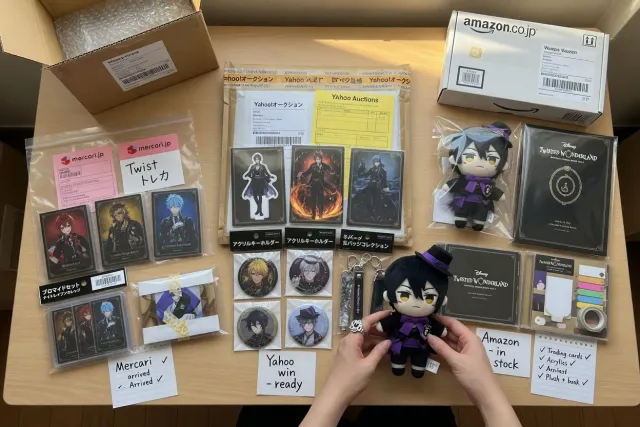
In general, orders can be considered for consolidation once they have physically arrived at the warehouse and are available in your account. The fact that products came from different Japanese platforms does not by itself prevent combining them. A Mercari purchase, a JDirectItems/Yahoo Auctions win, and an Amazon Japan item may all be candidates if they are in warehouse storage and can be shipped together.
Typical items collectors combine include:
- Trading cards, clear cards, bromides, and postcard sets
- Acrylic stands, acrylic keychains, badges, and strap charms
- Plush toys, nui outfits, and mascot items
- Art books, magazines, soundtrack CDs, and stationery
- Prize goods and character collaboration merchandise
- Small lots containing several related goods
However, physical compatibility matters. A flat card set may be easy to pack alongside an acrylic stand, while a large plush, fragile framed item, or unusually shaped display piece can change the box size and packing approach. Some goods may also have carrier restrictions because of their material, batteries, liquids, aerosols, or other shipping limitations. If an item cannot travel with a particular carrier or destination, the available shipping choices may be adjusted accordingly.
Consolidation is not a guarantee that every item will fit into one parcel. It is a packing process guided by the real dimensions, weight, destination rules, and available carrier services. If a collection is too large or includes items with conflicting shipping conditions, separate parcels may be more practical.
When to request consolidation
The best time to submit a consolidation request is after the orders you want have arrived at the warehouse. If you request consolidation while part of your planned collection is still moving domestically, that later order will not automatically be included in a package already being prepared.
A useful approach is to make a simple list of your expected arrivals. For example, suppose you have purchased a dorm-themed badge set, two second-hand acrylic stands, and a preorder item. If the preorder has not yet been released, it may be better to ship the arrived items first rather than wait indefinitely. On the other hand, if all orders are expected to arrive around the same time, combining them can reduce the number of outbound parcels you need to manage.
Plan around release dates and dispatch timing
Twisted Wonderland merchandise is often tied to campaigns, anniversaries, seasonal illustrations, pop-up stores, and lottery releases. Store dispatch schedules may differ even when you purchase on the same day. Second-hand listings can also arrive at a different pace from retail stock. Treat the warehouse arrival date, not the purchase date, as the point at which an item becomes available to consolidate.
Avoid waiting solely for one uncertain order
For auction purchases, seller dispatch can vary. For preorders, the product release date may change or the retailer may ship in batches. Consider whether holding several ready items for one outstanding purchase makes sense for your collecting plans and storage availability. You can make separate consolidation requests at different times if that better matches your order flow.
How the two-payment system fits into consolidation
JPFinds uses a two-payment structure, and understanding it helps prevent confusion when you consolidate Twisted Wonderland purchases.
The first payment relates to buying the item from the Japanese seller or store. Depending on the order, this can include the product price and applicable Japan-side fees or domestic delivery costs. This payment secures the purchase process; it does not mean international shipping has already been paid.
The second payment is requested after the item or combined package is ready for international dispatch. It is based on the shipping arrangement for the actual outbound parcel, including its packed weight and dimensions, destination, selected carrier, and any applicable service charges. Consolidating changes this stage because several orders are packed together and assessed as one shipment rather than several independent international shipments.
This distinction is important for compact collectibles. Five individual badge orders may each have modest item prices, yet sending them separately would create five separate international shipments. When they are packed together, the final charge is calculated from the consolidated parcel — not by simply adding five hypothetical small-parcel prices.
At the same time, consolidation is not automatically the lowest-cost answer in every situation. International rates commonly reflect both weight and parcel dimensions. Bulky packaging, large plush, and oversized boxes can increase the dimensional size of a parcel. The most useful decision is usually based on the actual mix of items rather than a general assumption that ·one box is always cheaper.·
How to choose orders for one parcel
Before submitting a request, review the warehouse orders in your account and group items with similar shipping needs. A thoughtful selection can help you build a parcel that is practical for both protection and cost management.
Group small, compatible collectibles
Small flat items and compact merchandise often work well together. Card packs, badges, charms, and acrylic goods can share one parcel more efficiently than if each were sent alone. This does not eliminate the need for secure packing, but it can make the outer carton more economical than repeatedly mailing individual purchases.
Consider bulky items separately
Large plush toys, display boards, cushions, oversized shopping bags, and boxed sets may occupy substantial volume. Combining a bulky item with dense small goods can be sensible, but it may also require a larger carton. If you are comparing shipping options, consider whether the bulky item should form its own shipment or whether it can safely share space with lighter purchases.
Keep fragile goods in mind
Glass items, ceramics, framed goods, and delicate figures need appropriate space and protective packing. Adding many heavy items to the same parcel can create pressure risks during transport. If you have a mixed order of fragile and robust items, leave room for packing materials rather than focusing only on fitting everything into the smallest possible box.
Check your destination's import requirements
Customs rules, tax thresholds, and restricted-item rules are set by the destination country or region, not by the fandom or the Japanese selling platform. Consolidation can change the declared shipment value because multiple purchases are sent together. Review your local import requirements before choosing how to group higher-value orders.
Packaging, parcel size, and carrier selection
Once your consolidation request is processed, the selected items are packed for international shipment. The final parcel size is affected by more than the merchandise itself. Retail boxes, original packaging, protective materials, and the outer carton all contribute to the shipment’s dimensions and weight.
For Twisted Wonderland goods, packaging is particularly relevant because collectible formats are varied. A stack of clear files needs protection against bending; acrylic goods need separation to reduce scratching; a boxed figure needs enough space to avoid crushing; and plush items can take up more volume than their listed weight suggests. A parcel containing only lightweight plush may cost differently from a parcel of the same weight filled with dense books or metal badges because carrier pricing can account for dimensions as well as actual weight.
JPFinds offers multiple carrier options, subject to availability for the destination and the contents of the package. When options are shown, compare the service conditions presented for your destination instead of choosing only by the carrier name. Availability can vary based on destination, package dimensions, and restricted goods rules.
Do not rely on a seller’s original shipping carton as a prediction of your final international package size. Multiple orders require a new packing arrangement, and a Japanese domestic parcel may be resized or combined with other deliveries. The final shipping amount becomes clear after the package has been prepared for dispatch.
Common consolidation mistakes to avoid
Consolidation is straightforward, but a few planning mistakes can lead to unexpected delays, separate parcels, or a package that is larger than anticipated.
- Requesting too early: Items still in domestic transit cannot be added until they arrive at the warehouse.
- Forgetting a preorder: Check whether a later-release item is worth waiting for before you submit a package request.
- Assuming all items can ship by every carrier: Carrier and destination restrictions can affect the options available.
- Ignoring parcel volume: Several lightweight plush or retail boxes can create a large carton even when the scale weight seems low.
- Combining without considering customs: One consolidated parcel may have a higher total declared value than separate shipments.
- Expecting one parcel at all costs: Splitting a very large or mixed order can sometimes be the more manageable option.
For collectors building an order from the Twisted Wonderland selection, the simplest routine is to monitor arrivals, decide which items belong together, and submit consolidation only when your intended group is ready. This keeps the process predictable while preserving flexibility for new finds.
A practical consolidation example
Imagine you purchase four separate items: a set of character badges from Mercari, an acrylic stand from JDirectItems/Yahoo Auctions, a new art book from Amazon Japan, and a plush from Surugaya. Each seller sends to the JPFinds warehouse independently. The badge set and acrylic stand arrive first, the art book follows, and the plush arrives last.
Once all four are marked as arrived, you select them for one consolidation request. The warehouse packs the items in a suitable outer carton, accounting for the art book’s flat shape, the acrylic stand’s need for protection, the badges, and the plush’s volume. After packing, you review the available international shipping options for your destination and complete the second payment for the selected method.
If the plush were much larger than expected, the practical outcome might be a larger box or, where appropriate, separate shipment options. That is why consolidation should be viewed as a flexible packaging decision rather than a fixed promise that every purchase will become one compact parcel.
By consolidating deliberately, you can collect across different Japanese sources while keeping your international shipping organized around the items you actually want to receive together.