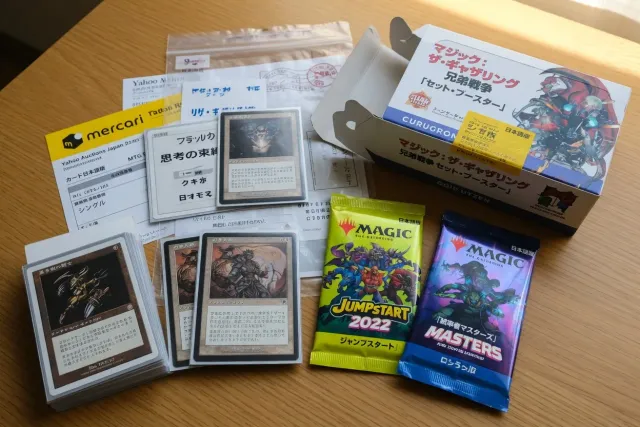
The best Magic: The Gathering purchase depends on what you want from it. Buy singles when you need specific cards, sealed products when you want unopened packs or a complete product experience, and Japanese editions when you enjoy Japanese card presentation, local printings, or collecting a particular language version. Understanding the differences helps you avoid paying for the wrong format.
Start with the purpose of your purchase
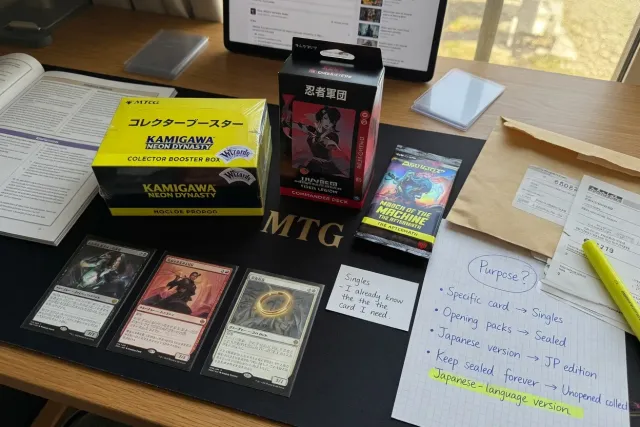
·What should I buy?· sounds simple, but singles, sealed products, and Japanese editions solve different problems. Before comparing listings, decide whether your priority is a specific card, the experience of opening product, an unopened collectible, or a Japanese-language version of a card you already know.
Singles are individual cards sold separately. A sealed product is an unopened item such as a booster box, booster pack, Commander deck, Bundle, collector booster box, or preconstructed deck. A Japanese edition is a language and regional printing choice: it may be a single card or a sealed product, but its card text and packaging are primarily in Japanese.
- Choose singles when you already know the cards you want.
- Choose sealed products when the unopened item itself matters or you want the pack-opening experience.
- Choose Japanese editions when language, artwork presentation, local release identity, or Japanese printing preferences are central to your purchase.
Many collectors mix all three. For example, someone may buy a Japanese foil single for a binder, a sealed Japanese booster box from a favorite set, and English singles for cards whose rules text they want to read instantly. There is no universally ·best· format; there is only the format that best matches the reason you are buying.
When browsing the Magic The Gathering collection, use the product title, photographs, condition notes, language field, and set information together. A card image alone does not always establish whether a listing is Japanese, English, foil, borderless, serialized, or part of a particular release.
When singles are the smartest choice
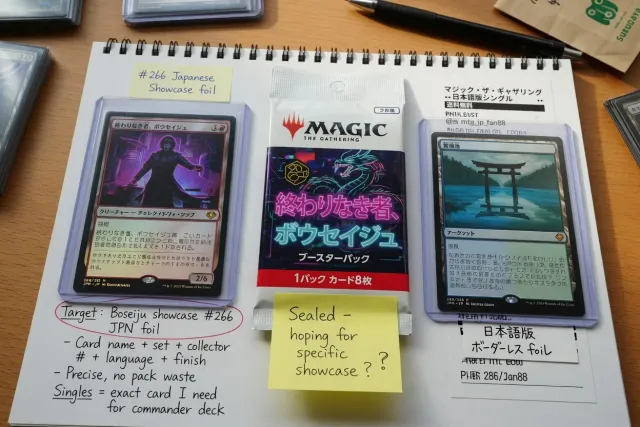
Singles are usually the most direct route to a particular card. If you want one specific legendary creature, a certain printing of a land, a Japanese showcase card, or a replacement for a card missing from a collection, buying that exact card is more focused than opening packs in hope of finding it.
Buy singles for precise collecting goals
Singles work especially well when your target can be described clearly. Useful details include the card name, set name, collector number, language, finish, border treatment, and condition. For modern cards, the collector number near the bottom of the card is often one of the quickest ways to distinguish variants within the same set.
For example, ·Japanese Liliana card· may describe multiple releases across many years. ·Japanese non-foil, regular-frame copy from a named set· is far more precise. The same is true for treatments such as extended art, borderless, textured foil, etched foil, retro frame, and showcase frame. Do not assume that every visual variant exists in every language or every product configuration.
Read condition wording carefully
Condition matters most when the physical card, rather than only the game piece, is important to you. Japanese listings may use terms such as 美品 (beautiful item / very good-looking condition), 傷あり (has damage), 白欠け (edge whitening), 反り (warping or curling), and プレイ用 (for play use). These are useful signals, but photos remain essential because sellers can apply condition terms differently.
A listing described as 美品 may still show tiny edge wear, print lines, surface marks, or slight foil curvature. Conversely, a card listed as プレイ用 may be perfectly suitable if your goal is simply to own a readable copy. Match your standards to the intended role of the card. A binder centerpiece may justify waiting for cleaner photos and clearer condition notes, while a casual deck copy may not require the same level of selectivity.
Singles reduce uncertainty about what you receive
With a single-card listing, you can generally evaluate the exact card shown or described. This is useful for cards with many versions, especially Japanese-language promotional cards and recent sets with several booster-exclusive finishes. Check whether the listing is for one card, a playset, a lot, or a random assortment. Japanese listings often use 1枚 for one card, 4枚 for four cards, and まとめ売り for a grouped sale.
Singles also make sense when your budget is meant for a defined result. Rather than buying several products for a chance at one card, you can place the entire budget toward the actual version you want. This is not a judgment on opening packs; it is simply a different purchasing objective.
When sealed MTG products make more sense
Sealed Magic products are best approached as products in their own right, not merely as containers for singles. A sealed Japanese booster box can appeal because it represents a particular release, contains Japanese packaging and cards, and provides an opening experience that individual cards cannot replicate. A sealed Commander deck, Bundle, or starter product may also be desirable as a complete snapshot of a release.
Know exactly what type of sealed item you are viewing
MTG product names can be deceptively similar. A draft booster box, set booster box, collector booster box, and play booster box are not interchangeable. Their pack counts, intended opening experience, card treatments, and contents differ. Older products may use formats that no longer appear in newer releases, so always compare the listing to the exact set and product name rather than relying on a generic phrase such as ·booster box.·
- Booster packs are individual unopened packs and may be useful for a small purchase or a specific pack-art collection.
- Booster boxes contain multiple packs, but the number and type depend on the set and era.
- Collector boosters are premium-format packs with their own contents and finishes; they are not simply standard packs with better odds.
- Bundles and gift bundles can include boosters, lands, accessories, and packaging, but contents vary by release.
- Preconstructed decks are complete products and may include exclusive cards or Japanese packaging.
For official product and set information, consult Magic: The Gathering’s official website alongside the listing details. Official announcements are particularly useful when you need to confirm whether a set had Japanese collector boosters, special treatments, or a particular preconstructed release.
Recognize sealed-condition language
For unopened items, common Japanese terms include 未開封 (unopened), 新品 (new), シュリンク付き (with shrink wrap), and シュリンクなし (without shrink wrap). These terms describe important aspects of the listing, but they are not identical. Some products are legitimately sold without an outer shrink wrap depending on the product and retailer, while some sealed products use factory seals, pull tabs, or other packaging methods instead.
Read the full description for wording about dents, tears, shelf wear, price stickers, or damaged corners. If you care about display condition, packaging photos matter just as much as card photos do for singles. A sealed box can remain unopened while still having a crushed corner or torn wrap. That may be acceptable for an opening purchase but less desirable if your goal is to keep the item displayed.
Do not buy sealed solely as a substitute for a target single
If you need a particular card, sealed product is not a guaranteed route to it. Pack contents are randomized, and special inserts can have their own distribution patterns. Buy sealed because you want sealed: to open, to collect the product, to enjoy the set’s presentation, or to keep an unopened example. Buy a single when the exact card is the objective.
What makes Japanese editions different
Japanese MTG editions are not a separate game. They are official Magic cards printed with Japanese card names and rules text, subject to the same set identity, card mechanics, and format legality as the corresponding version, unless a card’s printing or product context says otherwise. The biggest practical difference is language, followed by the visual and collector appeal of the Japanese printing.
For many collectors, Japanese cards are attractive because the typography gives familiar cards a different character. Certain releases have Japanese-specific promotional cards, alternate-art treatments, or culturally distinctive collaborations. At the same time, not every Japanese card is exclusive, and not every special treatment is available in Japanese. Verify the precise printing rather than relying on broad assumptions about the set.
Japanese text affects how you use the card
A Japanese-language card has Japanese rules text, so it is worth considering how comfortably you can identify the card during play or sorting. The English card name is not always printed on standard Japanese versions. If you are buying for a multilingual collection, this may be part of the appeal. If you need to reference rules text often, keep the card name, Oracle text, or a translation tool accessible.
The official Magic: The Gathering website remains a reliable starting point for official card and release context, while a listing’s collector number and set symbol can help match a Japanese copy to the correct printing.
Watch for Japanese-only and Japan-market items
Some items sold in Japan are clearly marked for the Japanese market, while others are global products stocked by Japanese sellers. Look for product photos showing the language of the box, deck insert, or pack wrapper. A listing may be located in Japan without being a Japanese edition. Likewise, a Japanese-language single may come from a globally released set rather than a Japan-exclusive promotion.
Terms such as 日本語版 (Japanese version), 英語版 (English version), and 海外版 (overseas version) are especially helpful. When a listing title is short, the photos and description should determine your final interpretation. If language is essential to your purchase, do not treat an omitted language field as confirmation.
How to compare listings without mixing up variants
Modern Magic products can have numerous versions of the same character or card. A listing title may prioritize the character name or a popular descriptor while omitting the exact finish or collector number. Comparing listings carefully prevents accidental duplicates and helps ensure that a ·Japanese edition· is the edition you intended to buy.
Use this checklist before adding an item to your order:
- Card or product: Is it an individual card, pack, box, deck, Bundle, or accessory?
- Language: Does the listing explicitly state 日本語版, or do photos clearly show Japanese text?
- Set: Is the set name, symbol, release branding, or collector number visible?
- Version: Is it non-foil, traditional foil, etched foil, textured foil, borderless, showcase, retro frame, or another treatment?
- Quantity: Is the price for one card, a set of copies, or a mixed lot?
- Condition: Are the stated condition and photos suitable for your standards?
- Sealed status: For products, is it clearly 未開封, and is the outer packaging condition shown?
This comparison process is especially useful when live listings are translated automatically. Translation can make Japanese titles easier to search, but abbreviations, seller shorthand, and product nicknames may remain ambiguous. Search using a combination of English card name, Japanese set name when known, collector number, and terms such as 日本語版 or 未開封.
Build a purchase plan that fits mixed orders
Japan is a strong source for both individual Japanese cards and locally stocked sealed products, so it can be practical to combine several formats in one shopping plan. A collector might order a few Japanese singles from one seller, a sealed deck from another, and a small accessory or storage item from a third. With JPFinds, purchases from supported Japanese marketplaces and stores can be bought through the two-payment system, then consolidated before international shipping options are selected.
For mixed orders, organize your list by priority. Put exact singles first, since individual listings can be one-of-one or condition-specific. Then add sealed products whose packaging condition and language have been verified. Finally, consider lower-priority packs or duplicate copies if they fit your overall order.
A simple plan can look like this:
- Primary target: one exact Japanese single with a confirmed collector number and preferred condition.
- Product target: one unopened Japanese booster or deck product, with photographs of its packaging.
- Optional additions: inexpensive duplicates, basic lands, tokens, or cards from the same set that complement the main purchase.
Browse available Magic The Gathering items from Japan with these priorities in mind. The best order is not necessarily the largest one; it is the one where each item has a clear purpose and has been checked at the right level of detail.
Common mistakes to avoid
The most frequent mistake is treating ·Japanese· as a complete description. It is only one part of the item. A Japanese card can still be from the wrong set, wrong finish, wrong frame, wrong condition, or wrong quantity. A sealed Japanese item can likewise be the wrong booster type or a product with packaging wear that does not suit your collection.
- Do not assume every Japanese-language card is exclusive to Japan.
- Do not assume a Japanese seller is offering a Japanese-language product.
- Do not confuse a loose booster pack with a sealed booster box.
- Do not rely on artwork alone when collector numbers and variants are available.
- Do not read 美品 as a universal condition grade; consult photographs and notes.
- Do not choose random sealed packs if your real goal is one named single.
The practical answer is straightforward: define the exact object you want, verify the language and version, and choose the purchasing format that delivers that object most directly. Singles provide precision, sealed products provide an unopened product experience, and Japanese editions add a meaningful language and regional dimension to either format.
Related guides: explore the wider Magic The Gathering hub for more Japan shopping ideas.