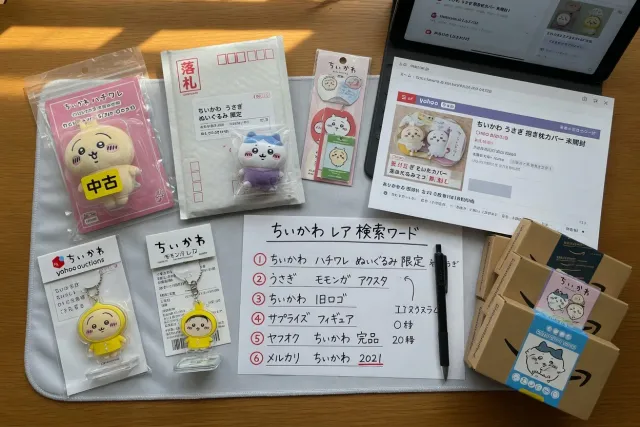
To search Japanese marketplaces for rare Chiikawa collectibles, combine the character name with Japanese product terms, event names, release years, and condition words. Search several spelling variations, save focused queries, and check photos and descriptions for release labels, prize series, store-exclusive details, and bundle listings. Japanese-language searches usually uncover far more results than English-only terms.
Start with the exact Chiikawa character or collection
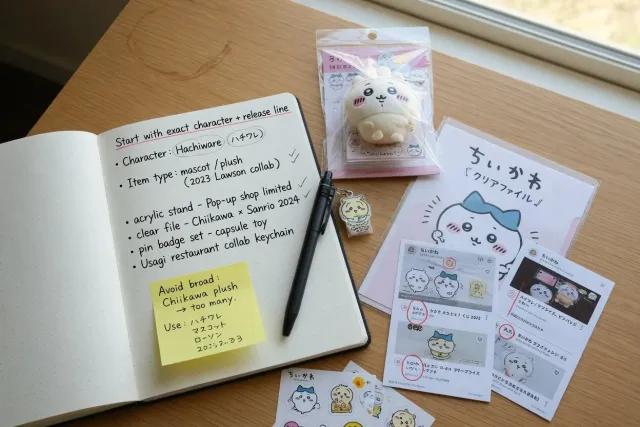
Rare-item searches become much more effective when you begin with a specific target rather than a broad phrase such as ·Chiikawa plush.· Chiikawa merchandise is released in many formats: plushies, mascots, acrylic stands, keychains, stationery, lottery prizes, restaurant collaborations, pop-up shop items, capsule toys, and campaign gifts. A character name alone may return thousands of listings, while a character name plus the release line can narrow results dramatically.
First, write down every identifying detail you know:
- Character: Chiikawa, Hachiware, Usagi, Momonga, Kurimanju, Rakko, Shisa, or another character.
- Item type: plush, mascot, acrylic stand, clear file, pin badge, sticker, figure, or keychain.
- Collection or campaign: a pop-up title, caf· collaboration, seasonal theme, store event, lottery series, or amusement-prize line.
- Approximate release period: a year, season, or anniversary can be enough to improve a search.
- Visual identifiers: costume, colorway, food motif, logo, package artwork, or a distinctive accessory.
The official Chiikawa information site is useful for confirming official announcements, collaboration names, and product-line terminology. Even if an older item is no longer featured prominently, knowing its official Japanese campaign name helps distinguish it from similar fan descriptions.
For example, do not stop at searching a character name. If you are looking for a small plush from a themed release, build toward a query such as a character name + ·マスコット· (mascot) + the event or collection name. This approach also helps when a seller has used only the official line name in the listing title.
Use Japanese search terms that sellers actually use
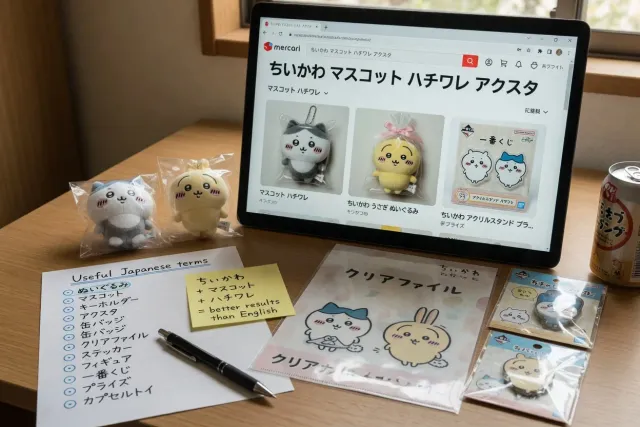
Japanese listings often contain the most useful discovery terms in their titles. Automatic translation can make browsing easier, but entering Japanese keywords yourself is the best way to reach listings that would not appear for an English search.
Core product-type terms
- ぬいぐるみ · plush toy
- マスコット · small plush mascot, often with a ball chain or loop
- キーホルダー · keyholder/keychain
- アクリルスタンド or アクスタ · acrylic stand
- 缶バッジ · pin badge
- クリアファイル · clear file folder
- ステッカー · sticker
- フィギュア · figure
- 一番くじ · Ichiban Kuji-style lottery item
- プライズ · amusement-prize item
- カプセルトイ or ガチャ · capsule toy
Use these terms with a character name or ·ちいかわ,· the Japanese title. For example:
- ちいかわ マスコット
- ハチワレ アクスタ
- うさぎ ぬいぐるみ
- ちいかわ 缶バッジ まとめ売り
Be aware that ·うさぎ· is a general Japanese word for rabbit, so a search for this character can produce unrelated rabbit merchandise. Add ·ちいかわ,· the product type, or a collection name to keep results relevant. Similarly, sellers may shorten common product names, which is why trying both ·アクリルスタンド· and ·アクスタ· is worthwhile.
Useful rarity and listing-description terms
These words do not guarantee rarity or condition, but they are valuable filters and clues:
- 限定 · limited edition
- 非売品 · not for sale; often a promotional or prize item
- 特典 · purchase bonus or benefit
- 購入特典 · purchase bonus
- ノベルティ · promotional novelty item
- 当選品 · prize won through a campaign
- 初期 · early/initial release
- 廃盤 · discontinued
- 完売 · sold out
- レア · rare
Search these terms selectively. ·レア· is subjective and often overused, while ·特典,· ·非売品,· or the name of a specific event can be more informative. A listing described as ·初期· may indicate an early design, but compare it with official images or other listings before treating that claim as proof.
Build search strings in layers instead of relying on one query
The strongest search routine uses several short, purposeful queries. Marketplace titles are limited, sellers describe items differently, and some omit the exact official product name. Build a set of searches that capture those variations.
A practical sequence looks like this:
- Broad discovery: ちいかわ + product type
- Character search: character name + product type
- Release-focused search: collection or event name + character
- Scarcity-focused search: character + 特典, 非売品, 限定, or 当選品
- Bundle search: collection name + まとめ売り or セット
- Missed-title search: product type only + a visual theme or costume term
For hard-to-find items, test spacing, word order, and shortened terms. A seller might write ·ちいかわ マスコット,· ·ちいかわマスコット,· or use only the character name and campaign title. Japanese marketplace search engines do not always handle these differences identically.
Also search both singular targets and sets. A rare item can be overlooked inside a mixed-character bundle, a ·整理· (collection clear-out) listing, or a lot described only as ·グッズ まとめ売り· (goods sold together). Bundles may require more review, but they often expose older pieces that are difficult to locate as individual listings.
When exploring live listings through the Chiikawa collection hub, use the translated titles as a starting point, then look at the original Japanese title and description whenever a listing seems promising. The original wording often contains the event, retailer, or distribution detail that explains why an item is uncommon.
Search each marketplace with its strengths in mind
Different Japanese marketplaces surface different kinds of Chiikawa collectibles. Searching across multiple sources matters because seller behavior, listing formats, and typical inventory vary.
Mercari: frequent individual listings and collection clear-outs
Mercari is especially useful for everyday resale listings, small collectibles, opened blind-box items, and bundles from personal collections. New listings can appear quickly, so saved searches and regular checks are important. Look closely at whether a photo shows the actual item rather than a stock image, particularly for older mascots and promotional goods.
Use condition language carefully. 未開封 means unopened, but packaging can still have storage wear. 美品 generally means the seller considers it to be in very good condition; it is not a standardized grade. For paper items and acrylic goods, review photos for corner wear, scratches, bends, protective-film status, and any visible discoloration.
JDirectItems Auction: older stock, lots, and competitive listings
Japanese auction listings can be useful for discontinued products, larger lots, and items listed with detailed release information. Auction titles sometimes use compressed keywords, so try shorter searches and search the product line without the character name. Read the full description for notes about missing parts, box condition, set contents, or whether an item is being sold ·as is.·
For auctions, decide your maximum total before placing a bid. Include the item price, domestic handling where applicable, international shipping, and any optional services you choose. Rare collectibles can attract attention near an auction’s closing period, so a low current price is not necessarily a final-value indicator.
Amazon Japan, Surugaya, and Minne: use different discovery angles
Amazon Japan can help identify official product titles and packaging variations, particularly for retail releases. Check whether an offer is clearly described as new, used, or a marketplace seller listing, and compare photos with the stated edition.
Surugaya is useful for browsing categorized pre-owned merchandise, including character goods and older retail releases. Inventory can change quickly, so a specific product title is valuable when you find one. Minne is best treated as a source for handmade fan-made accessories and display items rather than official rare merchandise; use clear wording if your search is limited to licensed goods.
JPFinds brings live listings from these sources together with automatic translation, making it easier to compare terminology and availability. Begin broad, then refine once you identify a consistent Japanese item name or release label.
Read photos and descriptions for release clues before committing
A good search result is only the beginning. Rare Chiikawa collectibles are commonly distinguished by small details: a logo on a tag, an event name on the packaging, a different ball-chain color, a retailer sticker, or a campaign insert. Compare all visible details with reliable references and other examples of the same release.
Prioritize these checks:
- Tags and packaging: Is the paper tag present? Does it show the expected logo, copyright line, series name, or manufacturer?
- Included components: Confirm bases for acrylic stands, box inserts, chains, bonus cards, and any original packaging stated in the release.
- Actual-item photography: Prefer photos of the exact item from several angles over generic promotional images.
- Damage disclosure: Read for stains, scratches, fading, odor, peeling, missing pieces, or package damage.
- Set composition: Confirm that every character or item shown is included, especially in lots.
- Edition evidence: For claims such as ·limited,· ·early,· or ·campaign prize,· look for packaging text, event identifiers, or documentation that supports the description.
Do not assume a high price proves authenticity or rarity. Conversely, a modestly priced listing is not automatically a bargain. Sellers may be clearing space, may not know a product’s release history, or may have grouped it into a broad bundle. The most dependable approach is to match the listing’s photos and wording against known official release information.
Use filters, alerts, and repeatable tracking to catch scarce listings
Rare collectibles are often a timing problem. A single search session may not reveal an item that appears later in the week, under a different title, or as part of a bundle. Create a repeatable system rather than repeatedly typing one broad query.
Keep a simple search list with three tiers:
- Exact: official collection name + character + item type.
- Flexible: character + item type, including abbreviations.
- Opportunity: event name, retailer name, 特典, 非売品, まとめ売り, セット, and collection-clear-out terms.
Check newly listed results first when a release is especially scarce. Then review older results sorted by relevance or price, because overlooked listings may use incomplete titles. Remove irrelevant terms gradually instead of making a search too broad all at once.
A tracking note can prevent duplicate buying and help you recognize a fair listing. Record the Japanese product title, release year if known, expected inclusions, distinguishing features, and a few observed asking prices. This is particularly helpful for Chiikawa characters with many similar mascot and acrylic releases.
Once you have found a suitable listing, JPFinds· two-payment system separates the item purchase from international shipping after consolidation. This can be helpful when you are collecting several small items over time: you can search and purchase listings as they appear, then combine eligible orders into one shipment when ready. Review each listing carefully before requesting purchase, since condition and included accessories can vary significantly between sellers.
Avoid common search mistakes that hide rare Chiikawa items
The biggest mistake is searching only in English. English descriptions are often incomplete, and Japanese sellers may use official Japanese names, abbreviations, or campaign-specific language that translation does not surface in a basic query.
Other common issues include:
- Using only ·rare· as a keyword: Search release details, bonuses, and event names instead.
- Ignoring bundle listings: Older items frequently appear in mixed lots.
- Confusing prize and retail releases: ·プライズ· identifies amusement-prize goods, which may have packaging and distribution differences from store merchandise.
- Skipping seller descriptions: Important flaws and missing accessories are often written in Japanese text rather than shown clearly.
- Assuming all similarly designed items are the same release: Reissues, size variants, and closely related seasonal designs can differ in rarity and included tags.
- Waiting for a perfect English title: Use visual clues and Japanese product vocabulary to investigate unfamiliar listings.
For a broad starting point and live cross-marketplace browsing, visit the Chiikawa page on JPFinds. The most successful searches pair that broad discovery with a carefully maintained list of Japanese keywords for the exact collectible you want.
Related guides: browse more Japan shopping topics through the Chiikawa hub.