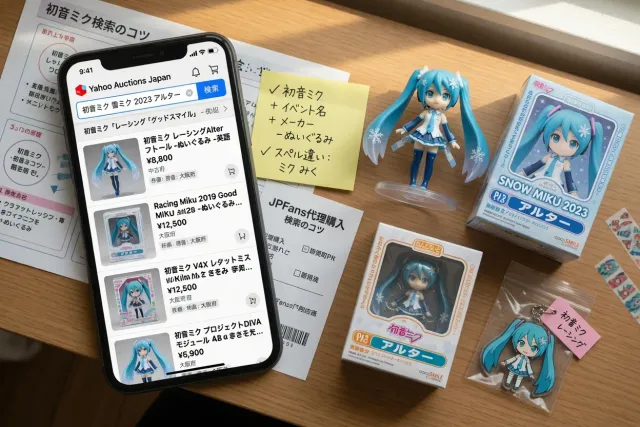
To search Japanese Hatsune Miku listings effectively, start with her Japanese name, 初音ミク, then add the product type, collection name, maker, outfit, or event name in Japanese. Search both broad and highly specific phrases, try spelling variations, and use exclusions to remove unrelated results. This approach reveals listings that English-only searches often miss.
Start with the essential Japanese Hatsune Miku keywords
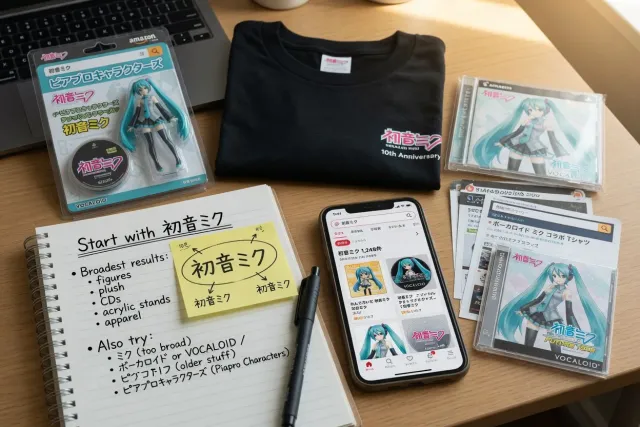
The single most useful search term is 初音ミク (Hatsune Miku). It is the standard Japanese name used across Japanese resale listings, auction titles, official product descriptions, and fan-made goods. Entering it on its own produces the broadest possible results, including figures, plush, CDs, acrylic stands, apparel, collaboration items, and stationery.
For a wider search, combine or alternate it with these closely related terms:
- 初音ミク · Hatsune Miku; the main search term.
- ミク · Miku; useful but much broader and more likely to bring unrelated items.
- ボーカロイド or VOCALOID · Vocaloid; helpful for older releases or mixed-character lots.
- ピアプロキャラクターズ · Piapro Characters; used for products featuring Miku alongside Kagamine Rin, Kagamine Len, Megurine Luka, MEIKO, and KAITO.
- クリプトン · Crypton; useful when a listing refers to the character brand or manufacturer context rather than writing Miku’s full name.
Begin with 初音ミク, then progressively narrow your query. For example, a broad search may uncover a listing that does not identify a specific series in the title, while a more precise phrase can quickly locate a particular release. You can browse current results through the Hatsune Miku collection hub before refining your own search terms.
Japanese listing titles are often short. Sellers may include only the character name and product category, or rely on photos for details. That is why searching several keyword combinations matters more than expecting one exact English product name to work every time.
Add the Japanese product category you want
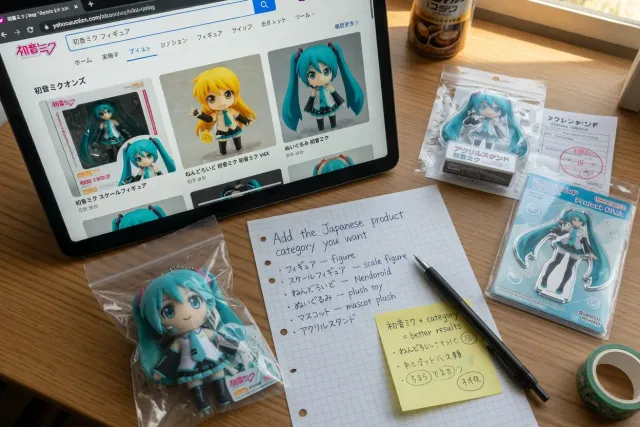
Once you have searched 初音ミク, add the item type in Japanese. This sharply reduces noise and helps surface listings whose English translations use inconsistent wording. Japanese collectors and sellers use predictable category terms, so learning a small vocabulary can substantially improve search results.
Common Hatsune Miku collectible terms
- フィギュア · figure; the best general term for scale figures, prize figures, and many other display figures.
- スケールフィギュア · scale figure; use it for higher-detail fixed-scale releases.
- ねんどろいど · Nendoroid; search this exact brand term rather than a translated equivalent.
- ぬいぐるみ · plush toy.
- マスコット · mascot plush, small soft charm, or mini character item.
- アクリルスタンド or アクスタ · acrylic stand; アクスタ is the common abbreviation.
- 缶バッジ · can badge / pin badge.
- タペストリー · tapestry or fabric wall hanging.
- ポスター · poster.
- キーホルダー · key holder / keychain.
- クリアファイル · clear file, a plastic document folder.
- カード · card; add another term because this can be very broad.
Examples of useful searches include 初音ミク フィギュア, 初音ミク ぬいぐるみ, 初音ミク アクスタ, and 初音ミク 缶バッジ. If you are not sure how a category is labelled in Japanese, start broad with the character name and inspect the translated titles of relevant results. Reuse the Japanese words that repeatedly appear in those listings.
Be especially careful with the word figure. A Japanese seller may list a prize figure simply as フィギュア, while a scale figure may be described by its maker, its line name, or its sculpted outfit instead. Searching only ·scale figure· can therefore exclude relevant results.
Search by series, outfit, event, or collaboration name
Many Hatsune Miku products are organized around named themes rather than generic character merchandise. Searching by the relevant Japanese series name is often the fastest route to a particular design. It can also reveal matching items from the same event, campaign, or product line.
Popular examples include:
- 雪ミク · Snow Miku, the seasonal Sapporo design project.
- 桜ミク · Sakura Miku.
- レーシングミク · Racing Miku.
- マジカルミライ · Magical Mirai.
- 初音ミクシンフォニー · Hatsune Miku Symphony.
- MIKU EXPO · commonly written in Roman letters even in Japanese titles.
- プロジェクトセカイ · Project SEKAI; add this only when you specifically want Miku goods connected to that franchise.
For a themed item, use both a broad and a narrow version. Search 雪ミク first, then try 雪ミク フィギュア or 雪ミク ぬいぐるみ. If you know the year, append it: 雪ミク 2023. Annual event merchandise can have very similar names, and a year is often the easiest way to distinguish an exact illustration or costume.
Outfit terms can be equally important. Words such as 制服 (school uniform), 浴衣 (yukata), チャイナ (Chinese-style outfit), or ウェディング (wedding) can help when a figure or illustration is remembered by appearance rather than its formal release name. Search the outfit with 初音ミク, then compare product photos and maker details.
For official context on the character and related projects, consult the official Piapro website. Official naming is useful because Japanese listings often preserve a campaign’s original Japanese title even when overseas fans use a different translated name.
Use maker, brand, and line names to narrow figure searches
When looking for a particular Hatsune Miku figure, the maker or product line can be more reliable than the character name alone. Sellers may shorten a release title, but they often retain a recognizable manufacturer name or figure-line label. Adding one of these terms can separate a specific kind of collectible from a large general result set.
- グッドスマイルカンパニー · Good Smile Company.
- グッスマ · common abbreviation for Good Smile Company.
- ねんどろいど · Nendoroid.
- POP UP PARADE · usually written in English.
- フリュー · FuRyu.
- セガ · Sega.
- タイトー · Taito.
- バンプレスト · Banpresto, frequently found in older prize-figure listings.
- 一番くじ · Ichiban Kuji lottery prizes.
Try combinations such as 初音ミク グッスマ, 初音ミク ねんどろいど, 初音ミク フリュー, or 初音ミク 一番くじ. If you know a figure’s official title, search its title in quotation marks only if the source supports phrase searching; otherwise, enter the most distinctive two or three words alongside 初音ミク.
Do not assume every listing will include a maker. Some sellers list only ·Miku figure,· particularly for opened items or mixed lots. Run a second, maker-free search after your precise search. This balances accuracy with discovery.
Understand Japanese condition and completeness terms in listings
Condition words are useful search refiners when you are looking through second-hand Hatsune Miku listings. They do not replace carefully reading the full listing or reviewing every photo, but they can help you prioritize results that match your preferences.
- 未開封 · unopened. Usually indicates that the retail package has not been opened, though package wear may still be described separately.
- 美品 · very good condition / beautiful item. This is subjective, so check the seller’s notes and photos.
- 中古 · used / pre-owned.
- 開封済み · opened.
- 箱あり · box included.
- 箱なし · no box.
- 付属品 · included accessories.
- 欠品 · missing item or missing accessory.
- 現状品 · sold as-is; review the description carefully.
- 初版 · first edition or first printing, most relevant to books, printed goods, and certain releases where edition matters.
A search like 初音ミク フィギュア 未開封 can reduce results to unopened figure listings. Conversely, 初音ミク フィギュア 箱なし may help find display pieces when original packaging is not essential to your search. For acrylic stands, badges, or paper goods, look for 未使用 (unused) as well as 未開封.
Be cautious with bundle terms. まとめ売り, セット, and 大量 can indicate lots containing several Miku items, but they may also include other characters or unrelated merchandise. These searches are excellent for discovery, provided you read the item count and contents closely.
Use exclusions and spelling variations to remove irrelevant results
Japanese searches can become noisy when your keyword has multiple uses, when a seller adds many character tags, or when a franchise includes several product types. Exclusion operators, where supported by a source, are a practical way to clean up results. A minus sign before a word commonly removes listings containing that term.
For example, if you want standalone Hatsune Miku items rather than mixed Vocaloid merchandise, try 初音ミク -鏡音 -巡音 -KAITO -MEIKO. If you want physical goods and keep seeing music media, try 初音ミク -CD -DVD. Apply exclusions cautiously: a desirable group illustration or set may disappear if you exclude associated characters too aggressively.
Also search spelling and formatting variants. Japanese titles may use full-width or half-width characters, Roman letters, abbreviations, spaces, punctuation, or no spaces at all. A product might be listed as MIKU EXPO, ミクエキスポ, or a partial title. Similarly, an acrylic stand may appear as アクリルスタンド, アクスタ, or simply アクリル.
A productive sequence is to start with the formal name, then search the abbreviated form, then remove one term at a time. For instance: 初音ミク マジカルミライ アクリルスタンド, then マジカルミライ アクスタ, then 初音ミク アクスタ. This reveals listings with incomplete titles without abandoning useful specificity.
Adapt your search to the source and use JPFinds translation well
Different Japanese sources tend to have different listing styles. Auction-style listings may use attention-grabbing short titles and broad keyword tags. Fixed-price second-hand listings often include practical condition terms. Specialist hobby shops may use more structured maker, series, and product-category details. Handmade marketplaces may use artist, motif, or accessory language instead of official product-line terminology.
Rather than copying one search unchanged everywhere, keep a small set of query versions:
- Discovery query: 初音ミク
- Category query: 初音ミク フィギュア
- Theme query: 雪ミク ぬいぐるみ
- Maker query: 初音ミク ねんどろいど
- Condition query: 初音ミク 未開封
- Lot query: 初音ミク まとめ売り
JPFinds brings live listings from multiple Japanese shopping sources into one place and provides automatic translation, but the original Japanese wording remains valuable. Read the translated title and description, then identify the Japanese terms that explain why a result is relevant. Add those words to your next search. Over time, this turns a broad browse into a repeatable research method.
Use product images to confirm the version, but let text guide the search. Box art, outfit colors, event logos, and included accessories can distinguish closely related releases. If a translated title seems vague, look for Japanese text such as a year, brand, series name, size, or item count. Searching one distinctive term from that text can uncover companion products and alternate listings.
For an easy starting point across available sources, return to the Hatsune Miku listings hub and build a more specific query from the product styles you find there.
Create a repeatable search checklist
The best Japanese Hatsune Miku search is rarely a single query. Use a simple routine whenever you are trying to locate a specific item or explore a theme:
- Search 初音ミク broadly to understand the current result landscape.
- Add the Japanese item category, such as フィギュア, ぬいぐるみ, or アクスタ.
- Add the theme, year, event, outfit, maker, or line name if known.
- Run an abbreviated version of the search, such as アクスタ instead of アクリルスタンド.
- Search without one restrictive word to catch incomplete listing titles.
- Use exclusions only after you understand what irrelevant results are recurring.
- Check translated descriptions and photos for edition, included parts, and condition details.
This method works because Japanese marketplace titles are not standardized. A seller may emphasize the character, brand, event, condition, or item type first. Searching from several angles gives you a much better chance of finding a listing that uses a different naming convention from the one you expected.
Related guides: Visit the Hatsune Miku hub for a broader view of available character merchandise.