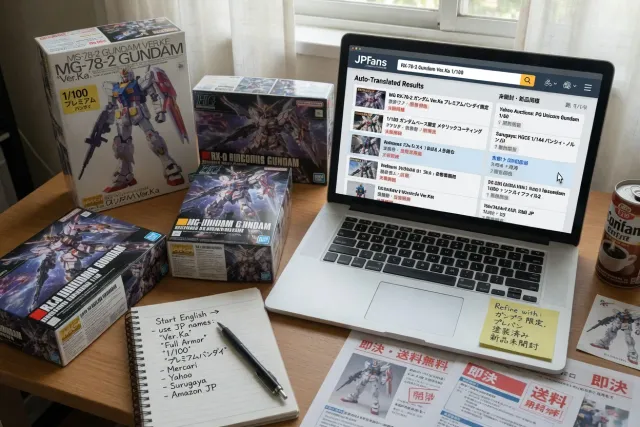
To search Japanese Gundam listings with JPFinds, start with a clear English phrase, then use the auto-translated results to refine your search with Japanese product names, series titles, scales, grades, and condition terms. Searching in both English and Japanese helps uncover listings from Mercari, JDirectItems/Yahoo Auctions, Amazon Japan, Surugaya, Minne, and other supported Japanese sources that may not appear under one broad keyword.
Start with a specific Gundam search phrase
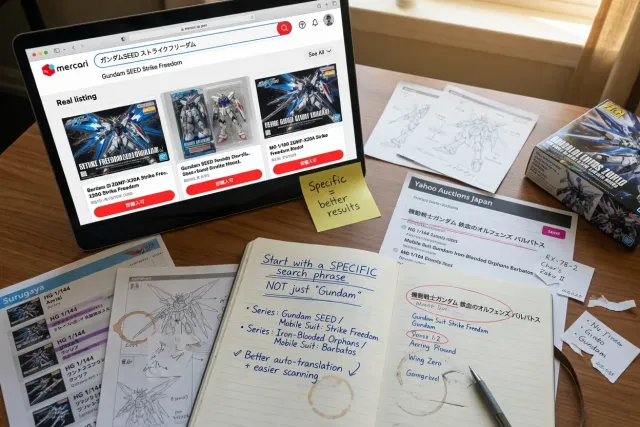
The fastest way to improve your results is to search for the item you actually want rather than simply typing ·Gundam.· Japanese listings can contain thousands of unrelated products, including model kits, completed builds, trading cards, manga, apparel, DVDs, manuals, capsule toys, and spare parts. A specific first search gives JPFinds auto-translation better context and makes the result pages easier to scan.
Build your first query from one or more of these details:
- Series: Mobile Suit Gundam, Gundam Wing, G Gundam, Gundam SEED, Iron-Blooded Orphans, The Witch from Mercury, or Gundam 00.
- Mobile suit: RX-78-2, Zaku II, Char’s Zaku, Nu Gundam, Sazabi, Wing Zero, Aerial, Barbatos, or Strike Freedom.
- Product type: Gunpla, action figure, art book, soundtrack, trading card, keychain, garage kit, or vintage toy.
- Model-kit grade or scale: HG, RG, MG, PG, SD, 1/144, 1/100, or 1/60.
- Maker or line: Bandai, Bandai Spirits, Metal Build, Metal Robot Spirits, Gundam Fix Figuration, or Robot Damashii.
For example, ·MGEX Strike Freedom· is far more focused than ·Gundam model.· ·Metal Build Eva· would be too broad and can bring in non-Gundam products, while ·METAL BUILD ストライクフリーダム· is targeted to a specific line and character item.
If you are not yet sure which name is official, use the official Gundam website to confirm spellings, mobile suit names, and series terminology. Official English names are helpful as a starting point, but Japanese sellers may use an abbreviation, katakana spelling, or a model number instead.
Use JPFinds auto-translation as your first discovery tool
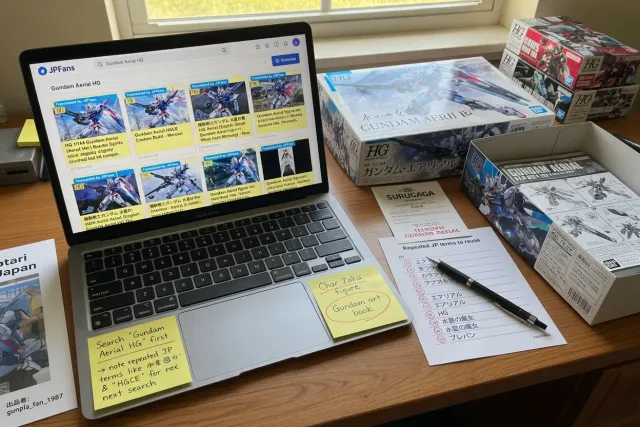
JPFinds lets you search live Japanese listings in English while auto-translation helps make Japanese titles and descriptions more understandable. This is especially useful for Gundam products because listing titles often combine shorthand, part numbers, manufacturer names, grade labels, and condition notes in a small amount of space.
Begin in English when you know the general item but not the Japanese spelling. Search ·Gundam Aerial HG,· ·Char Zaku figure,· or ·Gundam art book.· Read the translated listing titles that appear and look for repeated Japanese terms. Those repeated terms are often your best clues for a second, more precise search.
For instance, an English search for ·Gundam Aerial model kit· may reveal listings containing:
- ガンダムエアリアル · Gundam Aerial
- 水星の魔女 · The Witch from Mercury
- HG · High Grade
- 1/144 · common High Grade scale
- バンダイ · Bandai
You can then try combinations such as ·ガンダムエアリアル HG,· ·水星の魔女 1/144,· or ·HG ガンダムエアリアル.· This two-step approach — English discovery followed by Japanese refinement — is one of the most reliable ways to search a large Japanese catalog.
Auto-translation is useful, but treat it as an aid rather than an exact product database. Machine translation may render a product line differently across sellers, and a title may omit details that appear only in photos or the Japanese description. Compare the translated title with the original Japanese terms, item photographs, and model number whenever a result is close but not obviously correct.
Search with Japanese Gundam names, model numbers, and abbreviations
Japanese keywords dramatically expand the number of relevant listings you can find. Sellers may write Gundam names in Japanese, English capitals, katakana, abbreviations, or simply a model number. Running several versions of the same search is normal, particularly for older or limited items.
Use model numbers when available
Model numbers are often the most dependable search terms because they cross language barriers. ·RX-78-2,· ·MS-06S,· ·RX-93,· ·MSN-04,· and ·ASW-G-08· can identify a mobile suit even if the listing title does not use its full English name. However, model numbers can also bring up decals, manuals, parts, or unrelated references, so pair them with a product category when needed.
Useful combinations include:
- RX-78-2 プラモデル for an RX-78-2 plastic model kit.
- MS-06S フィギュア for Char’s Zaku-related figures.
- RX-93 MG for Master Grade Nu Gundam kits.
- MSN-04 METAL BUILD for Sazabi-related results in that figure line.
Try common Japanese product words
Add a product word to separate kits from other merchandise. The most useful terms are プラモデル (plastic model), ガンプラ (Gunpla), フィギュア (figure), 完成品 (completed product), 説明書 (instruction manual), デカール (decal), ジャンク (junk/as-is), and 限定 (limited).
·ガンプラ· is especially helpful, but it is not a perfect filter. It may show tools, display cases, custom parts, and completed builds alongside boxed kits. If you only want a particular kit, add its grade, scale, or exact suit name. If you want a broader overview of Japanese listings across product types, browse the Gundam shopping hub and use the product names you find there as search ideas.
Search alternate spellings and nicknames
Some Gundam names are shortened in casual listings. Sellers may write ·νガンダム· instead of Nu Gundam, ·ストフリ· instead of Strike Freedom, ·フリーダム· instead of Freedom Gundam, or ·エアリアル· without ·Gundam.· Search both the complete official name and the likely shorthand.
Katakana punctuation and spacing can vary too. A seller may write ·ウイングガンダムゼロ,· ·ウイングゼロ,· or ·Wゼロ.· If a direct search returns few results, remove punctuation, shorten the phrase, or search the series title plus the mobile suit name.
Refine searches by product category and release format
·Gundam· is a franchise, not one product category. Deciding whether you are looking for a kit, a collectible figure, printed material, or media prevents irrelevant results and helps you choose the right Japanese vocabulary.
For model kits, the grade and scale are usually central. Search terms such as ·HGUC,· ·RG,· ·MG Ver.Ka,· ·PG Unleashed,· ·SDW HEROES,· and ·ENTRY GRADE· distinguish releases that may share the same mobile suit. A Nu Gundam search, for example, can return numerous versions from different decades and lines. ·MG νガンダム Ver.Ka· is much more exact than ·Nu Gundam.·
For finished figures, prioritize the brand or product line. ·METAL ROBOT魂,· ·ROBOT魂,· ·METAL BUILD,· ·GFFMC,· and ·超合金· identify different types of collectibles. The symbol in ·ROBOT魂· may not be convenient to type on every keyboard, so ·ロボット魂· can be a practical alternative search.
For books and print items, add terms such as 設定資料集 (setting/reference materials), 画集 (art book), ムック (mook/book-magazine), 攻略本 (guidebook), 雑誌 (magazine), or コミック (comic). A series title plus ·設定資料集· can reveal reference publications that an English ·art book· search may miss.
For apparel, accessories, and handmade fan items, search by the character or mobile suit plus the object type. Terms including Tシャツ, キーホルダー, アクリルスタンド, and ハンドメイド can help distinguish official-style merchandise, accessories, and creator-made pieces. Read the translated listing carefully because Gundam-inspired handmade work and licensed products are not the same category.
Read translated titles carefully and recognize condition terms
When searching listings for goods, Japanese condition vocabulary can change the meaning of a result substantially. A listing title may be short, so use the translated details and photographs to understand what is included, whether parts are missing, and whether an item is assembled or sealed.
Common terms include:
- 未開封 · unopened.
- 新品 · new.
- 美品 · described as being in very good condition; this is subjective.
- 中古 · used/pre-owned.
- 初版 · first printing, usually relevant to books, manga, or printed media.
- 箱なし · without the box.
- 欠品 · missing item or parts.
- 組立済み · assembled.
- 素組み · straight-built, generally assembled without extensive painting or modification.
- ジャンク · sold as-is, often with defects, missing parts, or an unclear condition.
Do not assume that ·new· automatically means every part of the package is flawless, or that ·used· means an item is unusable. The key is to match the Japanese condition wording, translated description, visible photos, and item category. For a boxed Gunpla kit, ·未組立· (unassembled) may be as important as ·未開封.· For a completed figure, check whether stands, weapons, effect parts, and alternate hands are listed.
Search condition terms only when they are important to your goal. Adding ·未開封· can narrow results quickly, but it may exclude good listings whose sellers did not include that word in the title. A useful strategy is to search the item name first, then repeat the search with one condition term after you understand the available listings.
Compare results across Japanese listing sources
Different sources tend to surface different kinds of Gundam listings. JPFinds brings together live listings from multiple Japanese shopping channels, so it is worth checking more than one source tab rather than stopping at the first result page.
Mercari often has individual sellers listing single kits, figures, books, and mixed lots. JDirectItems/Yahoo Auctions can be useful for auction-style listings, older releases, bundles, and items where the title includes detailed Japanese collector terminology. Amazon Japan may be helpful for currently cataloged products and published releases. Surugaya is particularly relevant for pre-owned hobby goods, media, and collectibles, while Minne can show handmade or creator-made accessories.
Source comparison matters because the same search phrase may behave differently depending on how sellers create titles. On one source, ·RG Hi-ν· may be enough. On another, ·RG ハイニューガンダム· or ·1/144 Hi-νガンダム· may reveal more matches. Re-run your strongest query in English, Japanese, and model-number form before deciding that an item is unavailable.
Use broad searches for discovery and narrow searches for confirmation. For example:
- Discovery: ·Gundam Hathaway figure.·
- Japanese refinement: ·閃光のハサウェイ フィギュア.·
- Character refinement: ·クスィーガンダム フィギュア.·
- Line refinement: ·METAL ROBOT魂 クスィーガンダム.·
This progression avoids guessing one perfect keyword too early. It also exposes related Japanese naming conventions that can be reused in future searches.
Build a repeatable Gundam search routine
A repeatable routine saves time, especially when searching for a specific release that may appear under inconsistent titles. Start with a broad English search through JPFinds auto-translation. Note the official Japanese name, model number, product line, and grade or scale. Then test two or three Japanese keyword combinations, adding only one narrowing term at a time.
A practical search checklist looks like this:
- Search the English mobile suit or product name.
- Copy the Japanese name found in relevant translated listings.
- Search the Japanese name with a category word such as ガンプラ or フィギュア.
- Add grade, scale, model number, or figure line.
- Check multiple listing sources and compare titles.
- Add condition words only if they are essential.
- Try abbreviations, alternative spellings, and series names.
Keep searches focused enough to be meaningful, but do not make them so long that you miss listings with abbreviated titles. ·MGEX ストライクフリーダム· is strong. ·MGEX Strike Freedom unopened Bandai Japan box· is likely too restrictive because sellers may not use every one of those words.
When you find a naming pattern that works, save it for future searches. Gundam collectors often return to the same categories — specific grades, favorite mobile suits, particular figure lines, or older series — so a short personal list of Japanese search phrases becomes increasingly valuable. For more starting points, explore current Gundam listings and search ideas on JPFinds.
Related guides: If you are new to the franchise rather than searching products, see the official Gundam site for series information and viewing resources.