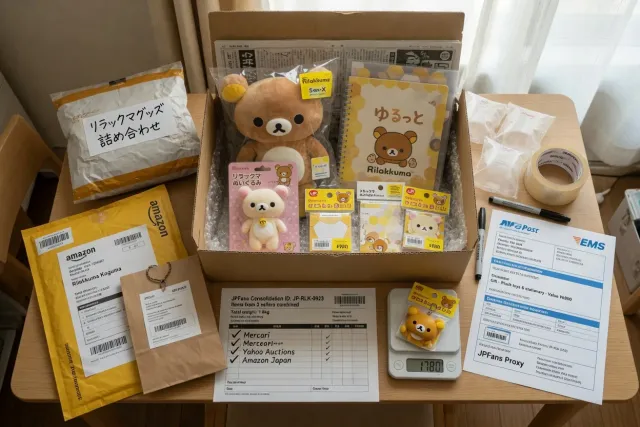
Consolidation lets you combine multiple Rilakkuma purchases from Japan into one international shipment, rather than paying overseas shipping separately for each order. With JPFinds, you can place orders from supported Japanese stores and marketplaces, have items gathered in one account, then select a worldwide shipping method based on your parcel’s size, weight, destination, and preferred balance of cost and handling.
How Rilakkuma order consolidation works
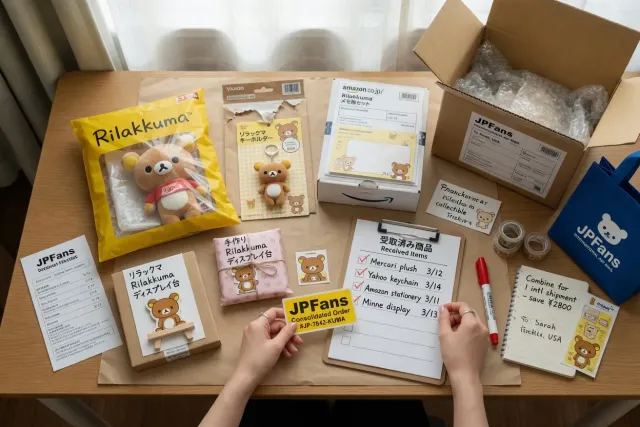
Rilakkuma collecting often involves more than one shop. A collector may find a plush release on Mercari, a keychain in a Yahoo Auctions listing, stationery on Amazon Japan, and a handmade display accessory on Minne. Individually shipping every purchase abroad can be inefficient because each parcel has its own shipping charge and packaging footprint.
Consolidation changes that process. Your purchases are sent from their Japanese sellers to JPFinds, where they can be held together before you request an international shipment. Instead of managing several overseas parcels, you can send the combined order to one destination.
The practical flow is straightforward:
- Find Rilakkuma items through JPFinds live listings from supported Japanese sources.
- Place orders and complete the first payment for item-related costs.
- Wait for your purchases to arrive at the JPFinds warehouse.
- Choose which available items you want to send together.
- Select an international carrier and complete the second payment for shipping-related charges.
- Your consolidated parcel is dispatched to your overseas address.
This model is especially useful for collectors building a themed order: for example, one Korilakkuma plush, several San-X stationery items, a coffee mug, and a small group of capsule-toy accessories. You can browse the Rilakkuma collection on JPFinds to bring listings from different Japanese sources into one shopping process.
Why consolidation is useful for Rilakkuma collectors
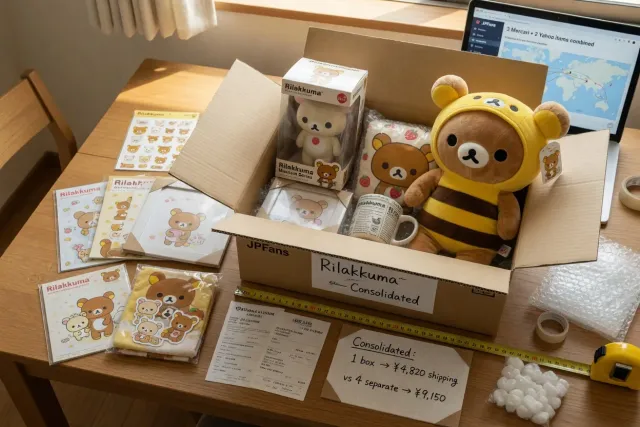
Rilakkuma merchandise comes in many formats, and each format creates a different shipping consideration. Flat goods such as memo pads, clear files, postcards, stickers, and small towels can often share space around sturdier items. Soft goods, including plush toys and cushions, may occupy much more volume than their weight suggests. Ceramics, glassware, framed goods, and boxed figures need protective space, which can increase the final parcel dimensions.
Consolidation is not automatically the cheapest choice in every possible situation. It is most useful when the savings from avoiding multiple international shipments outweigh the effect of combining the goods into a larger parcel. A single large plush, for example, may already require a sizeable box. Adding several lightweight stationery pieces can make sense if they fit efficiently. Adding another bulky plush may move the shipment into a different size or volumetric-weight range.
Common Rilakkuma order combinations
- Stationery bundle: letter sets, notebooks, stickers, washi tape, folders, and small pouches are usually easy to combine.
- Plush-and-accessory order: a medium plush paired with keychains, badges, or flat goods can use unused space inside the parcel.
- Seasonal collection: limited campaign items from several sellers can be held and sent as one themed shipment.
- Gift order: several small character items for different recipients can be shipped together before being distributed locally after arrival.
Because Rilakkuma is produced by San-X, collectors may also want to compare item names, characters, and release themes against the official San-X website. This can be helpful when organizing items from a particular series before deciding which purchases belong in the same shipment.
Plan your orders before requesting worldwide shipping
The best time to think about consolidation is before you submit your first order. Make a simple list of the Rilakkuma items you expect to buy, their general size, and whether they are fragile, flexible, or bulky. This does not need to be exact; its purpose is to help you avoid accidentally creating a shipment that is much larger than expected.
Start by separating your wish list into practical groups. One group might be flat stationery and paper goods. Another might be plush and fabric products. A third could contain breakable items such as mugs, plates, snow globes, or display pieces. If you are ordering a mixture, decide whether the convenience of one parcel is more valuable than keeping fragile or oversized items in separate shipments.
Think about dimensional weight, not only item weight
International carriers may calculate charges using actual weight, dimensional weight, or whichever is higher under their service rules. Dimensional weight reflects the amount of space a parcel occupies. This matters for Rilakkuma plush because a large, lightweight stuffed toy can require a large carton even though it does not weigh very much.
For example, ten acrylic keychains may add little size and weight to a parcel. One large face cushion may add comparatively little weight but significantly increase the box dimensions. When both are included together, the cushion is likely to be the item shaping the shipping category. Planning around your bulkiest item helps create more realistic expectations.
It is also wise to leave room in your plan for seller packaging. Boxes, blister packs, gift bags, and retail cartons can affect the space needed during international packing. If original packaging is important to you as a collector, account for the fact that retaining it may require a larger shipment.
Choosing an international shipping method
JPFinds offers multiple carrier options for worldwide shipping, but availability and service characteristics can vary by destination, parcel dimensions, and carrier restrictions. The best option depends on where you live and what you are sending — not simply on which service has the lowest displayed price.
When comparing available methods, consider the following factors:
- Destination coverage: confirm that the carrier can serve your country or region for the parcel type you are sending.
- Parcel limits: every carrier has rules for maximum dimensions and weight.
- Tracking options: choose a service whose tracking level suits your needs for a collectible order.
- Cost structure: compare rates after considering both actual and dimensional weight.
- Contents: batteries, liquids, food products, and certain materials may be subject to carrier or customs restrictions.
- Signature or delivery preferences: where available, consider whether your address is suitable for the carrier’s delivery procedures.
For a parcel containing Rilakkuma plush, stationery, and accessories, the most practical method is usually the one that accepts the completed parcel dimensions and gives you a comfortable combination of tracking, cost, and destination coverage. For a heavy ceramic collection, weight limits and protective packing space may be more important than the rate for a lightweight document-style shipment.
Do not assume that a shipping method suitable for a small keychain is also suitable for a large plush set. Review the options after all items intended for consolidation have arrived, because that is when the combined order is known.
Packaging considerations for plush, stationery, and fragile goods
Rilakkuma merchandise ranges from soft and compressible to delicate and rigid. A well-planned consolidated order takes these differences into account. Plush can fill empty areas in a carton, while stationery may need protection from bends, creases, or moisture. Ceramic and glass items require separation from hard edges and enough cushioning so they do not shift against other products in transit.
Match the parcel plan to the merchandise
For plush-focused orders, consider whether the item’s shape matters to you. Some collectors prefer to preserve the form of a display plush or avoid unnecessary pressure on a tagged item. For stationery-focused orders, try not to add a bulky or rigid item that could place pressure on notebooks, folders, or paper goods. For mugs and tableware, recognize that protective materials and spacing are part of the parcel’s volume.
A mixed Rilakkuma parcel can still work very well. A practical arrangement is to pair sturdy boxed goods with soft items and place flat goods where they are less likely to bend. The key is understanding that the final shipment is designed around the physical characteristics of the entire order, not the value or rarity of one individual item.
If an item is especially large, unusually shaped, or easily damaged, splitting it into a separate shipment may be worth considering. Consolidation gives you flexibility; it does not require every warehouse item to be sent in one box.
Understanding the two-payment system for consolidated orders
JPFinds uses a two-payment system, which helps separate the cost of purchasing goods from the cost of sending the completed parcel internationally. This is useful for Rilakkuma collectors because the final shipping cost cannot be fully determined until the items arrive and the shipment’s combined weight and dimensions are known.
The first payment covers your item-order stage, including the relevant purchase costs for the Japanese listings you have selected. The second payment is requested when you are ready to ship and covers the international shipping stage and applicable shipping-related charges. Keeping these stages separate means you can continue gathering items before making the final decision about consolidation and carrier choice.
This is particularly helpful when ordering from several sources. A Mercari listing may arrive quickly while an auction purchase or store order takes longer to reach the warehouse. Once the items you want are available, you can decide whether to ship them now or wait until more of your planned Rilakkuma order has arrived.
Remember to budget for both stages. The item price alone is not the final landed cost of a Japan-based order. Your final total can be affected by domestic seller shipping, service-related fees, international carrier charges, parcel size, and any duties or taxes assessed by your destination country. Customs charges are set by local authorities, not by JPFinds or the carrier’s base shipping rate.
Customs declarations and destination-country costs
Every international Rilakkuma shipment is subject to the import rules of its destination. Customs authorities may review the declared contents and value, and they may assess import duties, sales tax, VAT, handling fees, or other charges according to local law. Requirements differ widely between countries, so a collector in Canada, the United Kingdom, Australia, the European Union, or the United States may have different obligations for a similar parcel.
Use accurate item descriptions and values for your shipment. Descriptions such as ·plush toy,· ·character stationery,· ·keychain,· or ·ceramic mug· are clearer than vague terms such as ·gift· or ·goods.· Accurate declarations support smoother customs processing and help you understand the likely import category of the products you are receiving.
Before shipping, check your local customs authority’s current guidance for personal imports, tax thresholds, restricted goods, and any required recipient information. If you are sending a Rilakkuma order as a gift to someone else, the recipient may still be responsible for import charges depending on the destination’s rules.
For easy planning, keep orders containing ordinary merchandise separate from items that may have special shipping restrictions. This is especially relevant if you are shopping beyond plush and stationery and considering goods with batteries, fragrance liquids, or food-related products.
Build a smarter Rilakkuma shipment with JPFinds
A successful consolidated order begins with choosing items that work well together physically and financially. Start with the Rilakkuma pieces you genuinely want, estimate which ones will determine the box size, and avoid treating every small addition as ·free· simply because it can fit in the same shipment. Space, protective packing, and carrier rules still matter.
Use JPFinds to gather purchases from supported Japanese marketplaces and stores, then create a shipping plan once your selected items are available. Smaller accessories can be excellent additions to a plush order; paper goods can complement boxed collectibles; and a separate parcel can be sensible when one item is especially bulky or fragile.
Explore current Rilakkuma listings from Japan when you are ready to build your order. By planning for consolidation early, comparing available worldwide shipping methods carefully, and budgeting for the two payment stages, you can make international Rilakkuma collecting more organized and easier to manage.