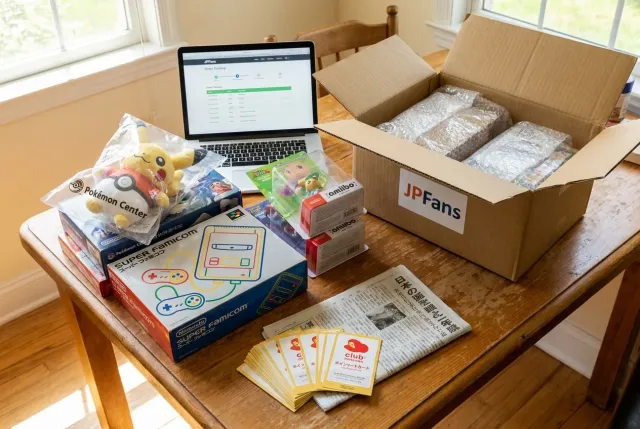
Consolidation lets you combine eligible Nintendo purchases from Japan into one international parcel rather than paying overseas shipping for every item separately. With JPFinds, you place orders from supported Japanese stores and marketplaces, pay for the items first, then choose consolidation, parcel options, and an international carrier once your purchases are ready to ship.
What consolidation means for Nintendo orders
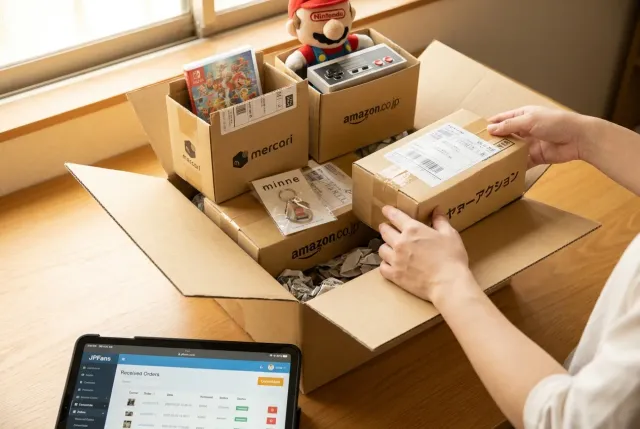
Nintendo orders often involve more than one purchase: a game from Mercari, a controller from Amazon Japan, a collector’s item from Yahoo Auctions, and character goods from Minne, for example. If each purchase were sent overseas individually, every parcel could have its own international shipping charge, carrier handling rules, and customs process. Consolidation brings eligible purchases together so they can be dispatched as one shipment.
In practical terms, JPFinds receives the items you ordered from Japanese sellers and retailers, then gives you the option to create an international parcel containing multiple stored orders. You decide which available items to include together. This is especially useful when building a Nintendo collection over several days or weeks rather than finding everything from one seller.
Consolidation does not mean that shipping is automatically cheaper in every possible situation. A single combined carton can reduce the repeated base charges associated with multiple parcels, but its final price still depends on the destination, carrier, parcel dimensions, actual weight, volumetric weight, and the contents. Large but light Nintendo merchandise, such as plush items, retail display pieces, or bulky boxed accessories, can be affected more by parcel size than by scale weight.
For browsing items that may be suitable for a combined shipment, start with the Nintendo shopping hub. It brings together live Japanese listings and product sources in one place, making it easier to plan purchases around a single outgoing parcel.
The two-payment flow from purchase to dispatch
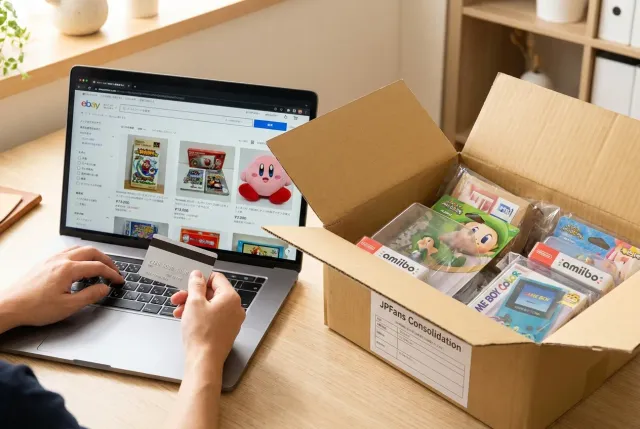
International proxy shopping generally has two separate cost stages because the final overseas shipping charge cannot be known until the ordered items arrive and a parcel is prepared. JPFinds uses a two-payment system that separates the cost of buying your items from the cost of sending the completed parcel internationally.
First payment: purchasing the Nintendo items
The first payment covers the item price and applicable purchase-side charges shown during checkout. This is the stage at which JPFinds places the order with the Japanese store or seller. If you are ordering through an auction-style source, the final item amount can depend on the winning bid and any applicable domestic charges.
This stage is best viewed as the cost to secure the items in Japan. It is not the final international shipping bill. A Nintendo game listed at a low price may still be part of a larger shipment with other goods, while a large console bundle may require its own shipping calculation because of its size and contents.
Second payment: consolidation and international shipping
After your purchases have arrived and you are ready to send them abroad, you create a parcel from the available orders. The second payment covers the international shipping and applicable parcel-side charges based on the shipment you create. This is when you select from the carrier options available for your country and destination.
Separating these payments helps you make better decisions. You can wait until several Nintendo purchases are available, compare the resulting parcel choices, or split items into more than one package if a combined parcel would be too large, too heavy, or unsuitable for a preferred shipping method.
- Payment one: item costs and purchase-related charges for orders placed in Japan.
- Payment two: the cost to dispatch the parcel internationally after you choose its contents and shipping method.
- Your decision point: select which orders travel together before paying for overseas shipping.
Which Nintendo items are practical to consolidate
Many Nintendo-related purchases are naturally suited to combined shipping. Small physical games, amiibo, cards, keychains, art books, manuals, controller parts, and compact accessories can often share space efficiently with other purchases. Combining several small items may be more economical than sending each one separately because they can share one outer parcel.
Boxed hardware and larger accessories require more planning. A console, dock, arcade controller, steering wheel, large figure, or collector’s edition can occupy substantial carton space even when it does not weigh much. Original retail packaging is important to many collectors, but it also increases the dimensions of the final shipment. Consider whether preserving multiple large boxes in one parcel is likely to push the package into a higher dimensional-weight bracket.
When reviewing a listing, think beyond the item price. A compact used game may be easy to add to an existing parcel, while a low-priced oversized item may significantly change the shipping calculation. The condition terms commonly seen in Japanese listings can also help you understand what is likely to arrive: 未開封 indicates unopened, 美品 generally means an item described as being in very good condition, and 初版 means first edition. These terms describe listing condition or edition, not shipping eligibility.
For battery-powered Nintendo hardware and accessories, carrier rules matter. Devices containing lithium-ion batteries may have restrictions that vary by carrier, destination, battery type, battery capacity, and whether the battery is installed in equipment. Do not assume that a console, wireless controller, rechargeable accessory, or replacement battery can travel by every method. Check the available shipping options shown for your parcel and choose accordingly.
How to plan a consolidated Nintendo shipment
A little planning before checkout can make consolidation simpler and reduce surprises later. Start by grouping purchases according to size, fragility, urgency, and shipping restrictions. Rather than ordering every item immediately, consider what you want the finished parcel to contain.
Build around a sensible parcel mix
A practical Nintendo parcel might include several standard game cases, a few small accessories, and one compact collectible. This type of mix uses carton space efficiently. By contrast, combining a large boxed console with fragile display items and several plush products may create a bulky parcel that is harder to pack efficiently.
If you are purchasing both hardware and paper-based collectibles, consider whether they should travel together. Art books, game guides, postcards, and manuals can be bent by pressure if packed carelessly among heavy objects. Figures with delicate parts, limited-edition boxes, and older game packaging also deserve careful consideration when deciding which items belong in the same outgoing parcel.
Account for domestic delivery timing
Different Japanese sellers and stores may dispatch at different speeds. Marketplace sellers can have their own handling schedules, while retailer stock status can affect when an order ships domestically. Your international parcel can only be created from orders that have reached the available stage, so an order from one source may be ready before another.
For a coordinated release-day purchase or a time-sensitive gift, it may be more practical to send ready items separately rather than holding everything for one larger parcel. Conversely, if your priority is reducing repeated international shipments, waiting until more items are available can be worthwhile. The right choice depends on your budget, destination, and the specific items involved.
Avoid mixing incompatible expectations
Physical Nintendo goods from Japan can be excellent additions to an international collection, but not every item works identically worldwide. Hardware may use Japan-specific plugs, voltage requirements, language settings, warranties, or regional features. Software compatibility can vary by system and title. These are product questions to research before purchase; consolidation changes the shipping process, not the item’s technical specifications.
Digital products are also different from physical goods. Download codes, online subscriptions, and account-linked content may have regional redemption limitations and do not need international parcel shipping. If your goal is a package from Japan, focus on physical items that can be transported under the selected carrier’s rules.
Choosing an international carrier for Nintendo parcels
Once you have created a parcel, JPFinds presents the shipping options that are available for its destination and contents. Multiple carrier options can provide different combinations of cost, tracking, service coverage, parcel-size limits, and handling rules. Availability is not identical for every country, and options can change based on current carrier conditions.
Do not choose solely by the lowest visible price. A lower-cost option may have narrower size limits, different coverage in your area, or restrictions relevant to batteries and electronics. For a Nintendo shipment, compare the methods available at the parcel stage and consider the value and physical nature of what you are sending.
- Games and small collectibles: often straightforward, but their protection and total declared value still matter.
- Consoles and rechargeable controllers: check available methods carefully because batteries can affect eligibility.
- Large boxed items: compare dimensional limits as well as the quoted shipping amount.
- Fragile collector items: prioritize a method and parcel plan appropriate for the item’s size and packaging needs.
The official Nintendo website is a useful starting point for confirming product specifications before ordering, particularly for consoles, accessories, and software releases. For shipping eligibility and quoted costs, however, rely on the options displayed for your actual JPFinds parcel, since those reflect its destination and shipment details.
Shipping cost: actual weight, parcel size, and packaging
International shipping charges are typically influenced by both physical weight and dimensional, or volumetric, weight. Carriers may charge based on whichever figure is higher. This is why a carton full of lightweight plush, empty retail boxes, or oversized collector packaging can cost more than a smaller parcel containing heavier games.
Consolidation can reduce unnecessary repetition, but it cannot eliminate the space required to protect items. A Nintendo console in its original box, for example, usually needs an outer carton and protective material around it. Adding several game cases to that carton may make good use of empty space; adding another bulky box may increase the parcel dimensions enough to change the carrier rate.
Use these questions before creating a parcel:
- Will the items fit efficiently together, or are several boxes competing for the same space?
- Is one item likely to determine the parcel’s dimensional weight?
- Are there batteries, fragile components, or unusually shaped items that limit carrier choices?
- Would separating a large item from compact purchases create more manageable parcels?
- Does keeping original packaging matter enough to justify its added shipping volume?
The final quote is generated after the parcel is prepared because the relevant dimensions and shipment characteristics must be known. Treat estimates from product pages as rough planning tools, not guarantees of the final international shipping amount.
Customs, declarations, and import charges
When a Nintendo parcel enters your country, it may be subject to customs procedures, import tax, VAT, GST, duty, brokerage charges, or other fees set by local authorities and carriers. The rules depend on the destination, declared value, product category, and local thresholds. These charges are separate from the purchase payment and international shipping payment unless a shipping option explicitly states otherwise.
Accurate item information and values are important. A parcel containing games, accessories, collectibles, or electronics should be declared consistently with its contents. Do not base your purchase plan on the assumption that imported Nintendo goods will be exempt from local charges. Check your country’s current customs guidance before ordering, especially for higher-value hardware, large bundles, or collector editions.
Keep your order records, payment confirmations, and item descriptions accessible. Customs authorities or carriers may request supporting information, and clear records can help you respond to questions about the shipment. If you are sending several items together, make sure you understand the total value of the consolidated parcel rather than looking only at the price of each individual game or accessory.
A simple example of consolidating Nintendo purchases
Imagine that you find three Japanese Nintendo items over one week: a used physical game, an unopened amiibo, and a limited-edition controller. You complete the first payment for each purchase as you place the orders. The sellers dispatch them within Japan, and the purchases become available for parcel creation once they arrive.
At that point, you can create one international parcel containing all three items. You review the shipping methods available for your destination, taking into account the controller’s rechargeable battery and the combined parcel dimensions. After choosing the carrier option that suits your budget and shipment requirements, you complete the second payment for international shipping.
This approach gives you control over whether the three items travel together. If the controller creates a carrier limitation or makes the carton much larger, you can compare the practical alternative of shipping it separately while sending the game and amiibo together. Consolidation is therefore not just ·put everything in one box·; it is a way to make informed parcel decisions after your Japan-side orders are available.
Explore current games, consoles, accessories, and collectibles through the JPFinds Nintendo category when you are ready to build a shipment from Japan.