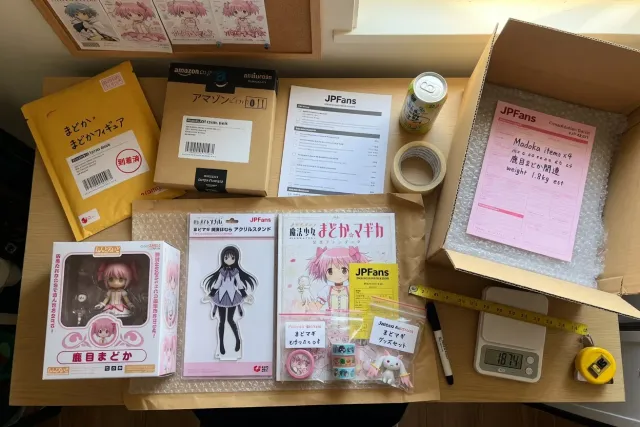
Consolidation lets you combine multiple Madoka Magica purchases that arrive at JPFinds into fewer outbound parcels. Instead of paying international shipping separately for a figure, acrylic stand, artbook, and character goods, you can select eligible stored purchases for one shipment. The final shipping cost depends on the consolidated parcel’s packed size, weight, destination, and carrier option.
Why consolidate Madoka Magica purchases?
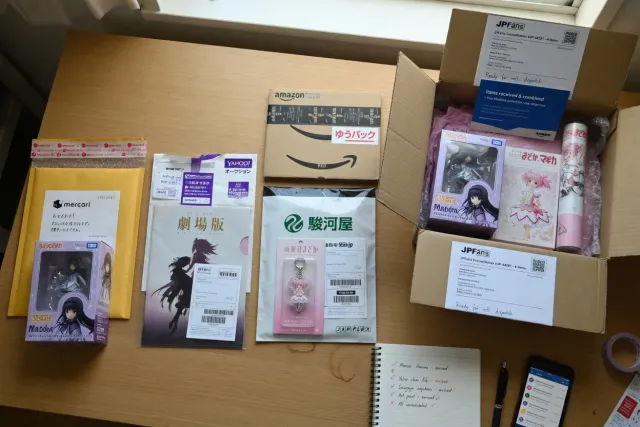
Madoka Magica collecting often involves purchases from several Japanese stores and listings rather than a single order. A collector may find a Homura figure on Mercari, a limited clear file on Yahoo Auctions, a Madoka Kaname keychain from Surugaya, and official artwork from another marketplace. Sending each item overseas separately can create repeated international shipping charges and more individual parcels to track.
Consolidation is designed to turn those separate domestic arrivals into a more manageable overseas shipment. JPFinds receives purchases from supported Japan-based sources, records them in your account, and allows selected items to be prepared together for international dispatch.
- Fewer outgoing parcels: Useful when you have several small character goods or media items.
- One shipping decision: You can compare available carrier choices for the combined package rather than making a separate choice for every purchase.
- Simpler collecting records: A single shipment can keep items from one buying period together.
- Potentially better shipping efficiency: Small parcels can have disproportionately high shipping costs when sent individually.
Consolidation does not automatically mean that shipping will be cheaper in every situation. A large figure box, heavy book collection, or unusually shaped item may increase dimensional weight or require more than one parcel. The useful comparison is not simply ·one box versus many boxes,· but the packed weight and dimensions of each possible shipping arrangement.
How the consolidation process works
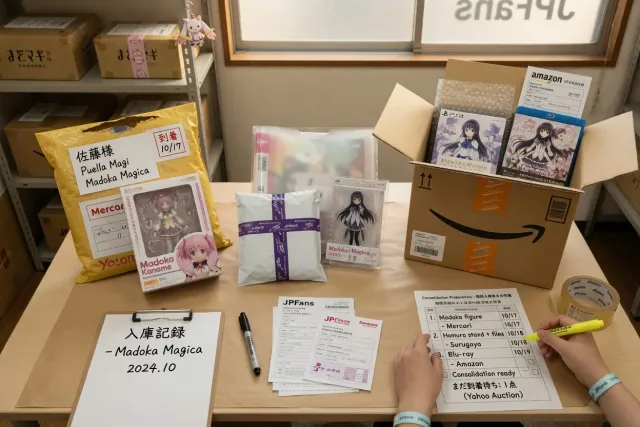
The process begins after you place separate orders through JPFinds and each seller or store sends the purchase to the JPFinds warehouse. Domestic delivery timing can vary by marketplace seller, auction completion date, store handling, weekends, and Japanese holidays, so the purchases may not all arrive at the same time.
1. Make your Madoka Magica purchases
Use the Madoka Magica shopping page to search live listings across supported Japanese marketplaces and stores. Each purchase is handled as its own transaction at first. This is important: consolidation happens after the individual domestic purchases are received, not while unrelated sellers are still preparing their orders.
During this stage, keep an eye on item type. A boxed scale figure, manga set, wall scroll, plush, and thin paper goods all pack very differently. If you expect to consolidate, planning your purchases around physical size can make the later shipping decision easier.
2. Wait for warehouse arrival
When a purchase reaches the warehouse, it becomes available in your stored-purchase list according to the status shown in your JPFinds account. Wait until the items you want to ship together have arrived and are eligible for shipment. If one auction purchase is delayed, you can either hold the earlier arrivals until it appears or ship the available group first.
3. Select the purchases to combine
Choose the Madoka Magica items you want in the same outgoing shipment and submit the consolidation or shipping request through the applicable account flow. Review the selected items carefully before confirming. This is the point where you should separate goods that should not travel together, such as a fragile display item and a dense stack of books, if you believe separate parcels would be more practical.
4. Review shipping options and complete payment
Once the shipment is prepared, the final international shipping charge is based on the actual packed parcel. JPFinds uses a two-payment system: the first payment covers the item purchase and relevant domestic-side charges, while the second payment covers international shipping after warehouse handling and packing. Choose from the carrier options available for your destination, then pay the second invoice to send the parcel onward.
Which Madoka Magica items work well in one parcel?
The best consolidation groups tend to contain items with compatible shapes and reasonable combined weight. Flat and small merchandise is usually easier to combine than several large retail boxes. That does not mean collectors should avoid bulky items; it means that bulky items deserve their own shipping plan.
Good candidates for combined shipping
- Trading cards, postcards, bromides, stickers, and clear files.
- Small acrylic stands, badges, straps, keychains, and rubber charms.
- Character goods such as towels, pouches, small plush items, and stationery.
- Manga volumes, guidebooks, artbooks, CDs, and DVDs, within a sensible total weight.
- Prize figures or compact model kits when their retail boxes fit efficiently together.
Items that need more planning
Large scale figures and display pieces can occupy substantial volume even when they are not particularly heavy. Original retail packaging may include clear windows, shaped inserts, or protruding parts that limit how tightly boxes can be packed. Long wall scroll tubes, framed items, and oversized posters can also determine the parcel dimensions for everything else placed alongside them.
If preserving a figure’s retail box matters to you, avoid assuming it can be flattened or packed around. Collectors often value a clean outer box as part of the item, particularly for limited releases, older releases, or goods described as 未開封 (unopened) or 美品 (excellent condition). Consolidation can still be practical, but the shipping plan should allow room for the original package.
How consolidation affects shipping cost
International shipping is influenced by more than the number of items. Carriers may use actual weight, dimensional weight, parcel dimensions, destination country, and service level. Consolidation can reduce repeated outer packaging and combine lighter items into a single shipment, but it can also push one parcel into a higher weight or size bracket.
For example, consider four purchases: a 250 g acrylic stand set, a 400 g artbook, a 300 g plush, and a 600 g boxed prize figure. Separately, each outbound parcel needs its own outer carton and has its own minimum shipping charge. Combined, the merchandise weight is 1.55 kg before packing materials. One consolidated carton may be more efficient, especially if the artbook and small goods fit safely around the figure box. However, if the figure’s box creates a large carton, dimensional weight may matter more than the merchandise weight.
Compare consolidation options with these questions:
- Will one large box be charged mainly by dimensions?
- Would the books make a fragile figure parcel too heavy?
- Can a long or oversized item be shipped more economically on its own?
- Do the available carrier options change after the final parcel dimensions are known?
- Would two well-packed parcels be easier to receive than one very large one?
The most cost-conscious approach is usually to consolidate compact goods together, then evaluate unusually large, heavy, or delicate purchases separately. Do not rely solely on a seller’s listing weight: retail packaging, protective materials, and the export carton affect the final result.
How to plan purchases before requesting consolidation
A little planning prevents the common problem of buying many attractive listings without considering how they will ship together. Create a simple list as you shop: item name, listing source, approximate size, item category, purchase date, and whether keeping the original box is important. This is especially useful for franchise collections that include a mix of figures, publications, gacha goods, and limited event merchandise.
When browsing the Madoka Magica listings available through JPFinds, group potential purchases into rough shipping categories:
- Flat goods: Paper products, files, books, and discs.
- Small collectibles: Acrylics, badges, straps, mini figures, and charms.
- Boxed display items: Prize figures, Nendoroids, scale figures, and model kits.
- Oversized goods: Plush, tapestries, cushions, framed pieces, or long items.
This does not lock you into a final parcel arrangement. It simply helps you recognize which purchases are likely to complement each other. A stack of books and a collection of acrylic stands may pack efficiently; a large plush and several pristine figure boxes may not.
Also consider domestic arrival order. Auction purchases may finish later than fixed-price listings, and sellers do not all dispatch at the same speed. If you are waiting for a particular item before shipping, check your account status rather than assuming every purchase is already ready for consolidation.
Choosing one parcel or multiple consolidated parcels
Consolidation is flexible, not an all-or-nothing rule. You do not have to put every stored Madoka Magica purchase into one box. For many collectors, the best result is two consolidated parcels: one for durable and compact items, and another for larger or more delicate collectibles.
Consider splitting your shipment when:
- A large figure box would force every other item into an oversized carton.
- Several books would add significant weight around a collectible with a retail box you want protected.
- One item has a long or irregular shape that determines the parcel’s dimensions.
- You want to use a different available carrier option for a particular parcel.
- The combined shipment would become inconvenient to handle at delivery.
Conversely, one parcel often makes sense when your purchases are all small, flat, or similarly sized. A collection of Kyubey charms, Puella Magi trading goods, art prints, compact media, and small accessories can be a natural consolidation group. The final practical limit is the packed parcel and the carrier services available to your destination.
Details to check before paying for international shipping
Before completing the second payment, review the shipment details in your account. Confirm that the selected purchases are the ones you intended to combine and that your delivery address is current. If you have several similar listings — such as duplicate Madoka acrylic stands or multiple editions of the same artbook — matching item names and order records can prevent confusion.
Pay attention to the following:
- Declared shipment contents: Ensure the item descriptions and values required in the shipping flow are accurate.
- Carrier availability: Available options can depend on destination, parcel size, weight, and service restrictions.
- Import charges: Customs duties, taxes, and local handling charges may be assessed by the destination country and are separate from the purchase price and international shipping payment.
- Address format: Use a complete, deliverable address and include any required local details.
- Collection priorities: Decide whether minimizing parcel count, protecting retail boxes, or reducing dimensions matters most for this shipment.
Consolidation works best when the shipment reflects your actual priorities. For a collector focused on opening and displaying items, compact packing may be the main goal. For someone preserving boxed collectibles, separating a large figure from heavy books may be the better choice even if it produces an additional parcel.
Common consolidation mistakes to avoid
The most frequent mistake is requesting shipment as soon as the first item arrives, then purchasing several more items that could have been included. If you are actively building a Madoka Magica haul, wait until the purchases you genuinely want together have reached the warehouse and are ready to select.
Another mistake is treating all merchandise as interchangeable. A small charm, a hardcover artbook, and a boxed figure have different packing needs. Think in terms of volume, rigidity, fragility, and weight distribution rather than simply counting items.
Finally, do not assume a single giant parcel is automatically the least expensive option. Ask whether the largest item sets the carton size and whether splitting it from compact goods could create a more efficient result. Reviewing shipment choices at the packing stage is more useful than guessing from listing photos alone.
For Madoka Magica collectors, consolidation is ultimately a way to turn separate Japanese purchases into a shipment plan that fits the collection: small goods together, major display pieces handled thoughtfully, and international shipping chosen after the final package is known.