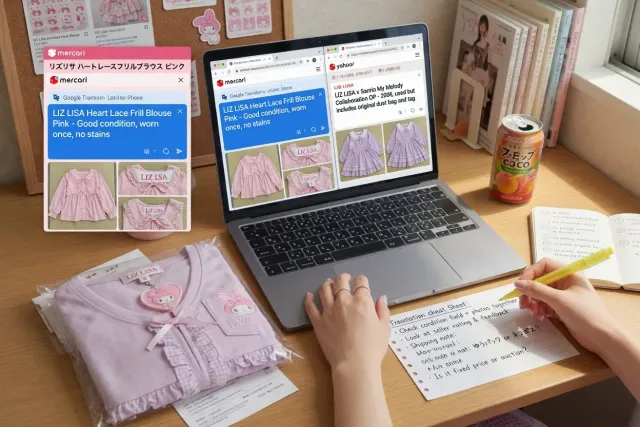
Translated Mercari and Yahoo Auctions Japan listings make Japanese secondhand shopping far easier, but automatic translation works best when you know what details matter most. Read the title, condition fields, description, photos, seller information, and shipping notes together — not as separate pieces. This helps you understand what is actually included, how the item has been used, and whether an auction or fixed-price listing suits your needs.
Start with the listing type: Mercari or Yahoo Auctions
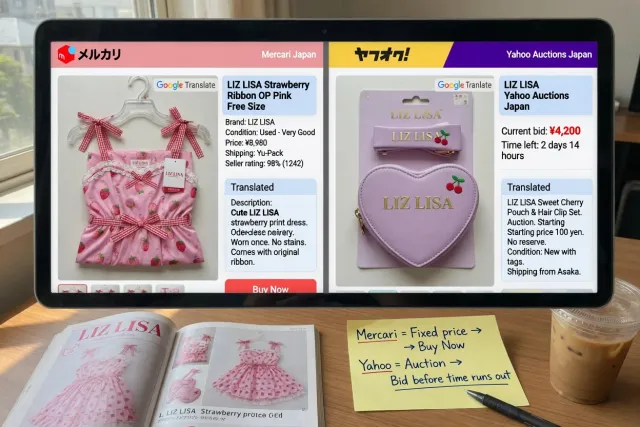
Mercari and Yahoo Auctions Japan can both display useful translated information, but their listing formats and buying mechanics are different. Before interpreting individual phrases, identify which platform you are viewing and whether the item is offered at a fixed price or through an auction.
Mercari listings are usually fixed-price offers
Mercari Japan is generally straightforward: a seller sets a price, provides photos and a description, and lists the item for purchase. The translated page may show a product title, category, brand, condition, shipping method, seller rating, and a written description. Some sellers may be open to offers, but the listing price is the main reference point.
Because many Mercari listings are posted by individual owners, descriptions vary widely. One seller may carefully list measurements, flaws, fabric composition, and accessories, while another may write only a few words. The photos and condition field become especially important when the translated description is brief.
Yahoo Auctions listings may have bidding language
Yahoo Auctions Japan can include both auction-style and fixed-price listings. On an auction listing, pay close attention to the current bid, number of bids, remaining auction time, and any buyout option. A translated title may look like a normal product listing, but the purchase process can be very different if bidding is active.
Terms such as starting price, current price, buyout price, reserve price, and auction end affect how you should read the listing. The current price is not necessarily the final price; it can rise before the auction closes. A buyout price, when present, is usually a fixed amount that can end the auction without waiting for its scheduled finish.
For a practical way to browse Japanese fashion listings across supported marketplaces, you can begin with the LIZ LISA shopping page and compare how translated product information appears across individual listings.
Read translated titles as search summaries, not complete descriptions
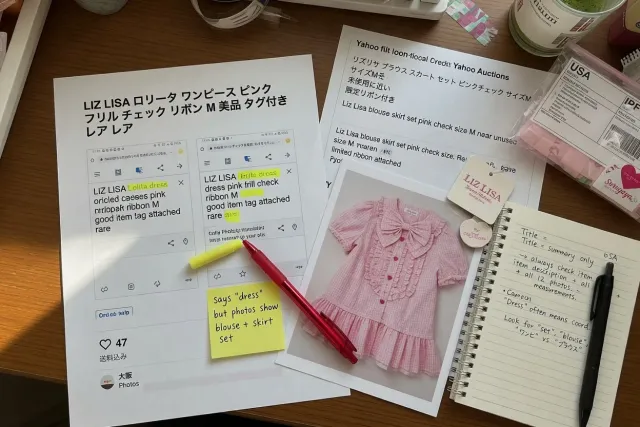
Japanese listing titles are often compressed strings of brand names, colors, sizes, keywords, condition notes, and style labels. Automatic translation can make them readable, but it may not preserve the exact order or nuance of the original Japanese text. Treat the title as a quick summary, then verify the details elsewhere on the page.
A typical title might combine information such as:
- Brand name or sub-brand
- Item type, such as dress, blouse, bag, figure, or jacket
- Color or print
- Size
- Condition shorthand
- Words such as ·rare,· ·limited,· ·set,· or ·with tag·
Translation tools may render a garment name broadly. For example, a Japanese term could be translated as ·dress· when the photos show a tunic, a one-piece outfit, or a layered style. Similarly, ·pink· may refer to a main color, a trim color, or simply a product line name. Use the title to decide whether the item is worth a closer look; use photos, item specifics, and the description to confirm it.
Watch for brand and collection names that should not be translated literally
Japanese sellers frequently include collection names, character names, seasonal labels, abbreviations, or romanized brand terms in titles. These may be translated awkwardly or left unchanged. If a phrase looks unusual, it may be a proper name rather than a product feature.
This is particularly useful for fashion searches. A translated listing may identify a dress as ·ribbon rose one piece,· for example, where ·one piece· is a common Japanese fashion term for a dress rather than an indication that an item is incomplete. When browsing items from a specific label, compare the title with the photos and the product’s visual design rather than relying on one translated phrase alone.
Use the condition field and photos together
The condition field is a helpful first filter, but it is not a substitute for inspecting the listing photos and description. Marketplace condition labels are broad categories. Two items marked as used can differ significantly: one may have only light wear, while another may have discoloration, missing parts, or repairs that the seller explains in the text.
Common Japanese condition wording you may encounter includes:
- 新品 · new
- 未使用 · unused
- 未開封 · unopened, commonly used for sealed goods
- 美品 · beautiful item / very good condition; this is subjective
- 中古 · used or secondhand
- 傷や汚れあり · scratches or stains present
- ジャンク · junk; may be damaged, incomplete, untested, or sold for parts
Words such as 美品 can be positive signals, but they are seller assessments rather than universal guarantees. Look for close-up photos of corners, cuffs, hems, prints, hardware, packaging, and other areas that commonly show wear. For clothing, check whether the listing shows the front, back, care label, size tag, and any stated flaw. For collectibles, review photos of boxes, seals, inserts, and included components.
Read condition disclaimers carefully
Japanese sellers often use polite disclaimers that may be softened by translation. Phrases like ·please understand,· ·there may be overlooked damage,· or ·for those who are sensitive, please refrain· usually mean the seller does not want disputes over minor wear, scent, storage marks, or subjective expectations.
These statements do not automatically mean the item is in poor condition. They do mean you should make your decision based on the visible evidence and written details rather than assume a near-new condition. If the description says an item was stored at home, it may have been kept in a household environment rather than a retail stockroom.
Interpret descriptions line by line instead of relying on a single translation
The description is where sellers often disclose the information that matters most. Machine translation is useful, but short Japanese phrases can be context-dependent. Read the full translated text slowly, especially when it refers to defects, included accessories, sizing, or shipping.
Descriptions commonly cover the following points:
- Whether the item has been worn, used, displayed, or stored
- Specific flaws, such as stains, fading, loose threads, scratches, or peeling
- What is included and what is not included
- Measurements or fit notes
- Whether original packaging, tags, manuals, or accessories are present
- Seller policies about returns, cancellation, and questions
Pay special attention to negations. A translated sentence containing ·not included,· ·no box,· ·tag removed,· or ·operation not confirmed· can change the meaning of the entire listing. For example, an item may be described as ·main unit only,· which means the pictured accessory, charger, box, or other original component may not be part of the sale.
Measurements are often more reliable than labeled size
For apparel, a Japanese size label alone may not tell you how an item will fit. Sellers may provide flat measurements for shoulder width, chest width, waist, total length, sleeve length, or inseam. Translation may render these in slightly different ways, but the numbers are the key information.
Compare listed measurements with a similar item you already own. Check whether measurements were likely taken flat, and remember that fabric type, stretch, gathering, elastic, and layered construction can affect the usable fit. If no measurements are listed, the photos and official sizing conventions may provide context, but should not be treated as a precise substitute.
Check what is included before comparing prices
A low price does not always mean a better deal. Listings that look nearly identical may differ because one includes original tags, a box, a detachable accessory, a full set of parts, or multiple items. Translation can help identify these differences, but the listing photos should confirm them whenever possible.
Useful inclusion-related phrases include:
- 付属品 · accessories or included items
- 本体のみ · main item only
- 箱なし · no box
- タグ付き · with tag
- セット · set or bundle
- まとめ売り · sold together as a lot
- ばら売り不可 · not available for separate sale
·Set· can be especially important. It may mean a coordinated clothing set, a bundle of several related items, or multiple copies of the same product. Conversely, a photo may show several objects for display purposes while the description specifies that only one is included. The written description normally clarifies the seller’s intent.
When comparing fashion listings, consider whether the item includes detachable bows, belts, brooches, straps, or other original details. You can explore current examples through the LIZ LISA marketplace listings, where photo sets and translated descriptions can help distinguish a complete listing from an item sold on its own.
Understand seller information, shipping notes, and marketplace wording
Translated marketplace pages often display seller ratings, location information, and shipping-related fields. These details provide context, though they should be interpreted realistically. A high rating can indicate a seller has completed many transactions successfully, while a newer seller may simply have less marketplace history.
Look for information about:
- Seller feedback count and overall rating
- Item location within Japan
- Estimated dispatch handling shown by the original marketplace
- Whether shipping is included in the listed domestic price
- Whether the seller has stated limitations or transaction preferences
On Japanese marketplaces, ·shipping included· generally refers to domestic Japanese shipping between the seller and the proxy’s receiving location. It does not mean international shipping is included. With JPFinds, purchases are handled through the service’s two-payment system: the first payment covers the item-related purchase costs, while the second payment is requested after consolidation and package preparation for international shipping and related charges.
Do not assume that a seller’s stated marketplace shipping schedule is the same as an international delivery estimate. The item must first be dispatched by the seller, received in Japan, and prepared with any other items you choose to consolidate before you select from available worldwide carrier options.
Make better decisions when a translation is unclear
Automatic translation is most useful when combined with practical cross-checks. If a phrase is ambiguous, avoid filling in the gaps with assumptions. Instead, compare several parts of the listing and look for the evidence that is least open to interpretation.
A reliable review order is:
- Read the translated title for the basic item identity.
- Check the item category, brand field, size, and condition selection.
- Study every listing photo, including close-ups and labels.
- Read the entire translated description for flaws and inclusions.
- Confirm whether the listing is fixed-price, auction, or has a buyout option.
- Review seller feedback and shipping-related notes.
- Compare similar listings before committing to a purchase.
If the photos conflict with the translated text, treat that as a reason to investigate further rather than choosing whichever detail is more appealing. For example, a title may say ·new,· while the description explains that the tag is missing or the outer packaging has damage. Likewise, a translated color name may be broad, but photos can show whether an item is ivory, cream, pale pink, or another shade affected by lighting.
For auction listings, decide your maximum bid before bidding begins and include the full cost structure in your budget. For fixed-price listings, compare condition, completeness, and seller detail — not only the displayed item price. The strongest shopping decisions come from reading the translated page as a whole.