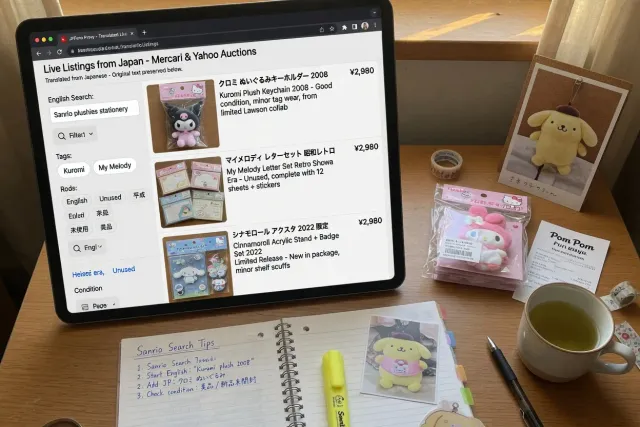
Translated live listings make it easier to find Sanrio goods from Japan by showing active Japanese marketplace listings in English while preserving the details that matter: character names, product type, condition, seller photos, and price. Search broadly in English first, then refine with Japanese character names, era terms, and condition words to uncover plushies, stationery, accessories, limited releases, and discontinued items.
Why translated live listings are useful for Sanrio collectors
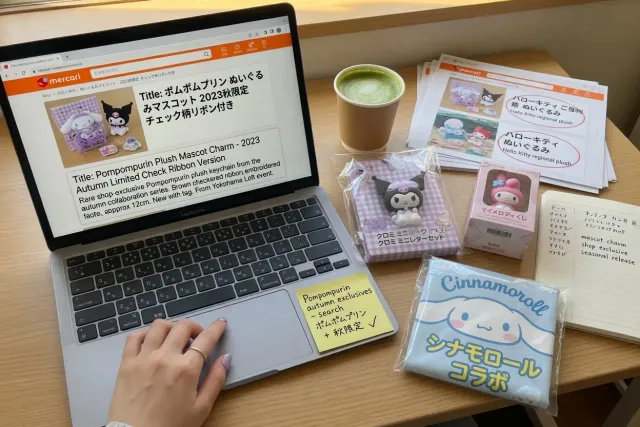
Sanrio merchandise is produced in enormous variety. The same character may appear on small mascot charms, plush toys, lunch goods, stationery, clothing, prize items, shop exclusives, seasonal releases, and collaboration products. A single English search can miss listings because Japanese sellers usually describe items with Japanese product names, abbreviated character names, or terms specific to the item format.
Translated live listings reduce that language barrier. Instead of relying only on a pre-translated catalog, you can browse currently available listings from Japanese sources and read the seller's title and description in a more accessible format. This matters especially when looking for older or uncommon goods, because the best discovery often happens through individual listings rather than a standard retail product page.
For example, a search for ·Hello Kitty plush· may reveal many current items. A more targeted search can surface older pieces described as ぬいぐるみ (plush), マスコット (small mascot), キーホルダー (key holder/keychain), or レトロ (retro). Translation helps you understand the listing, while those Japanese terms help you reach a broader range of live results.
Start with the Sanrio collection hub when you want a focused place to browse character merchandise across available Japanese listings.
Start with the character, then add the item type
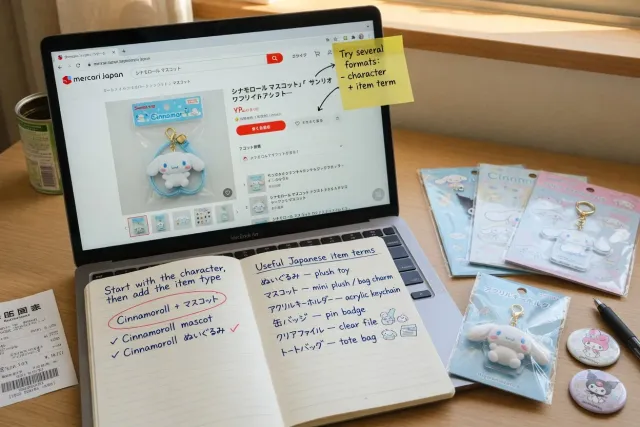
The most dependable search method is to combine a character name with the kind of item you want. Character-only searches are useful for browsing, but they can return hundreds of unrelated products. Adding an item term gives the search a clear purpose and makes it easier to compare similar listings.
Useful Japanese item terms to try
- ぬいぐるみ · plush toy
- マスコット · mini plush, bag charm, or mascot figure
- キーホルダー · keychain or key holder
- アクリルキーホルダー · acrylic keychain
- アクリルスタンド · acrylic stand
- 缶バッジ · pin badge
- クリアファイル · clear file folder
- 文房具 · stationery
- シール · stickers
- ポーチ · pouch
- トートバッグ · tote bag
- フィギュア · figure
Try searches in several formats. For a Cinnamoroll bag charm, search ·Cinnamoroll mascot,· then try シナモロール マスコット. For Kuromi stationery, test ·Kuromi stationery,· クロミ 文房具, and individual item terms such as クロミ ペンケース for a pen case.
Be aware that Japanese names do not always map one-to-one to English naming habits. Cinnamoroll is commonly written as シナモロール, while Pompompurin is ポムポムプリン. My Melody is usually マイメロディ, often shortened in listings to マイメロ. Hello Kitty may appear as ハローキティ or simply キティ. Testing both the full and shortened version can reveal different results.
Use translation as a clue, not a substitute for seller photos
Machine translation is highly useful for scanning titles and descriptions, but it can simplify Japanese phrasing. Read translated text together with all available photos, especially when condition, size, included accessories, or edition details affect your decision.
Pay close attention to the title first. Japanese listing titles often pack the most important details into a short line: character, product type, collaboration, condition, and whether an item is a set. Then read the description for notes about wear, packaging, missing parts, or storage.
Condition words worth recognizing
When purchasing pre-owned Sanrio goods, these terms can help you interpret a translated listing more accurately:
- 未使用 · unused
- 未開封 · unopened
- 美品 · item described as being in very good condition; still review photos carefully
- 中古 · used or pre-owned
- 傷あり · has scratches or damage
- 汚れあり · has stains or dirt
- タグ付き · with tag attached
- 箱なし · without box
- 現状品 · sold as-is
A translated phrase such as ·no noticeable scratches· is often based on a seller’s subjective assessment. Check close-up photos of printed faces, embroidery, metal hardware, acrylic edges, and packaging corners. For plush items, look for discoloration, flattened filling, fabric wear, loose threads, and whether the original tag is present if that matters to you.
If a listing is for a set, translation may say ·all included· or ·bulk sale.· Confirm exactly what is pictured. Some sellers use まとめ売り, meaning a grouped or bundle sale, which can be excellent for building a themed collection but may include duplicates or mixed conditions.
Search by release style, collaboration, and era
Sanrio goods are often easier to find when you search for the context around a release rather than the character alone. Japanese listings may emphasize the event, store, series, artist, or decade associated with an item. This is particularly effective for collectors seeking discontinued products.
Add terms such as 限定 (limited), コラボ (collaboration), 周年 (anniversary), 当たりくじ (lottery-style prize promotion), or 一番くじ (prize lottery) when relevant. For older-looking merchandise, try レトロ, 平成 (Heisei era), or a year, such as ·2000· or ·2010.· Keep in mind that ·retro· is a broad seller label, not a guarantee of a particular production year.
Collaboration searches are especially useful because a Sanrio character can appear with fashion labels, anime franchises, musicians, restaurants, amusement parks, sports teams, and regional campaigns. Search both names together. If the translated result names a collaboration but does not clearly identify the series, inspect the photos for logos, copyright text, packaging stickers, and product labels.
For official character background and current brand information, consult the official Sanrio website. It can help distinguish similarly named characters and identify current visual branding, although older merchandise may use previous art styles or logos.
Choose the right live listing source for the item you want
Different Japanese selling sources tend to be useful for different Sanrio searches. It is worth checking more than one source rather than assuming a single result set represents the full market.
- Mercari: Often useful for individual pre-owned items, prize goods, character bundles, and quick decluttering listings. Search carefully because product titles can be brief.
- JDirectItems/Yahoo Auctions: Helpful for auctions, larger lots, older collections, and unusual items that benefit from bidding. Review the listing format and current price before deciding how much you are willing to spend.
- Amazon Japan: A practical place to look for newer retail merchandise, books, licensed accessories, and currently distributed items.
- Surugaya: Often worth checking for pre-owned character goods, figures, hobby items, and older stock that has entered a specialist resale catalog.
- Minne: Best approached for creator-made items and handmade accessories inspired by a general kawaii aesthetic. Confirm that the listing itself is appropriate for your intended collection and does not imply official licensing when it is not stated.
Comparing sources is not only about price. One listing may be inexpensive but lack packaging, while another may include tags, boxes, or a complete set. A retail listing can be more straightforward for a current item, while a resale listing may be the only option for a discontinued design.
Build better searches with filters, saved variations, and comparison notes
Live inventory changes constantly, so a good Sanrio search is usually a process rather than a one-time query. Build a small set of search variations and revisit them. This is more effective than repeatedly entering one broad phrase.
For a specific goal, prepare three levels of terms:
- Broad: ·Pompompurin plush· or ポムポムプリン ぬいぐるみ
- Specific: character plus size, color, series, collaboration, or event
- Alternative: mascot, charm, keychain, prize, set, retro, or the seller’s likely abbreviated name
Use available filters for price, item condition, category, and listing status where appropriate. If you find a product name you like, copy the Japanese wording from that listing and search it again. Sellers frequently reuse official release names, which can lead you to matching pieces, different sizes, or better-condition examples.
Keep comparison notes for higher-priced or hard-to-find items. Record the listing price, item condition, included parts, dimensions, whether it is a set, and visible defects. This prevents a familiar character design from making two different editions look identical at a glance. It also helps you decide whether a bundle is genuinely useful or simply contains several items you do not want.
When you are ready to browse, return to the Sanrio goods listings and apply the search approach that matches your collecting goal.
Read listings carefully before placing an order
Before proceeding with a live listing, verify the essentials: the exact character, item type, size, condition, quantity, and included accessories. Do not assume a photo is representative if the description says the item is ·image only,· ·sample photo,· or part of a multi-item listing. Likewise, do not assume a character appears on every item in a mixed bundle.
For boxed figures and collectible accessories, check whether packaging is present and whether seals, stands, chains, or inserts are shown. For apparel and bags, confirm measurements rather than relying on a translated size label. For stationery, confirm whether an item is one sheet, one pack, or a larger lot. Small differences in Japanese quantity wording can substantially change what arrives.
JPFinds uses a two-payment system: the item-related charge is handled first, while international shipping is paid after items reach the warehouse and you choose shipment arrangements. Consolidation can be useful when you have found several Sanrio items from different sellers and want them sent together. Compare the final size and weight implications of plush, boxed goods, and large bundles before grouping many items into one shipment.
The strongest habit is simple: use translated text to understand the listing quickly, use Japanese keywords to expand your search, and use photos plus item details to make the final call.
Related guide: learn more about the brand and its character universe in our Sanrio shopping hub.