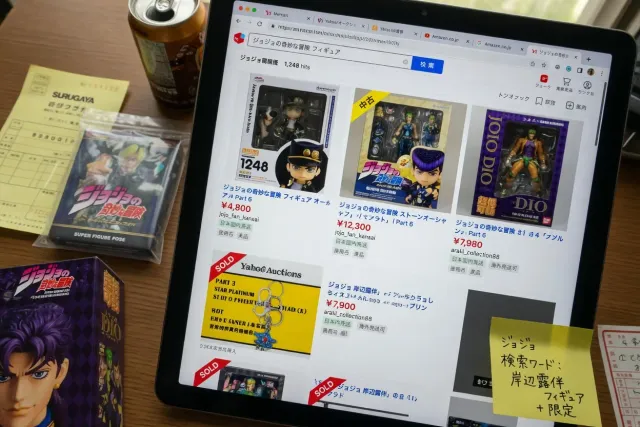
To search Japanese JoJo listings effectively, start with the official Japanese title, ジョジョの奇妙な冒険, then add a character, series part, product type, brand, or condition term. Search in Japanese rather than English whenever possible, try multiple name spellings, and use marketplace filters to narrow large result sets. This approach works for figures, manga, cards, apparel, art goods, and older fan collectibles.
Start with the Japanese title and common shorthand
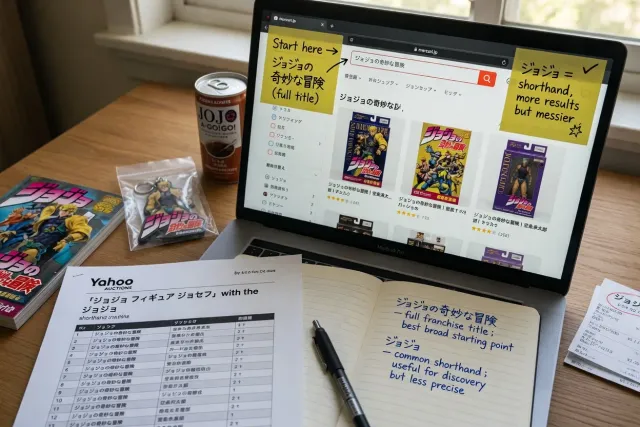
The most reliable starting phrase is ジョジョの奇妙な冒険 (JoJo no Kimyō na Bōken). Japanese sellers commonly use this full title in listings for licensed goods, prize figures, manga, DVDs, character merchandise, and event items. It is a broad search, so expect many results across every part of the franchise.
For a quicker search, use the common shorthand ジョジョ. This returns substantially more listings, but it can also bring up unrelated items, usernames, and products with only a passing JoJo reference. Use it when you want to browse widely, then add a more precise keyword.
- ジョジョの奇妙な冒険 · full franchise title; best broad starting point.
- ジョジョ · common shorthand; useful for discovery but less precise.
- JOJO · worth trying because some sellers use Roman letters.
- ジョジョグッズ · JoJo goods/merchandise; useful for small character items.
- ジョジョ展 · JoJo exhibition; helpful for exhibition-exclusive or commemorative goods.
Search results are not standardized. One seller may write the full Japanese title, another may write ·JOJO,· and another may list only a character name or a brand name. Running several short, focused searches is usually more productive than relying on one long query.
For a broad overview of collectible categories and live Japanese marketplace searches, visit the JoJo's Bizarre Adventure collection hub.
Search by part, arc, and Japanese series name
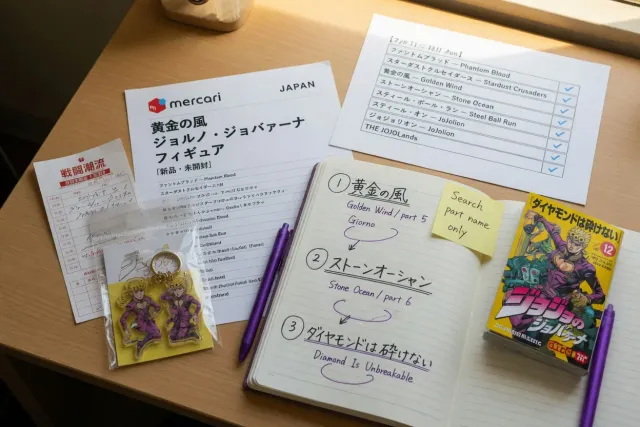
JoJo merchandise is often organized by part rather than by the full franchise title. A listing may say only ·黄金の風· or ·ストーンオーシャン,· especially when the item is a character product from a recent anime release. Adding the part name greatly reduces irrelevant results and helps distinguish characters with similar names.
These are the Japanese titles most useful for marketplace searching:
- ファントムブラッド · Phantom Blood
- 戦闘潮流 · Battle Tendency
- スターダストクルセイダース · Stardust Crusaders
- ダイヤモンドは砕けない · Diamond Is Unbreakable
- 黄金の風 · Golden Wind
- ストーンオーシャン · Stone Ocean
- スティール・ボール・ラン · Steel Ball Run
- ジョジョリオン · JoJolion
- THE JOJOLands · The JOJOLands; Roman-title searches are often useful.
Try both the part title alone and a combined query. For example, ジョジョ 黄金の風 フィギュア searches Golden Wind figures, while ストーンオーシャン 徐倫 focuses on Jolyne-related listings from Stone Ocean.
Some Japanese listings identify parts by number: ジョジョ 3部, ジョジョ 5部, or ジョジョ 7部. The character 部 means ·part· or ·section.· This abbreviated format is especially common for lots, older merchandise, and casual seller descriptions. Searching both ·5部· and ·黄金の風,· for example, prevents missed listings.
Part terminology can also reveal whether an item comes from the manga, anime, a game collaboration, or a themed event. Read the listing title and photos carefully rather than assuming every item tied to a part uses the same artwork or production line.
Use Japanese character names, aliases, and Stand names
Character-name searches are one of the best ways to find specific JoJo listings. Sellers frequently omit the franchise title when a character is recognizable from the product packaging, so a search for the Japanese name may find items that a ·JoJo· search misses.
Examples of useful character searches include:
- 空条承太郎 · Jotaro Kujo
- ディオ or DIO · Dio
- ジョルノ・ジョバァーナ · Giorno Giovanna
- ブローノ・ブチャラティ · Bruno Bucciarati
- 岸辺露伴 · Rohan Kishibe
- 空条徐倫 · Jolyne Cujoh
- ジョニィ・ジョースター · Johnny Joestar
- 東方定助 · Josuke Higashikata from JoJolion
Japanese punctuation is inconsistent in user-created listings. Search a full name with and without the middle dot: ジョルノ・ジョバァーナ and ジョルノ ジョバァーナ. Also try the surname alone, particularly for distinctive characters such as ブチャラティ or 露伴.
For certain products, Stand names are more effective than character names. A seller may describe a statue, card, acrylic stand, or key holder by its Stand artwork. Useful examples include スタープラチナ (Star Platinum), ザ・ワールド (The World), ゴールド・エクスペリエンス (Gold Experience), and キラークイーン (Killer Queen). Search the Japanese name, the Romanized name, and the character name separately.
Be alert to shared or changing names. ·Josuke,· for example, can refer to different characters depending on the part. Add 4部, 8部, 仗助, or 定助 to make the result set clear.
Add the Japanese product type you want
Once you have a franchise, part, or character term, add a product category. This is the fastest way to turn a huge general search into a useful list. Japanese marketplaces often have category filters, but text searches remain important because sellers may place products in broad or imperfect categories.
Useful product-type keywords
- フィギュア · figure
- 一番くじ · Ichiban Kuji lottery prize
- プライズ · arcade/prize item
- ねんどろいど · Nendoroid
- 超像可動 · Chozokado articulated figure line
- アクリルスタンド or アクスタ · acrylic stand
- 缶バッジ · pin badge/button badge
- クリアファイル · clear file
- ぬいぐるみ · plush
- キーホルダー · key holder/keychain
- ポスター · poster
- カード · card
- 原作 · original manga artwork/version
- アニメ · anime adaptation/version
For manga, search ジョジョ 漫画, 単行本 (tankōbon volume), 文庫版 (bunkoban edition), or the part title plus 全巻 (complete set). For art books and printed material, use 画集 (art book), 設定資料集 (setting/reference book), or パンフレット (pamphlet/program).
Brand terms can be equally valuable. For example, adding メディコス, バンプレスト, バンダイ, or セガ may locate a particular licensed release even if the seller has abbreviated the character name. Use a brand term only when you know the product line you are seeking; otherwise, it can hide relevant alternatives.
Understand condition, set, and listing-language terms
Japanese listing titles often use short condition terms. These words help you decide which results to open first, but always read the full description and view every available photo. A title alone cannot tell you whether accessories, inserts, packaging, or set pieces are present.
- 未開封 · unopened.
- 新品 · new.
- 美品 · described as being in very good condition.
- 中古 · used/pre-owned.
- 開封済み · opened.
- 箱なし · without box.
- 現状品 · sold in current/as-is condition.
- ジャンク · damaged, incomplete, non-working, or otherwise for repair/parts; inspect the description closely.
- まとめ売り · bundle/lot sale.
- バラ売り · individual sale from a set.
- コンプ or コンプリート · complete set.
- 初版 · first edition, commonly used for books and manga.
Combine these terms with your core query according to your needs. For example, ジョジョ 超像可動 未開封 narrows to unopened Chozokado listings, while ジョジョ 缶バッジ まとめ売り is useful for badge lots. If you are looking for a single random-trading item, add 単品 (single item) or the exact character name.
Do not treat terms such as 美品 as a universal grading standard. They are seller descriptions, not a guarantee of a particular condition. Check for notes such as scratches (傷), discoloration (汚れ), fading (色あせ), missing items (欠品), and damage (破損).
Build better searches with combinations and exclusions
Japanese marketplace search is most effective when you use a simple formula: franchise or part + character + product type + optional condition or brand. Start with two terms, review the type of results returned, then add one narrowing word at a time.
For example:
- 空条承太郎 アクスタ · Jotaro acrylic stands.
- ジョジョ 5部 一番くじ · Golden Wind Ichiban Kuji prizes.
- 岸辺露伴 原画 · Rohan original-art-related goods.
- スティール・ボール・ラン 全巻 · Steel Ball Run complete manga sets.
- ジョニィ ジャイロ フィギュア · Johnny and Gyro figures.
- ジョジョ展 ポスター · JoJo exhibition posters.
If a marketplace supports exclusions, remove product types you do not want. For instance, a collector looking for a figure might exclude カード, 缶バッジ, or シール. If exclusions are unavailable, a more specific product-line term usually works better than adding many broad words.
Try alternative spellings for foreign names. Japanese transliterations can vary slightly, and sellers may use English, katakana, surnames, nicknames, or abbreviations. ·Polnareff,· for example, may appear as ポルナレフ, while a listing for a DIO product may use ディオ, DIO, or simply its Stand name. Search variation is a normal part of finding Japanese listings, not a sign that the item is unavailable.
Search across marketplace results and refine your shortlist
A strong search process includes checking more than one Japanese source because inventory differs by marketplace. Live peer-to-peer listings can surface individual items, bundles, and older releases, while auction-style listings may offer unusual lots or harder-to-find merchandise. Retail-style Japanese listings can be useful for currently stocked products and pre-owned inventory.
When using JPFinds, begin with a broad Japanese query, then compare the resulting listings by title, photos, item details, and seller-provided condition notes. Save or revisit promising searches using different combinations rather than assuming the first result page is complete. New peer-to-peer listings can appear with different wording at any time.
Prioritize details that identify the exact product: manufacturer logo, release line, character artwork, included accessories, size, edition name, and whether the displayed image is a stock image or an item photo. This is particularly important for JoJo because the same character may have manga-color, anime-color, event, prize, and collaboration versions.
Use the JoJo's Bizarre Adventure hub when you want to move from a general franchise browse into currently available Japanese listings. For official franchise naming and announcements, the JoJo Portal is also a useful reference when checking Japanese titles, character spellings, and project names.
Keep a reusable JoJo Japanese keyword list
The easiest way to search consistently is to keep a small keyword list for the characters and product types you collect. Copy and paste Japanese terms rather than relying on automatic translation alone. This reduces spelling errors and helps you repeat successful searches across different marketplaces.
A practical saved-search template might look like this:
- [Part title] + [character name] + フィギュア
- [character name] + アクスタ
- ジョジョ + [brand or product line] + 未開封
- ジョジョ展 + [product type]
- [manga title] + 全巻
Keep searches short enough to allow for seller wording differences. If a precise three- or four-word query finds nothing, remove one term and search again. In practice, the best Japanese JoJo searchers combine the official title, Japanese character names, part terminology, and product vocabulary — then compare several result pages before deciding which listings are relevant.