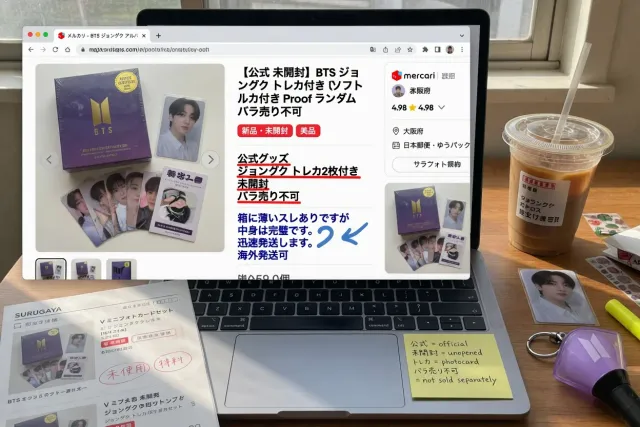
Japanese BTS listings can be read by identifying the item type, member name, condition label, included extras, and seller notes. Key words such as 公式 (official), 未開封 (unopened), トレカ (photocard), and バラ売り不可 (not sold separately) quickly explain what is being offered. Reading the full title, description, and photos together helps you understand exactly which BTS item is included.
Recognize BTS names and search terms in Japanese
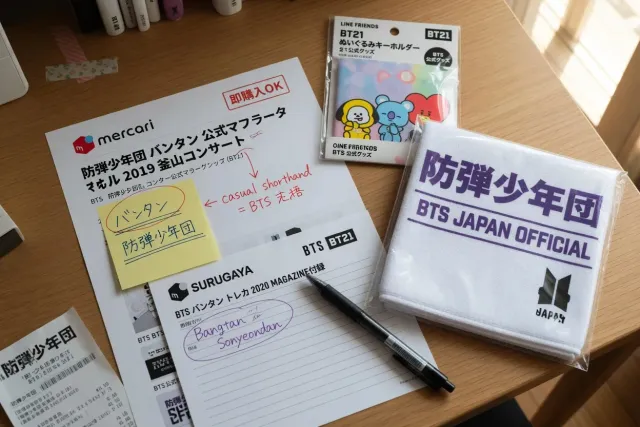
BTS is commonly written as BTS in Japanese listings, but sellers also use several Japanese names and nicknames. Knowing these variations is useful because a listing title may use only one of them, especially when space is limited.
- BTS · the most widely used name in listing titles.
- 防弾少年団 · the Japanese rendering of Bangtan Sonyeondan; literally ·Bulletproof Boy Scouts.· It may appear in older listings, official Japanese releases, or descriptions.
- バンタン · a casual Japanese shorthand for BTS, read as ·Bantan.·
- Bangtan or 방탄소년단 · Korean or romanized wording occasionally used by sellers.
- BT21 · a separate character brand created through a collaboration with LINE FRIENDS. A BT21 listing is not necessarily a BTS member-photo item.
Member names also appear in multiple forms. Japanese sellers frequently use stage names in Latin letters, Japanese katakana, or Korean names. For example, RM may be written as RM, ナムジュン (Namjoon), or ナム. V can appear as V, テテ (Taehyung’s Japanese nickname), or テヒョン. Jimin may be listed as ジミン, while Jung Kook may appear as ジョングク or グク.
For group items, look for 全員 (all members), 集合 (group image), オール (all), or 7人 (seven members). These usually indicate a group design, although photos should still confirm whether the item includes seven individual pieces or one group item.
To see how these terms appear in live titles and descriptions, browse the BTS collection on JPFinds.
Read the listing title from left to right
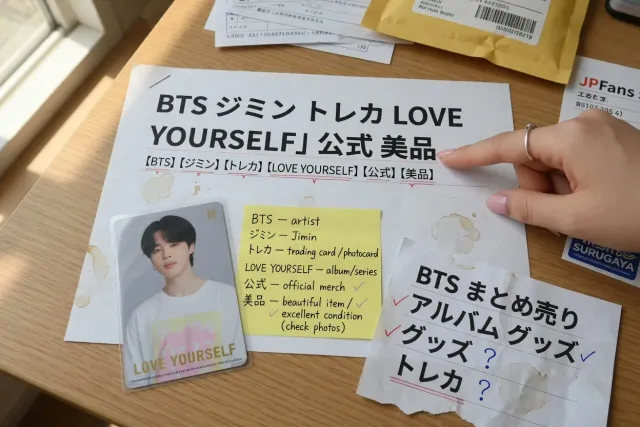
Japanese marketplace titles are often compressed into a string of keywords rather than a full sentence. They commonly follow a practical order: artist, item type, member, release or event, then condition or sales terms. Break the title into small parts instead of trying to translate it word for word.
For example:
BTS ジミン トレカ LOVE YOURSELF 公式 美品
- BTS · artist.
- ジミン · Jimin.
- トレカ · trading card, usually called a photocard by collectors.
- LOVE YOURSELF · the associated album, tour, or release series.
- 公式 · official merchandise.
- 美品 · ·beautiful item· or very good-looking condition; this is subjective and should be checked against the photos and description.
A title such as BTS まとめ売り アルバム グッズ トレカ means ·BTS bulk sale: albums, goods, photocards.· It does not mean every pictured item is guaranteed to be included. The detailed description is where sellers often specify exclusions, missing inclusions, or the exact number of items.
Other useful title terms include 限定 (limited), 特典 (bonus benefit), 購入特典 (purchase bonus), 公式ショップ (official shop), ファンクラブ or FC (fan club), and 会場限定 (venue-exclusive). These words can identify the origin of a release, but they do not replace checking the listing photos.
Understand common BTS merchandise categories
Accurately reading a listing starts with understanding what category of BTS merchandise is being named. Similar-looking Japanese terms can refer to very different items, especially in mixed lots.
Photocards and paper goods
- トレカ · trading card; usually a photocard.
- フォトカード · photocard.
- ポストカード · postcard.
- ミニフォト · mini photo, often a smaller official photo print.
- 生写真 · ·raw photo,· a term used for photo prints; it does not automatically prove official origin.
- ブロマイド · portrait-style photo print.
- ステッカー · sticker.
Albums, discs, and printed releases
- アルバム · album.
- CD · compact disc.
- DVD / Blu-ray · video disc formats.
- 日本盤 · Japanese edition.
- 韓国盤 · Korean edition.
- 日本語字幕 · Japanese subtitles.
- ブックレット · booklet.
- ランダム · random inclusion, often used for randomly packed photocards or member items.
A Japanese edition can have different packaging, bonus items, subtitles, or inclusions from a Korean edition. Likewise, an album listing that says トレカなし means ·without photocard,· even if the album itself is included. If a disc is important to your purchase, verify the stated edition and make sure its playback specifications suit your equipment.
Goods, apparel, and event merchandise
グッズ is a broad term for merchandise. It can include acrylic stands (アクスタ), keychains (キーホルダー), badges (缶バッジ), towels (タオル), light sticks (ペンライト), plush items (ぬいぐるみ), and apparel (アパレル). When a title says only ·goods,· do not assume a particular category; consult the photos and description for the complete contents.
Interpret condition labels without overreading them
Condition wording in Japanese listings is helpful, but it is not a universal grading system. Sellers may use a platform category, their own written assessment, or both. Treat the category as a starting point and use close photos plus detailed notes to understand the actual item.
- 新品、未使用 · new, unused. The item may still have opened outer packaging, depending on the product.
- 未開封 · unopened. This is especially relevant for sealed albums, blind-pack items, and boxed goods.
- 未使用に近い · close to unused; generally used for an item that has been handled but shows little sign of use.
- 目立った傷や汚れなし · no noticeable scratches or stains. Minor wear may still exist.
- やや傷や汚れあり · some scratches or stains.
- 傷や汚れあり · scratches or stains are present.
- 全体的に状態が悪い · overall condition is poor.
美品 is common in BTS listings, particularly for photocards. It suggests that the seller considers the item to be in attractive condition, but it is not a formal guarantee of a flawless surface. For paper goods, look closely for corner wear, edge whitening, bends, surface scratches, print marks, fading, or marks on protective sleeves that may not be on the card itself.
Condition notes often include 初期傷 (initial manufacturing flaw), スレ (scuffing or rubbing), 折れ (bend or crease), 凹み (dent), 黄ばみ (yellowing), and 日焼け (sun fading). A note such as 初期傷あり means the seller reports an issue believed to have been present from production or packaging. It is still an actual condition detail to consider.
Check what is included, excluded, or sold as a set
The most important information in a Japanese BTS listing may be a short sentence near the end of the description. It often clarifies whether the item is complete, whether a bonus is missing, or whether the pictured display accessories are excluded.
- 付属品 · included accessories or contents.
- 付属品なし · no accessories included.
- 写真のものが全てです · everything shown in the photos is included.
- トレカ付き · photocard included.
- トレカなし · photocard not included.
- 抜けなし · nothing is missing, usually from a set or album package.
- 抜けあり · one or more components are missing.
- コンプ or コンプリート · complete set.
- セット / まとめ売り · set or bulk lot.
- バラ売り不可 · individual pieces will not be sold separately.
Be careful with the word おまけ, meaning ·free extra· or bonus. Sellers may include an unofficial freebie, a duplicate, or a small additional item. Unless the description clearly identifies it, do not treat an おまけ as a core part of the listing.
Similarly, 外箱なし means ·without the outer box,· while 箱付き means ·with box.· For collectible figures, light sticks, and premium packaging, this distinction can matter as much as the condition of the item itself.
Use photos and seller notes to confirm official BTS merchandise
The word 公式 means official, while 正規品 means genuine or authorized product. Both are useful listing claims, but neither should be read in isolation. Compare the product images with the stated release, look for clear photos of branding and packaging where relevant, and read any notes about origin.
Terms that need extra attention include 非公式 (unofficial), 自作 (homemade), ハンドメイド (handmade), 韓流ショップ品 (K-pop shop item), and ノーブランド (unbranded). These do not necessarily mean an item is poor quality, but they do mean it should not be assumed to be official BTS merchandise.
For cards and printed items, compare the front and back photos, print finish, borders, and any release-specific identifiers described by the seller. For apparel and larger goods, check dimensions, tags, labels, package seals, and the exact product name. A listing may show multiple related items for context, so confirm which item is being sold through wording such as こちらの商品 (·this item·) or 1枚目の写真 (·the first photo·).
The official BTS website can also help you recognize official releases and current branding. When you are ready to compare Japanese-market offerings, explore more BTS merchandise listings.
Decode seller instructions and practical listing notes
Some Japanese phrases describe the seller’s preferences rather than the product. They still matter because they can explain whether a listed lot can be divided or whether the seller has added a condition caveat.
- 即購入OK · immediate purchase is okay.
- コメント不要 · no comment is needed before purchase.
- 専用 · reserved for a particular person. This is a seller convention, not a product feature.
- 取り置き · hold or reservation.
- 値下げ不可 · price reduction is not available.
- 返品不可 · returns not accepted.
- 中古品にご理解ある方 · intended for buyers who understand the nature of used items.
A particularly useful phrase is 素人保管, meaning ·stored by a non-professional.· It signals that the item was kept in a private home rather than professionally archived. This is common and does not automatically indicate damage, but it explains why the seller may mention minor wear, dust, scent, or storage-related changes.
Read phrases such as 状態は写真でご確認ください (·please check the condition in the photos·) carefully. They direct attention to the images as part of the seller’s condition disclosure. For a multi-item lot, count the visible pieces and compare them with wording such as 計○点 (·a total of ○ items·) to make sure the stated quantity matches your understanding.
Build a quick checklist before interpreting a BTS listing
A reliable reading routine prevents the most common misunderstandings. Start with the title to identify the member and product category, then use the description to establish contents and condition, and finally use photos to confirm the details.
- Is the item BTS group merchandise, a named member item, BT21 merchandise, or an unrelated item using a broad keyword?
- What is the exact item type: photocard, album, DVD, acrylic stand, light stick, apparel, or a mixed lot?
- Does 公式 or another origin note appear, and do the photos support that description?
- Are key inclusions present, especially photocards, booklets, boxes, bonus items, or member-specific pieces?
- Which condition label is selected, and are scratches, bends, fading, or missing packaging noted separately?
- Does the listing say セット, まとめ売り, or バラ売り不可?
- Do the photos show the actual item rather than a stock image or a broader collection?
Japanese listing language is often concise, but the important facts are usually there once you recognize the recurring vocabulary. Prioritize specific statements and visible evidence over broad labels such as ·rare,· ·beautiful,· or ·official.· That approach makes it much easier to distinguish a complete member photocard listing from an album without inclusions, or a genuine set from a mixed assortment of related goods.