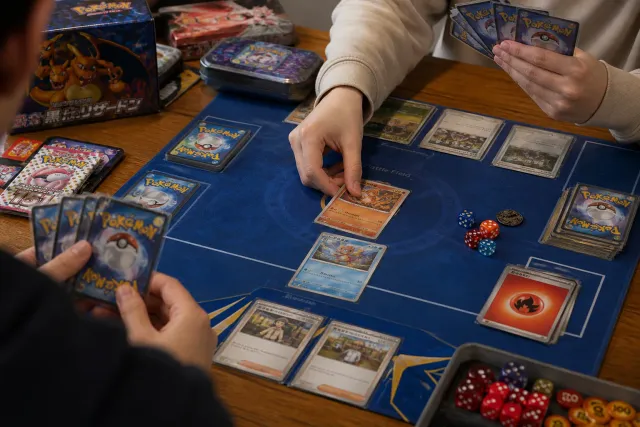
To play the Pokémon Trading Card Game (Pokémon TCG), build a 60-card deck, set up Pokémon in the Active Spot and on the Bench, attach Energy, use attacks, and take Prize cards when you Knock Out opposing Pokémon. A match is won by taking all Prize cards, Knocking Out an opponent with no Benched Pokémon, or when they cannot draw a card at the start of their turn. Pokémon TCG Live teaches the full tabletop rules online, while Pokémon TCG Pocket uses a faster, simplified digital format.
What You Need to Play the Pokémon TCG
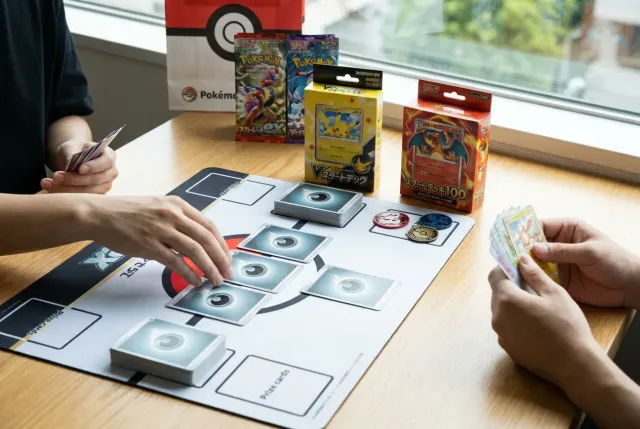
The standard Pokémon TCG is a two-player strategy card game. Each player brings a deck of exactly 60 cards and tries to set up Pokémon, power them with Energy, and take six Prize cards before the opponent does.
A beginner-friendly way to start is with two ready-to-play decks of a similar level. These decks include the necessary Pokémon, Trainer cards, and Energy cards, and they are designed to function as complete strategies rather than random groups of cards. You will also need a few game accessories:
- A 60-card deck: Your deck must contain at least one Basic Pokémon. In most constructed formats, you may include no more than four cards with the same name, excluding basic Energy.
- Damage counters: These track damage on Pokémon. A Pokémon is Knocked Out when its damage equals or exceeds its HP.
- A coin or die: Used for coin flips and certain card effects.
- Status markers: Useful for tracking Special Conditions such as Poisoned, Burned, Asleep, Confused, and Paralyzed.
- A playmat: Optional, but especially helpful for learning where the Active Pokémon, Bench, deck, discard pile, and Prize cards go.
If you are exploring Japanese releases or looking for Pokémon-related items, browse the Pokémon collection at JPFinds. Many collectors seek Japanese releases for exclusive artwork, promotional cards, or early access to new sets. Keep in mind that Japanese cards generally have Japanese text, so they may not be tournament-legal in every region even though they use the same core game concepts.
Understanding Pokémon TCG Card Types
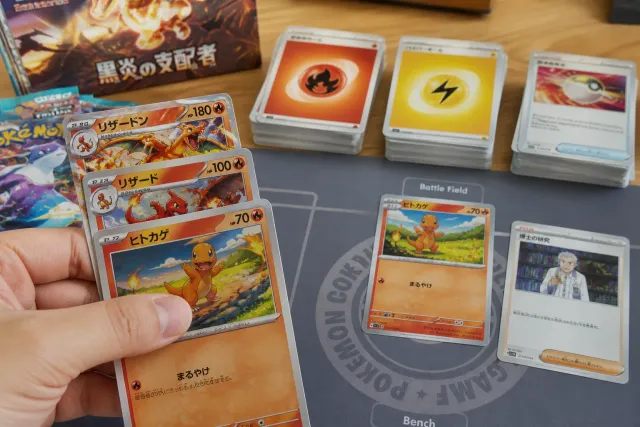
Every successful turn depends on knowing what each category of card does. A deck is usually built from Pokémon, Energy, and Trainer cards. The balance changes from deck to deck, but all three groups are fundamental.
Pokémon cards: your attackers and support
Pokémon cards enter play as either Basic Pokémon or Evolutions. A Basic Pokémon can be played directly from your hand onto your Bench or, during setup, into the Active Spot. Evolution cards must be placed on top of the correct Pokémon already in play.
For example, if you have a Charmander in play, you may evolve it into Charmeleon, then later evolve Charmeleon into Charizard. You normally cannot evolve a Pokémon on the same turn it entered play, and you cannot evolve a Basic Pokémon on your first turn.
Each Pokémon card has several important features:
- HP: The amount of damage it can take before being Knocked Out.
- Type: Such as Fire, Water, Grass, Lightning, Psychic, Fighting, Darkness, Metal, Dragon, or Colorless. Type can matter when Weakness applies.
- Attacks: Actions requiring specific Energy costs. An attack may deal damage, apply an effect, search your deck, move Energy, or otherwise change the game state.
- Retreat Cost: The Energy you must discard to move that Pokémon from the Active Spot to the Bench.
- Weakness and Resistance: Weakness usually increases incoming damage, while Resistance reduces it.
- Ability: A special effect that can often be used without attacking, subject to the text on the card.
Energy cards: the fuel for attacks
Energy lets Pokémon attack. On your turn, you may normally attach one Energy card from your hand to one of your Pokémon. Basic Energy provides a single Energy type, while Special Energy can offer multiple types or additional effects.
Because one manual Energy attachment per turn is the usual limit, Energy is one of the game’s most important resources. New players often attach Energy only to their current Active Pokémon. That can work, but it can also leave the Bench unprepared. Many decks use their early turns to build a second attacker before the first one is Knocked Out.
Trainer cards: consistency, search, and disruption
Trainer cards help you find the cards you need and create a reliable game plan. They come in several broad groups:
- Item cards: You can generally play as many as you want during a turn, provided their effects and game state allow it.
- Supporter cards: Powerful cards that often draw cards, search the deck, or disrupt the opponent. You may play only one Supporter each turn.
- Stadium cards: Cards that remain in play and affect both players or the game environment. Only one Stadium can be in play at a time.
- Pokémon Tools: Attach to Pokémon and give them an ongoing effect. Tools follow their own attachment rules and are not the same as Energy.
For official terminology, current products, and rule resources, consult The Pokémon Company’s official Pokémon website.
How to Set Up a Pokémon TCG Game
Before the first turn, both players prepare the game in a fixed order. Setup is simple once you have done it a few times.
- Shuffle your 60-card deck thoroughly.
- Draw seven cards.
- Choose one Basic Pokémon from your hand and place it face down in the Active Spot.
- You may place additional Basic Pokémon face down on your Bench, up to five Benched Pokémon.
- If you have no Basic Pokémon in your opening hand, reveal your hand, shuffle it back into your deck, and draw a new seven-card hand. This is called a mulligan. Your opponent draws an extra card for each mulligan you take.
- Place six cards face down as your Prize cards.
- Flip a coin to determine who goes first, then turn all Active and Benched Pokémon face up.
The player going first does not attack on their first turn. In the current standard rules, the first player also cannot play a Supporter card on that opening turn. This makes the coin flip strategically meaningful: going first can allow earlier board development, while going second may offer an earlier chance to use a Supporter and attack.
How a Turn Works in the Pokémon TCG
A turn begins by drawing one card from your deck. After that, you can take actions in a flexible order before ending the turn by attacking. There is no formal ·main phase,· but it is helpful to think of your turn as planning, developing your board, and then attacking.
Actions you can take before attacking
During your turn, you may perform many actions in the order that makes the most sense for your hand. Common actions include:
- Play Basic Pokémon from your hand onto your Bench.
- Evolve eligible Pokémon.
- Attach one Energy card from your hand.
- Play Item cards and use relevant Abilities.
- Play one Supporter card for the turn.
- Play or replace a Stadium card.
- Attach a Pokémon Tool, if permitted.
- Retreat your Active Pokémon once per turn by paying its Retreat Cost.
- Use card effects that move Energy, heal damage, switch Pokémon, or search your deck.
There are important timing details. For instance, a Pokémon usually cannot evolve on the turn it came into play. If you retreat, you cannot retreat again that turn unless a card effect specifically allows it. And once you attack, your turn ends immediately, so make all your other choices first.
Attacking and calculating damage
To attack, your Active Pokémon must have the required Energy attached. Announce the attack, pay any costs stated on the card, and follow its text in order. Then calculate damage, Weakness, Resistance, and effects.
Suppose your Active Pokémon uses an attack that does 120 damage. If the opponent’s Active Pokémon is Weak to your Pokémon’s type, the damage may be doubled to 240. If it is Resistant, the listed reduction is applied instead. Effects on Pokémon, Stadiums, Tools, and other cards can also change the result, so read every relevant card carefully.
Damage remains on a Pokémon unless an effect removes it. If a Pokémon with 180 HP has accumulated 180 or more damage, it is Knocked Out. All cards attached to it, including Energy and Tools, go to the discard pile unless an effect says otherwise.
Special Conditions
Some attacks inflict Special Conditions. These are not simply extra damage; each has its own rule:
- Asleep: The Pokémon is turned counterclockwise and cannot attack or retreat. A coin flip between turns determines whether it wakes up.
- Confused: The Pokémon is turned upside down. If it attacks or retreats, a coin flip may cause it to place damage counters on itself instead.
- Paralyzed: The Pokémon is turned clockwise and cannot attack or retreat until the condition ends.
- Poisoned: The Pokémon takes damage between turns.
- Burned: The Pokémon takes damage between turns, then a coin flip may remove the condition.
Switching a Pokémon to the Bench removes all Special Conditions.
How You Win a Pokémon TCG Match
The most familiar win condition is taking all six Prize cards. Whenever you Knock Out an opponent’s Pokémon, you take Prize cards based on that Pokémon’s rule box or card text. Many ordinary Pokémon give up one Prize card, while certain powerful Pokémon may give up two or more.
There are also two other ways to win:
- No Pokémon in play: If your opponent’s Active Pokémon is Knocked Out and they have no Benched Pokémon to promote, you win immediately.
- Deck out: If your opponent cannot draw a card at the beginning of their turn because their deck is empty, you win.
This means that taking KOs is not the only strategic route. Some decks pressure the opponent’s deck, while others aim to remove the only Pokémon they can use as an attacker. Still, beginners should focus first on a straightforward plan: set up attackers, attach Energy every turn, take Prize cards efficiently, and avoid leaving the Bench empty.
Pokémon TCG Live: The Full Digital Card Game
Pokémon TCG Live is the official digital way to play the traditional Pokémon Trading Card Game on supported devices. It follows the core 60-card rules: six Prize cards, deck construction, Energy attachments, Evolutions, Trainer cards, turns, and standard win conditions.
It is especially useful for learning because the client handles many rule checks automatically. It will prevent illegal plays, apply damage counters, identify valid targets, and guide you through required choices. That does not replace learning card text, but it can make the first few matches less intimidating.
TCG Live includes ways to play against the computer, complete guided learning content, and play against other people. It also has formats and deck-building tools that can change as official rotations and digital card availability change. If you plan to move from digital matches to in-person play, pay attention to the format label on your deck and the legality markings shown in the client.
A useful learning routine is to choose one deck, play several matches, and identify the cards you most often wish you could draw. That reveals the purpose of draw Supporters, search Items, and multiple copies of key cards. Rather than changing everything after one loss, look for a repeated problem: too few Basic Pokémon, not enough Energy, difficulty finding Evolutions, or a weak backup attacker.
Pokémon TCG Pocket: How It Differs From TCG Live
Pokémon TCG Pocket is a separate digital card game, not a direct replacement for tabletop Pokémon TCG or Pokémon TCG Live. It uses Pokémon cards and familiar concepts, but its battles are designed to be quicker and more mobile-focused.
The biggest differences are easy to remember:
- Deck size: Pocket uses compact decks rather than the traditional 60-card deck.
- Winning: Players score points for Knock Outs instead of taking six Prize cards.
- Energy: Pocket uses an Energy Zone system rather than requiring players to draw and manually attach Energy cards from a deck in the same way as the physical game.
- Rules and card effects: Pocket cards can have familiar names and mechanics, but they are balanced for Pocket’s own ruleset.
- Match length: The format is structured for fast battles and simplified decisions.
The best approach is to treat Pocket as its own game. Knowledge of types, HP, attacks, retreating, and evolving is helpful, but do not assume that a card interaction from the tabletop game works identically in Pocket. Read the in-app card text and tutorial prompts, especially when learning how points, Energy, and turn limits work.
Beginner Strategy Tips for Your First Games
Winning more often starts with making fewer avoidable mistakes. The following habits are useful in physical play, TCG Live, and — where the rules overlap — Pocket.
- Start with a clear attacker plan. Know which Pokémon you want in the Active Spot and which Pokémon you are preparing on the Bench.
- Bench more than one Basic Pokémon when safe. A backup prevents an immediate loss if your Active Pokémon is Knocked Out.
- Attach Energy every turn when it advances your plan. Missing manual Energy attachments can put you a full turn behind.
- Read attack costs exactly. Colorless Energy symbols can be paid with any type, but colored symbols require that specific type unless an effect changes the requirement.
- Do not use your Supporter too early without a reason. Because you only get one per turn, consider whether another card or Ability can solve the immediate problem first.
- Count remaining Prize cards. If you need only one Prize card, target selection may matter more than maximum damage.
- Plan for your Pokémon being Knocked Out. Ask what your next Active Pokémon will be, whether it has Energy, and whether it can attack on your next turn.
Ready to build your deck or collect exclusive Japanese cards? Explore the Pokémon shopping hub.