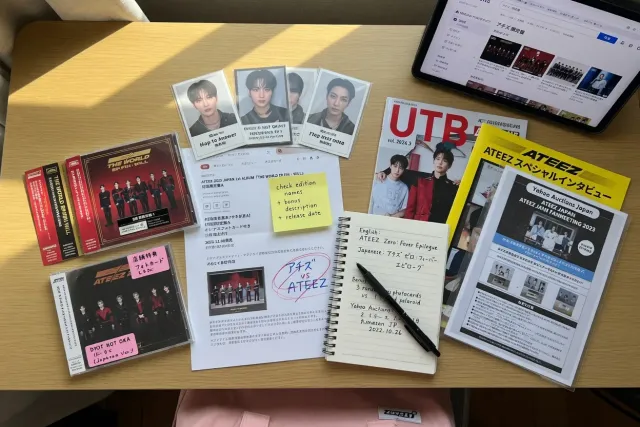
To find Japanese ATEEZ releases, search using both English and Japanese terms, then compare edition names, catalogue details, bonus descriptions, and release dates. Japanese listings may use the group name ATEEZ, Japanese title spellings, or abbreviations such as アチズ. Looking beyond standard CDs is important: Japan-exclusive versions, store benefits, DVDs, magazines, fan-club goods, and event items are often listed separately.
Understand what counts as a Japanese ATEEZ release
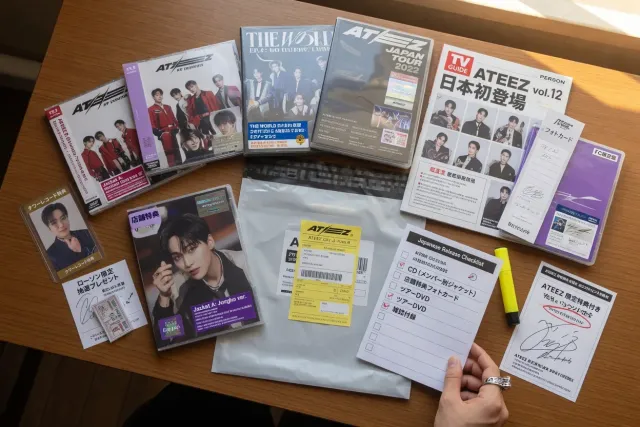
Japanese ATEEZ releases are not limited to albums sung in Japanese. For collectors, the category can include official Japanese-market CDs, Blu-rays, DVDs, retailer-exclusive editions, tour merchandise, magazine features, fan-club products, purchase benefits, and promotional materials issued for the Japanese market.
The first step is deciding what you are trying to find. A Japanese CD release may have a regular edition, several member-jacket editions, a limited edition with a DVD, or an edition tied to a specific retailer. Meanwhile, an item that looks like a simple photocard may have originated as a store benefit, a lottery prize, a fan-sign event item, or a bonus included with a Japanese release.
Common categories to search for include:
- Japanese singles and albums: physical CDs issued for the Japanese market, including standard and limited versions.
- DVD and Blu-ray releases: concert films, tour packages, behind-the-scenes content, and Japanese editions of live releases.
- Member editions: versions using a particular member’s cover or jacket image.
- Store bonuses: photocards, clear files, postcards, posters, acrylic items, and other purchase gifts.
- Fan-club and concert goods: Japan fan-club merchandise, venue items, event souvenirs, and tour products.
- Print media: Japanese magazines, photo books, newspaper inserts, and special publication editions.
For a broad starting point, browse the dedicated ATEEZ collection page. It can be useful when you want to see how Japanese listings describe different types of official items.
Use Japanese ATEEZ search terms and release keywords
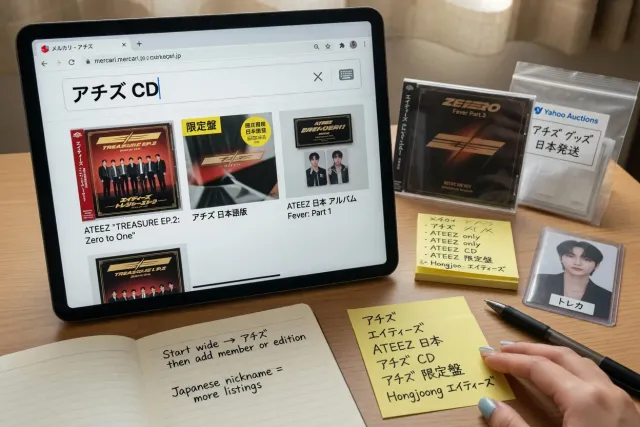
Japanese marketplace listings are frequently more discoverable when searched in Japanese. Sellers may write only the Japanese group nickname, a Japanese product category, or the release title without an English description. Start wide, then add a product type, edition clue, or member name if you need narrower results.
The most useful core searches are:
- ATEEZ · the official Latin-letter group name, widely used on listings.
- アチズ · a common Japanese shorthand for ATEEZ.
- エイティーズ · a Japanese phonetic rendering that can appear in older or less formal listings.
- ATEEZ 日本 or アチズ 日本 · useful when distinguishing Japanese-market items from general listings.
- ATEEZ CD, アチズ CD · for discs and album editions.
- ATEEZ DVD or Blu-ray · for video releases.
- ATEEZ 特典 · ·bonus· or purchase benefit.
- ATEEZ トレカ · photocard.
- ATEEZ 公式 · official; useful but not a guarantee on its own.
- ATEEZ 日本限定 · Japan limited/exclusive.
Use release-title searches whenever possible. An exact title plus ·CD,· ·特典,· ·トレカ,· or ·初回限定盤· can reveal listings that a general ATEEZ search misses. Japanese sellers often place the title first and the group name later, especially when listing several artists· items.
For a limited edition, these terms are especially helpful: 初回限定盤 means first limited edition; 通常盤 means regular edition; and 完全生産限定盤 generally indicates a fully limited production edition. Do not assume that every release has all of these formats. Always compare the listing photos and description with the known release configuration.
Track official Japanese release information before searching
Finding an item is easier when you know exactly what should exist. Before searching marketplaces, make a reference list with the release title, release date, edition names, included media, cover variants, and announced bonuses. This avoids buying an incomplete version when you intended to find a specific edition.
The group’s official channels are the best starting point for announcement details. Visit the official ATEEZ website for current artist information and official notices. Japanese release campaigns may also be announced through official Japanese social channels, record-label communications, or retailer announcements, so save reliable release images and product descriptions while they are available.
Build a simple checklist for each target release:
- Exact album or single title
- Japanese release date
- Regular, limited, or member edition name
- Catalogue number, if available
- Included CD, DVD, Blu-ray, booklet, or serial-related inserts
- Original retailer benefit and whether it was separate from the sealed product
- Cover artwork and number of versions
Catalogue numbers are particularly useful because titles may be abbreviated, translated inconsistently, or misspelled. A seller may not know every detail about an idol release, but a visible product code can help distinguish one format from another. For used goods, photographs of the back cover, spine, obi strip, disc label, and included inserts are more useful than a short title alone.
Recognize Japanese edition and bonus terminology
Japanese releases can have many layers of inclusions. The main product, an enclosed random photocard, and a retailer purchase benefit are not the same thing. Understanding that difference is essential when comparing listings and prices.
Items included inside the original product
These are items packaged with the CD, DVD, or Blu-ray at the time of manufacture. Listings may mention 封入特典 (enclosed benefit), 封入トレカ (enclosed photocard), ブックレット (booklet), or 応募券 (application ticket). Application tickets and serial-related materials may be expired or already used, so they should not be treated as active benefits unless the listing clearly confirms their status.
Retailer and campaign benefits
Retailer extras were often distributed separately at the time of purchase. Search terms such as 店舗特典 (store benefit), 購入特典 (purchase benefit), and 先着特典 (first-come bonus) can uncover these items. A listing for a CD without its original store photocard is not necessarily incomplete; it may simply be the standard product without a separate promotional extra.
Also watch for 特典のみ, meaning ·bonus only,· and CDなし, meaning ·no CD.· These phrases are useful when you are specifically seeking benefits, but they also prevent accidental purchases of a bonus card when you expected the full album.
Condition language on collectible listings
When buying physical releases, Japanese condition terms provide helpful context but should be read alongside photographs. 未開封 means unopened or sealed. 美品 means an item considered in very good condition, though it is subjective. 初版 means first edition or first printing and is more relevant to books, magazines, and printed items than standard music CDs. Check whether cards, obi strips, booklets, and discs are shown or explicitly listed.
Search each type of Japanese ATEEZ item differently
A broad search can produce thousands of results, especially for photocards and merchandise. Refine your search according to the item type and the information most likely to appear in its listing title.
- Albums: combine the release title with 初回限定盤, 通常盤, or a catalogue number. Add ·帯· if the obi strip matters to your collection.
- Photocards: search the title plus トレカ and the relevant retailer name or 特典. If the card is a pre-order gift, add 予約特典.
- Concert releases: add DVD, Blu-ray, ライブ, or ツアー. Check format and regional compatibility before choosing a disc.
- Fan-club items: use FC, ファンクラブ, or official fan-club wording. These can be listed with event names rather than product names.
- Merchandise: add the object type, such as アクスタ for acrylic stand, 缶バッジ for can badge, うちわ for fan, or ぬいぐるみ for plush.
- Magazines: search ATEEZ with 雑誌, 表紙 (cover), 切り抜き (clippings), or the publication title.
Try several word orders. Japanese marketplace titles are usually compact, and sellers may place the member name, item type, event, and condition in different sequences. Searching both English and Japanese terms also helps locate listings created by international fans living in Japan.
Compare listings carefully to identify the right version
Two listings with the same title can represent different editions, different inclusions, or entirely different campaigns. Before adding an item to your order, compare the listing against your reference checklist instead of relying on the thumbnail image.
Review these points:
- Product format: Is it a CD, DVD, Blu-ray, photocard, bonus, or empty outer box?
- Edition: Does the listing say regular edition, limited edition, member edition, or another named version?
- Included items: Are the booklet, disc, random card, obi, or bonus explicitly included?
- Photos: Do the images show the actual item rather than a stock image?
- Condition: Are scratches, corner wear, discoloration, tears, or missing pieces mentioned?
- Set wording: Terms such as まとめ売り, セット, and コンプリート indicate bundles, sets, or complete collections, but verify exactly what is in them.
Be especially attentive to listings labeled ジャンク (junk/as-is), 現状品 (sold in current condition), or 訳あり (with an issue). These may be suitable for display, repair, or spare packaging, but they require a closer reading of the description.
For current and older listings across Japanese stores and marketplaces, the ATEEZ hub is a convenient place to begin comparing available items. Search results can change quickly, so saving exact Japanese search phrases makes it easier to repeat a successful search later.
Find out-of-print and harder-to-locate Japanese releases
Older Japanese ATEEZ releases and time-limited benefits may not appear every day. The most effective approach is patient, repeatable searching rather than relying on a single query. Sellers often list collections after moving, downsizing, or organizing old fandom goods, and these listings may use broad terms such as ·K-pop goods· rather than the exact release name.
Create a rotation of searches: one for the exact title, one for the group name and item type, one for the Japanese shorthand アチズ, and one for the relevant bonus keyword. For a rare retailer card, search the release title with 特典, then try the retailer name, then search the member and card type separately.
Bundles can be useful for older releases, but assess them item by item. A group lot may contain several desired cards alongside duplicates or unrelated goods. Conversely, a single listing may be easier to verify if you need one exact jacket edition or one particular Japanese purchase benefit.
Keep expectations realistic around scarcity. A limited item is not automatically unavailable just because no listing is visible today. It may simply be listed under a different spelling, stored in a mixed lot, or awaiting a future resale. Accurate terminology and a saved release checklist are often more valuable than constantly repeating a very broad search.
Organize your Japanese ATEEZ release search
A small tracking system makes collecting more deliberate and reduces duplicate purchases. You can use a notes app or spreadsheet with columns for title, format, edition, target bonus, Japanese search terms, condition requirement, and whether the item has already been found.
Separate your targets into three groups: essential releases you want in any complete condition, edition-specific releases where packaging and included items matter, and optional bonuses such as store photocards. This helps you decide when a listing is a good match rather than an impulsive near-match.
When your items are ready, JPFinds can bring purchases from supported Japanese shops and marketplaces together for international forwarding. The service uses a two-payment system: you first pay for the item and applicable domestic costs, then pay international shipping after the items are prepared for dispatch. Multiple carrier options are available, allowing you to select an option that suits your destination and parcel preferences.
For related collecting help, see the ATEEZ selection for currently searchable group merchandise and releases.
What should I search to find Japanese ATEEZ albums?
Start with the exact release title plus ATEEZ, アチズ, CD, 初回限定盤, or 通常盤. Add a catalogue number if you have one, as it can identify the exact format more reliably than a title alone.
What does 特典 mean on an ATEEZ listing?
特典 means bonus or benefit. It can refer to an enclosed item, a retailer purchase gift, or a campaign extra. Read the description to determine whether the bonus is included with the main product or sold by itself.
How can I tell whether a Japanese ATEEZ photocard is a store benefit?
Look for terms such as 店舗特典, 購入特典, 予約特典, or the name of a Japanese retailer. Compare the image and wording with official release campaign information when possible.
Does 未開封 mean an ATEEZ album includes every original bonus?
Not always. 未開封 indicates that the main item is unopened, but separate retailer benefits may not have been packaged inside the product. Check whether the listing specifically states that the external bonus is included.
Why do Japanese ATEEZ listings use アチズ instead of ATEEZ?
アチズ is a common Japanese shorthand used by fans and sellers. Searching both ATEEZ and アチズ helps uncover more listings, especially for merchandise and older fan-collected items.