To find Bandai collectibles on Japanese marketplaces, search with Japanese product names, series titles, item numbers, and condition terms rather than English keywords alone. Check live listings across Mercari, JDirectItems Auction, Amazon Japan, Surugaya, and Minne; compare photos and included parts; then use a shopping proxy to purchase, consolidate, and ship your finds internationally.
Why Japanese marketplaces are useful for Bandai collectors
Bandai is one of Japan's most prolific collectible manufacturers. Its catalog spans decades and includes anime figures, robots, plastic model kits, capsule toys, character goods, trading items, candy toys, premium releases, and limited event merchandise. Japan-based marketplaces are especially useful because many Bandai products were originally sold only in Japan, distributed through lottery campaigns, offered at events, or released through the company’s own premium channels.
Collectors can find both recent releases and older items that have disappeared from overseas retail. Japanese sellers often list individual items from large collections, opened display pieces, duplicate prize figures, discontinued model kits, and parts lots. This can make Japanese listings valuable for filling a specific gap in a collection, such as a missing version, colorway, accessory set, or older release from a particular franchise.
A useful starting point is the Bandai shopping page, where you can browse relevant live listings and begin refining searches by franchise, product line, or category. Availability changes constantly, so searching regularly is often more effective than expecting one search to reveal every desired item.
Bandai operates across many brands and sub-lines, and product naming can be inconsistent in English. A listing may use a Japanese character name, a shortened series title, a product code, or simply a broad term such as フィギュア (figure). Learning a few search patterns therefore gives collectors a meaningful advantage.
Know the Bandai categories you are searching for
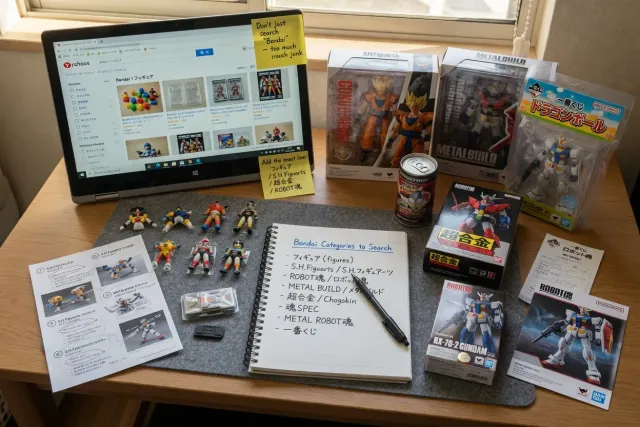
Before searching, identify the exact type of Bandai collectible you want. Broad searches for ·Bandai· produce enormous result sets, including inexpensive toys, empty packaging, replacement parts, and unrelated promotional goods. Adding a product-line term helps narrow listings quickly.
Figures, robots, and character collectibles
- フィギュア · figure; useful as a broad category term.
- S.H.Figuarts / S.H.フィギュアーツ · articulated character figures.
- ROBOT魂 / ロボット魂 · Robot Spirits collectible figures.
- METAL BUILD / メタルビルド · premium die-cast and action-figure line.
- 超合金 / Chogokin · die-cast robot collectibles.
- 魂SPEC and METAL ROBOT魂 · specialized robot and mecha lines.
- 一番くじ · Ichiban Kuji lottery prizes, often listed by prize rank such as A賞 or ラストワン賞.
Model kits and hobby releases
- ガンプラ · Gunpla, the common Japanese shorthand for Gundam plastic models.
- HG / RG / MG / PG · High Grade, Real Grade, Master Grade, and Perfect Grade.
- バンダイ プラモデル · Bandai plastic model.
- プレミアムバンダイ / プレバン · Premium Bandai releases, often abbreviated as P-Bandai or Preban.
- 限定 · limited edition; best used alongside the kit or series name.
Smaller Bandai collectibles
- ガシャポン / ガチャ · capsule toys and gashapon items.
- 食玩 · candy toys, frequently sold without the original candy.
- アクリルスタンド · acrylic stand.
- ぬいぐるみ · plush toy.
- キーホルダー · keyholder or keychain.
- まとめ売り · bundle or lot sale, useful for multiple small items.
Bandai’s official corporate site, Bandai, is useful for confirming the company’s current brands and official product families. For marketplace searches, however, seller wording and Japanese abbreviations are usually just as important as the official name.
Build better Japanese search queries
The strongest search queries combine a franchise, a Bandai line, and a specific character, mobile suit, item name, or product number. Start broad enough to see how Japanese sellers describe the item, then copy the terms that appear repeatedly in relevant listings.
For example, instead of searching only for ·Bandai Dragon Ball figure,· try combinations such as:
- ドラゴンボール S.H.Figuarts 孫悟空 · Dragon Ball S.H.Figuarts Son Goku.
- ガンダム METAL BUILD ストライク · Gundam METAL BUILD Strike.
- ガンプラ MGEX ストライクフリーダム · MGEX Strike Freedom Gunpla.
- 仮面ライダー 変身ベルト バンダイ · Kamen Rider transformation belt Bandai.
- たまごっち バンダイ 限定 · Tamagotchi Bandai limited edition.
Roman letters still matter. Many Japanese listings retain official line names such as ·S.H.Figuarts,· ·METAL BUILD,· ·HGUC,· or ·Figure-rise Standard.· Search both the Japanese and Romanized forms when possible. A seller may write ·エスエイチフィギュアーツ· in Japanese text, but another may use the English trademark styling.
Item codes can be even more precise. Look for product codes on official packaging photos, collector databases, old shop listings, or the box itself. A model kit’s grade and kit number, a figure’s release code, or a lottery prize title can distinguish the exact release from reissues and related products. If you are seeking a particular version, add the color, year, event, or campaign name in Japanese.
Use condition words to filter collectible listings
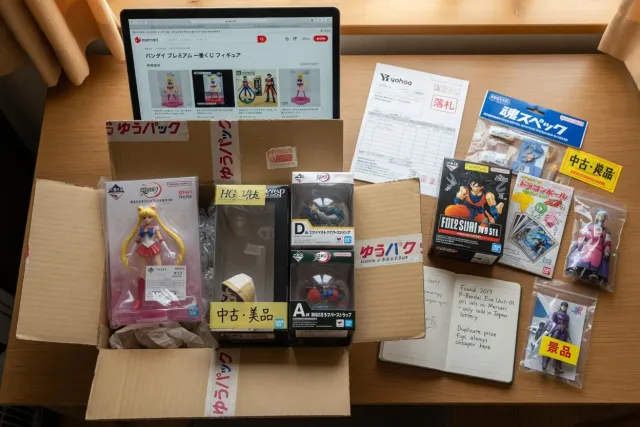
Japanese marketplace listings often describe condition in concise terms. These terms are helpful, but the photos and full seller description remain essential. A term such as 美品 may mean the seller considers the item attractive, not that it is factory-fresh or entirely free of wear.
- 未開封 · unopened. Usually indicates sealed packaging, though collectors should still review photos for storage wear, tape condition, and sun fading.
- 新品 · new. This may describe an unused item, but does not always guarantee factory seals.
- 美品 · very good condition or a beautiful item. Read the description for minor scratches, dust, or package wear.
- 中古 · used or pre-owned.
- 開封品 · opened item.
- 箱なし · without box.
- 欠品 · missing item or missing part.
- ジャンク · junk, damaged, untested, incomplete, or sold for parts; buy only when you understand the risk.
- 初版 · first edition or first production version. This can matter for collectors, but verify what the seller means for that product line.
For articulated figures and transforming toys, look closely for accessories, stands, effect parts, alternate hands, instruction sheets, and replacement joints. For model kits, determine whether the kit is unbuilt, partly assembled, painted, modified, or missing runners. For capsule toys and candy toys, check whether the listing includes the capsule, leaflet, stand, and all pieces if those matter to you.
Packaging condition deserves separate attention. A collector may prioritize an unopened box, while another may prefer a less expensive opened figure in excellent display condition. Decide which matters more before comparing prices. This prevents paying a sealed-box premium when you mainly want the item itself.
Search each Japanese marketplace with a different strategy
Different marketplaces tend to surface different kinds of Bandai collectibles. Searching more than one source gives you a better view of current asking prices, available condition levels, and the range of releases in circulation.
Mercari Japan
Mercari is useful for individual seller listings, quick sales, prize figures, capsule toys, character goods, and mid-priced collectibles. New listings can appear frequently, including bundles from collectors clearing shelf space. Search with precise Japanese terms and review all listing photos, since individual sellers may use broad titles.
Bundles can be particularly worthwhile for small Bandai items such as Gashapon sets, acrylic goods, keychains, or lottery prizes. If you only need one piece from a set, calculate whether the unused items still make the bundle worthwhile after shipping.
JDirectItems Auction
JDirectItems Auction can be useful for rare, older, or collector-focused pieces that attract competitive interest. Listings may include vintage robot toys, discontinued Chogokin releases, limited Premium Bandai items, large Gunpla lots, and unopened collections. Check the auction end time, current bid level, description, and any stated condition concerns before setting a maximum budget.
Auction titles may be abbreviated to fit limited space, so search both specific product names and broader category words. Terms such as レア (rare), 当時物 (period item), and 絶版 (out of print/discontinued) can reveal older material, but should not replace careful review of the actual item.
Amazon Japan, Surugaya, and Minne
Amazon Japan can help locate current releases, reissues, and standard retail products, though third-party offers should be compared carefully. Surugaya is widely known among Japanese hobby collectors for pre-owned games, figures, toys, and character merchandise; it can be a useful place to search for catalogued collectible stock. Minne is more relevant for fan-made display accessories, storage solutions, or handmade items inspired by collecting rather than official Bandai products.
Use the Bandai marketplace hub to explore listings across supported Japanese shopping sources. Comparing identical or closely related items helps you judge whether a listing is priced for scarcity, condition, included accessories, or simple seller preference.
How to spot the exact release you want
Many Bandai collectible lines have reissues, anniversary editions, regional variants, recolors, and near-identical package designs. Do not assume that two listings with the same character name are the same item. Compare the product line, release year, box art, accessories, item code, and stated version.
For example, a Gundam kit may exist as an original High Grade release, a later HGUC revision, a Real Grade version, and a Premium Bandai variant. A Kamen Rider figure might be sold as a standard release, a web-exclusive item, or an event recolor. Likewise, a Dragon Ball prize figure may have multiple releases with different sculpt colors, base designs, or prize tiers.
Helpful details to compare include:
- Official product-line logo and scale, where applicable.
- Japanese release name and character spelling.
- Box barcode, product number, or model-kit code.
- Original release year versus reissue year.
- Exclusive labels such as プレミアムバンダイ, 魂ウェブ商店, 会場限定, or 一番くじ.
- Included accessories and display base.
- Whether a listing is a complete item, a replacement part, or empty packaging.
Be especially careful with listings marked 箱のみ (box only), 台座のみ (base only), 部品取り (for parts), or 本体のみ (main body only). These can be useful when you deliberately need packaging or a replacement component, but they are not complete collectibles.
Plan your budget beyond the listing price
The visible listing price is only one part of the cost of obtaining Bandai collectibles from Japan. Consider domestic shipping within Japan where applicable, service fees, international shipping, and the packed size of the item. Large figure boxes, die-cast robots, and model kits can take up more space than their item price suggests.
JPFinds uses a two-payment system: the first payment covers the item and relevant Japan-side costs, while the second payment is requested after your purchases are prepared for international shipping. This structure is useful when buying multiple collectibles because final shipping depends on the combined parcel’s actual size, weight, and selected carrier option.
Consolidation can be particularly practical for collectors purchasing several smaller items, such as Gashapon figures, prize goods, acrylic stands, or replacement accessories. On the other hand, fragile boxed figures and large model kits may require more careful budget planning because protective packing and dimensional shipping can affect the final total.
Set a target all-in budget before bidding or purchasing. For auctions, include a buffer rather than bidding up to the exact amount you hoped to spend. For fixed-price listings, compare at least a few alternatives before committing, especially when the item is a recent release that may appear again.
Make a repeatable Bandai collecting search routine
Successful marketplace searching is usually a process rather than a one-time search. Create a shortlist of exact Japanese queries for your most wanted items and rerun them regularly. Keep separate searches for broad discovery, exact item names, and condition preferences.
- Search the franchise name plus the Bandai line.
- Search the character or mecha name in Japanese and English lettering.
- Add 未開封 if sealed packaging is important.
- Add 箱なし if you are open to lower-priced loose items.
- Add まとめ売り for bundles and collection lots.
- Exclude terms that repeatedly create irrelevant results, where the marketplace search supports exclusions.
Save photos and listing details of confirmed examples. Over time, this creates a visual reference for box art, accessories, authentic packaging layouts, and normal price ranges. It also makes it easier to recognize when a listing is for a different edition than the one you intended to find.
Patience is often the most useful collecting tool. A rare Bandai item may appear at an unrealistic price one week and in a reasonably priced lot the next. By knowing the Japanese terminology, comparing conditions, and checking multiple marketplaces, you can make more confident decisions when the right listing appears.
Related guide: browse current Bandai items from Japan to put these search terms into practice.