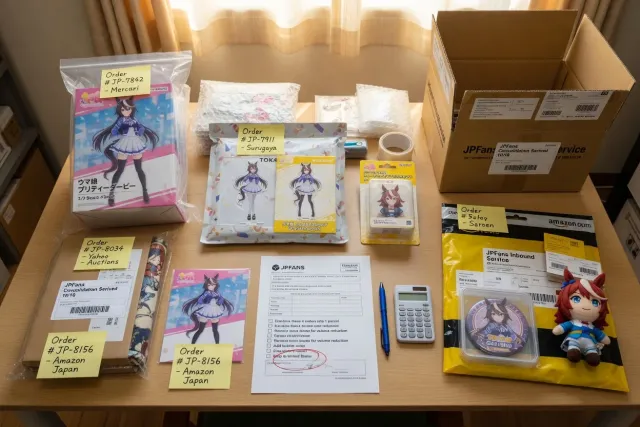
To consolidate multiple Umamusume purchases, place your orders through JPFinds, wait until the items arrive at the warehouse, then combine the eligible items into one international parcel. Consolidation can reduce repeated international postage and make a growing collection easier to manage. Plan your purchases around storage, package size, item protection, and the separate international shipping payment.
What consolidation means for Umamusume purchases
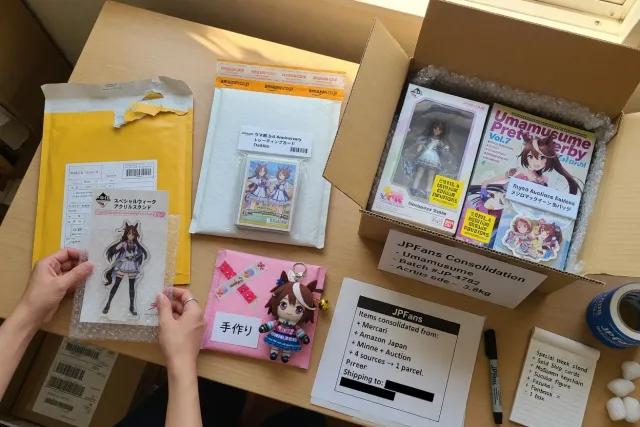
Consolidation is the process of putting items from separate Japanese orders into one outgoing parcel. Instead of sending every acrylic stand, plush, trading-card lot, keychain, magazine, or prize figure individually, you can collect several purchases at the JPFinds warehouse and dispatch them together.
This is especially useful for Umamusume: Pretty Derby merchandise from Japan, because collectibles are often spread across several listings and stores. You may find a desired character badge on Mercari, a set of event goods through JDirectItems Auction, a new release on Amazon Japan, and handmade fan accessories on Minne. Consolidation lets you shop across those sources while organizing the resulting purchases as one shipment.
The main advantage is that international shipping is assessed for the final parcel rather than separately for every small order. It may also reduce the number of delivery handoffs, tracking numbers, customs entries, and outer boxes you need to deal with. However, it is not automatically the lowest-cost choice in every situation. A very large combined box, a fragile figure, or an item restricted by a carrier can affect the available shipping methods and final cost.
Plan your Umamusume orders before you start buying
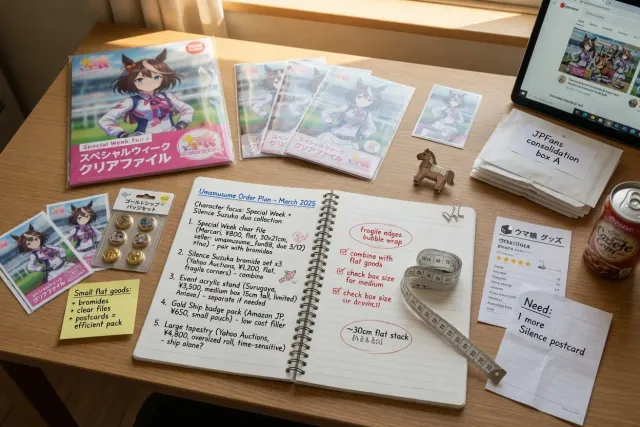
Good consolidation begins before the first order is placed. Decide what you are trying to build: a character-specific collection, a full set from an event, a group of low-cost trading goods, or a few larger display pieces. This makes it easier to choose which items should travel together and which may deserve separate handling.
Make a simple purchase list
Keep a list with the item name, source, price, approximate size, seller or store, and purchase date. Add a note for anything fragile, oversized, limited, or time-sensitive. For example:
- Small flat goods: bromides, clear files, stickers, postcards, and badges usually combine efficiently when packed with suitable protection.
- Medium collectibles: acrylic stands, towels, mugs, keychains, and boxed plush can be practical consolidation candidates, depending on quantity.
- Bulky items: large plush, framed goods, cushions, or multiple prize figures can increase parcel dimensions quickly.
- Fragile goods: figures, glassware, ceramics, and delicate display items may need extra space and protective materials.
When browsing the Umamusume: Pretty Derby hub, avoid treating every attractive listing as an isolated purchase. Consider whether it belongs to a shipment you are already building. A ·500 keychain can be a sensible addition to an existing parcel; sent alone, it may be inefficient compared with its item price.
Buy with an arrival window in mind
Orders from different marketplaces and sellers do not necessarily arrive at the warehouse at the same pace. Individual sellers may need time to ship, while stores and auctions have their own order processes. If you are collecting several items for a single parcel, start with the purchases that may take longer to reach the warehouse. Then add readily available items later.
Do not leave planning until the final days of the storage period shown in your JPFinds account. Allow room for marketplace-side delays, weekends, holidays, and separate seller dispatch schedules. Review the item status in your account before requesting consolidation so you know which purchases are actually ready to combine.
Choose items that work well in the same parcel
The best consolidation groups are not always the largest groups. Think about physical compatibility as well as total value. A parcel containing several similarly sized acrylic goods and textiles is usually easier to organize than one containing a large plush, a fragile scale figure, and a stack of flat paper goods.
Group by shape, durability, and collecting purpose
A useful method is to create shipment groups such as ·flat goods,· ·character display items,· or ·prize merchandise.· This can help keep heavy products away from bendable or delicate ones. If your collection includes an unopened figure (未開封) that you want to preserve for display or collecting, do not assume it should be packed tightly beside heavier items just to reduce empty space. Protecting the original retail box may be more important than minimizing the parcel volume.
Similarly, items described as being in excellent condition (美品) may still have packaging that is vulnerable to pressure. For paper products, file folders, and signed-style display goods, choose a consolidation plan that gives them an appropriate position within the parcel rather than placing them next to dense or irregularly shaped objects.
Separate orders when separation is more practical
Combining everything is not always the smart choice. Consider separate shipments when:
- A single item is unusually large and would force a much bigger outer carton.
- You want one high-priority item sent before the rest of your purchases are ready.
- Your items have very different packing needs, such as fragile figures and large soft goods.
- A carrier’s size, weight, or destination restrictions make one combined parcel less suitable.
- You prefer to divide a large collection into manageable customs declarations and receiving sessions.
The goal is not simply ·one box.· The goal is a sensible balance between parcel efficiency, safe packing, shipping options, and your own collection priorities.
How the JPFinds consolidation process fits the two-payment system
JPFinds uses a two-payment structure, which is helpful to understand when planning a multi-order shipment. The first payment is connected to purchasing the item or items from Japan and the applicable order-related costs shown during the purchase process. The second payment is for international shipping after the purchases are ready to be sent from the warehouse.
Because international postage depends on the completed parcel, it cannot always be known precisely while you are still buying individual listings. The final shipping amount is influenced by factors such as packed weight, parcel dimensions, destination, carrier selection, and any packing options available for the shipment.
A practical order of operations
- Place your individual orders. Buy the Umamusume items you want from the available Japanese marketplaces and stores.
- Monitor warehouse arrival. Wait until each intended item is marked as received and eligible for the next step in your JPFinds account.
- Select the items to combine. Choose only the purchases that belong in the same outgoing parcel.
- Request consolidation and select shipping. Review the available carrier options for your destination and parcel.
- Complete the second payment. Pay the international shipping charge shown for the finalized shipment.
- Track the dispatched parcel. Keep the tracking information and order records for your collection files.
Check the current itemized charges, storage information, and shipping choices displayed in your account before confirming. This is particularly important when you have purchases from several platforms, since domestic shipping and seller-side conditions can vary from order to order.
Manage parcel size, weight, and carrier choices
International carriers commonly consider both actual weight and parcel dimensions. A box filled with lightweight plush or bulky prize items may cost more to send than its scale weight suggests because it occupies substantial space. Conversely, a compact box of metal badges, books, or multiple figures can become heavy quickly.
Before adding ·just one more· item, ask whether it will fit naturally into the parcel. Small items can be efficient additions when they use unavoidable empty space, but they can be less efficient if they require a larger carton. This is why consolidation decisions should be reviewed as your purchases accumulate rather than made only at checkout.
Compare shipping options based on your priorities
JPFinds provides multiple carrier options for worldwide shipping, and the choices available can depend on the destination and parcel details. When comparing options, consider:
- Cost: compare the amount shown for each available method after consolidation.
- Tracking: choose a service level that matches the value and importance of the parcel.
- Parcel limits: check whether the method accepts the final size and weight.
- Destination rules: carrier availability and import requirements differ by country or region.
- Collection value: a parcel containing rare event goods may warrant a different choice from a box of common duplicates.
Avoid relying on estimates from a previous shipment. Two parcels with similar item counts can have very different costs because outer-box dimensions and item shapes matter. The shipping options displayed for your actual consolidated package are the relevant ones for your decision.
Pack a collector-friendly shipment
Consolidation gives you a chance to think beyond postage. For collectors, the condition of outer packaging, retail boxes, paper inserts, and display accessories can matter almost as much as the item itself. Provide clear instructions through the options and tools available in your JPFinds account when your items need particular attention.
For example, you may want to avoid having a boxed figure packed under dense books or multiple heavy prize items. You may also prefer flat goods to be supported so they are less exposed to bending pressure during transit. If you purchased a set that you intend to keep together, note that priority when arranging your consolidation request.
It is also wise to retain order screenshots, listing photos, and purchase records for higher-value items. This is useful for your own inventory, for remembering where a rare item came from, and for accurately documenting your collection. For official franchise context and current announcements, consult the official Umamusume: Pretty Derby website.
Common consolidation mistakes to avoid
- Requesting a shipment before all desired items arrive: confirm the warehouse status of every purchase on your list first.
- Combining incompatible items without a plan: large plush and delicate boxed collectibles can create packing challenges.
- Ignoring storage status: track each arrival and act within the storage terms shown in your account.
- Assuming a larger parcel is always cheaper: larger dimensions can change shipping costs and carrier choices.
- Forgetting import obligations: you are responsible for understanding applicable customs duties, taxes, and local import rules in your destination.
- Discarding purchase records: keep a list of item prices and descriptions for collection management and customs preparation.
With a little planning, consolidation turns a series of separate Umamusume purchases into a more organized international order. Start with a clear list, group items by packing needs, wait for the right warehouse statuses, and choose the final shipping option based on the actual parcel rather than assumptions.
Frequently asked questions about consolidating Umamusume purchases
Can I consolidate purchases from different Japanese marketplaces?
Yes. Once your eligible purchases have arrived at the JPFinds warehouse, you can select items from separate orders for consolidation. This is useful when your Umamusume goods come from different sources such as Mercari, JDirectItems Auction, Amazon Japan, Surugaya, or Minne.
Should I combine figures with acrylic stands and paper goods?
You can, but consider the packaging needs of each item. Figures may be heavy or have retail boxes worth preserving, while paper goods and acrylic items can be more vulnerable to pressure or bending. Grouping similar items is often easier, but the best decision depends on the sizes and quantities involved.
When do I pay international shipping for a consolidated order?
International shipping is part of the second payment, after the items are ready to ship and the relevant shipping choices are available. The amount depends on the completed parcel, destination, carrier, weight, dimensions, and selected options.
Is one large parcel always less expensive than several smaller parcels?
Not necessarily. Consolidation can reduce repeated shipping charges, but a large or bulky parcel may have different dimensional costs or carrier limitations. Compare the available options for the actual parcel before making your final choice.
What should I do if one Umamusume item arrives later than the others?
Monitor the status of the delayed order and the storage information for the items already received. You can wait and consolidate if that remains practical, or send the ready items separately if the late item would disrupt your plan.