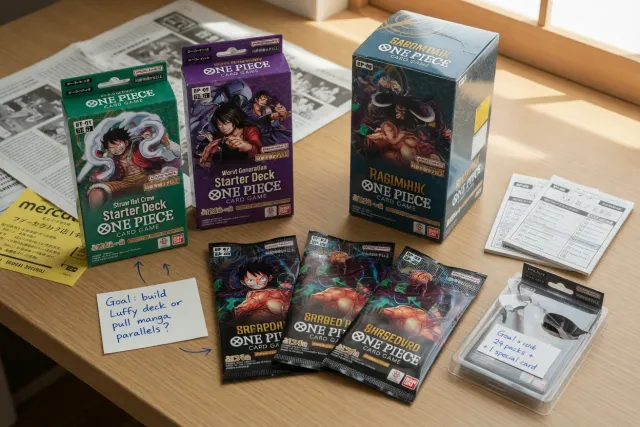
Choose One Piece TCG products by starting with your goal: build a ready-to-use deck, open packs for the fun of discovery, complete a favourite character collection, or target a specific card. Starter decks offer the clearest starting point, booster packs and boxes offer variety, and single cards offer precision. Check the product’s language, set code, contents and sealed condition before deciding.
Start with the kind of One Piece TCG experience you want
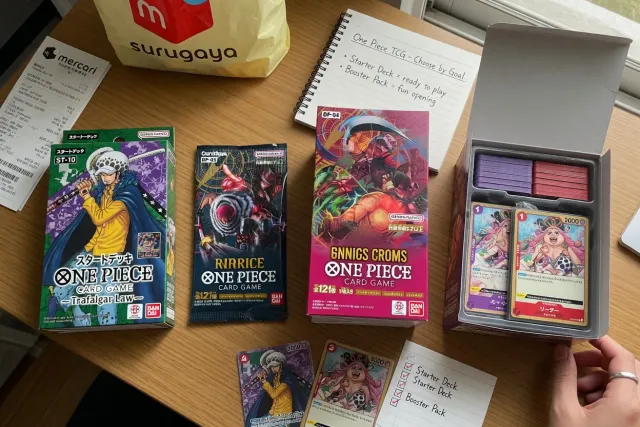
The One Piece Card Game has several product formats, and each solves a different problem. A collector who wants Trafalgar Law artwork, for example, does not necessarily need the same product as someone seeking a complete first deck. Choosing the format before looking at individual releases keeps a collection focused and avoids accumulating cards that do not suit your aim.
- Starter decks are preconstructed products built around a colour, Leader, theme or character group. They are the most straightforward option when you want a coordinated group of cards in one purchase.
- Booster packs contain a small random selection from one set. They suit collectors who enjoy opening cards and discovering different rarities.
- Booster boxes contain multiple packs from the same expansion. They provide a broader opening experience and a larger pool of cards from one release, but specific cards are still not guaranteed unless stated by the manufacturer.
- Single cards are individual cards selected by character, rarity, artwork, set or condition. They are generally the most direct format for completing a checklist or obtaining one wanted card.
- Special and premium products may include reprint-focused, themed, anniversary or presentation-oriented releases. Their content and purpose can differ significantly from standard expansion products.
A simple rule is useful: choose a starter deck for structure, packs for surprise, boxes for a deeper look at one set, and singles for a defined target. Many collectors combine formats, such as opening one box for the experience and then choosing singles to finish a character page.
Understand the main One Piece Card Game product formats
Single cards: the precise choice
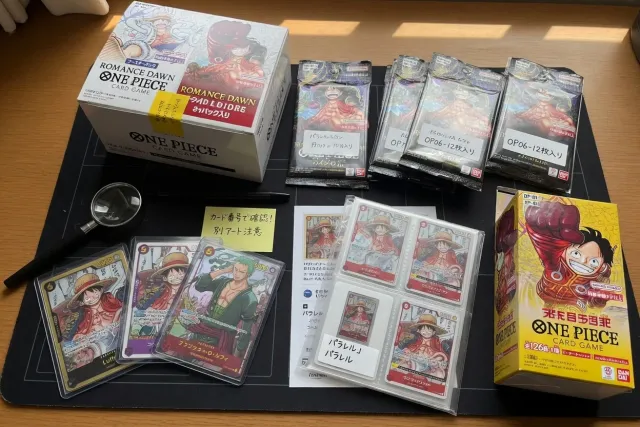
Singles make sense when you know exactly what you want. Search by card number, character, rarity or set identifier rather than relying on a card name alone. Multiple versions of the same character can exist across sets, including alternate-art cards, Leader cards, promotional cards and cards with different finishes. A listing photo should be compared with the card number and rarity marking whenever possible.
Singles are especially practical for collectors building a character-focused binder. Fans of the captain can browse Monkey D. Luffy One Piece collectibles alongside card searches to establish a consistent theme, while Zoro-focused collections can take inspiration from Roronoa Zoro items. The important point is to decide whether you are collecting every appearance of a character, only a particular art style, or only cards from selected sets.
Booster packs: the smallest sealed format
A booster pack is a compact way to sample an expansion. Packs are best viewed as an opening experience rather than a reliable route to one particular rare card. They can be appealing when you like a set’s characters, visual direction or theme but do not want the commitment of a full box.
Check that every pack belongs to the intended release. Similar packaging can represent different expansions, regions or product lines. Read the set code, product name and language shown in the listing rather than choosing by wrapper colour alone. For sealed collecting, Japanese terms such as 未開封 mean unopened, but the listing photos and seller description still matter because packaging can have shelf wear, dents or small tears.
Booster boxes: one expansion in depth
A booster box groups many packs from the same set. It is useful if you want to explore that expansion’s full character roster and artwork in more depth. It can also produce duplicates, which may be useful for a play-oriented card pool but less useful for a collector seeking only a handful of specific cards.
Do not assume every box has identical pulls or that a desired card will appear. Card-game product configurations can change by release, and official odds are not always presented as guarantees. Treat a box as sealed product from a particular set, not as a promised route to a specific rarity. When comparing listings, distinguish between a sealed box, a box with shrink wrap removed, and loose packs sold separately.
Starter decks: a cohesive entry point
Starter decks are designed around a ready-made card selection and are often the easiest way to understand a particular Leader, colour identity or crew theme. Typical deck products may include a fixed deck and game accessories, but exact contents differ by release. Always confirm the packaging details for the specific deck instead of assuming that every Starter Deck contains the same extras.
For collectors, starter decks are valuable because they can contain exclusive card treatments, distinctive Leader cards or first appearances connected to their theme. For someone beginning with physical cards, they also reduce the uncertainty of random packs: you know the core cards you are getting before opening the product.
Choose products by set, theme and card type
The product name is only the first layer. One Piece TCG releases are organised into product lines and sets, usually identified by codes such as OP, EB, PRB or ST. These codes help distinguish standard booster expansions, extra sets, premium-style releases, promotional cards and starter decks. A card’s code is one of the most useful details for avoiding confusion between similar versions.
Before selecting a product, make a short checklist:
- Set focus: Does the release feature an arc, era, crew or character group you genuinely enjoy?
- Card type: Are you looking for Leaders, Character cards, Events, Stages, DON!! cards or alternate-art variants?
- Artwork preference: Do you prefer manga-inspired art, anime scenes, original illustrations, foil finishes or clean standard versions?
- Collection scope: Will you collect one set completely, one character across many sets, or only a few display-worthy cards?
- Release relationship: Is the product a main expansion, a starter deck, a special release or a promotional item?
Set collecting is satisfying because it creates a clear finish line, but it can become extensive when parallel or alternate-art versions are included. Decide early whether your checklist includes only regular-numbered cards or every variation. Character collecting is more flexible, although it requires care because the same character may have numerous versions with similar names.
For a broad starting point, the One Piece collection at JPFinds can help you explore the franchise’s wider merchandise themes while narrowing down which characters and story arcs you want represented in your card collection.
Compare Japanese and other language editions carefully
One Piece Card Game products are released in different language editions, and language is a core collecting choice rather than a minor packaging detail. Japanese cards use Japanese text and Japanese product packaging, while other editions use their respective languages and can have different release timing, card formatting, product configurations or set relationships.
If you are collecting for artwork, language may be less important than card condition, set identity and visual appeal. If you want to read every effect or build a consistent deck, keeping the main cards in one language can make the collection easier to use and organise. Some collectors deliberately keep separate binders for Japanese and English editions because the layouts, print runs and release paths can differ.
Use the card code and product code as your anchor. A character name translated into English may not appear exactly the same way in a Japanese listing, but the alphanumeric code gives a clearer point of comparison. It is also helpful to confirm the official product name through the official One Piece Card Game website before choosing a release.
When looking at Japanese listings, common condition and status terms can help, but they should never replace reviewing the listing itself. 未開封 means unopened, 美品 generally means a card is described as being in good/beautiful condition, and 初版 means first edition or first printing in contexts where that distinction is applicable. Terminology is descriptive, not a universal condition standard; photos, visible corners, surface reflections and any notes about flaws remain important.
Match your budget to the right product, not to a chase card
It is easy to choose a product because it might contain a highly sought-after card. That approach often leads to disappointment, because premium pulls are inherently uncertain in randomised products. A more sustainable budget starts with what you will enjoy owning even if the rarest card does not appear.
For a modest budget, a starter deck or a few packs from a set you already like can provide a focused introduction. For a larger sealed-product budget, a box offers more variety from a single expansion. For a card-specific budget, compare the cost of opening products with the cost of selecting the desired single directly.
Separate your spending into three categories if you collect regularly:
- Core collection: cards or decks you definitely want to keep.
- Opening budget: money set aside for the experience of packs or boxes, with no assumed result.
- Display and storage: sleeves, binders, deck cases and boxes that help preserve cards after opening.
This approach prevents random openings from taking over a carefully planned collection. It also makes it easier to choose between a new release and an older set: buy the product whose theme, cards and presentation you will still value after the opening is over.
Check product details before adding One Piece TCG items to your cart
A careful product check matters most with sealed items, older releases and individual cards. Read the listing title, description and photos together. If one detail conflicts with another, use the photos and clearly stated product code as the basis for further comparison.
- Confirm whether the item is a single card, loose pack, sealed box, starter deck, bundle or empty display box.
- Verify the set code, card number and language edition.
- For a single card, inspect visible edge whitening, corner wear, scratches, dents, print lines and bending.
- For sealed products, look for the stated unopened status, wrapper condition and whether the box is factory sealed as described.
- Check whether bonuses, promotional cards or accessories shown in official images are specifically included in that listing.
- For multiple-item listings, confirm the quantity: one pack, one box, a complete deck, or several products can be described in similar ways.
Japanese marketplace listings can be particularly useful for finding releases and character items that are difficult to locate locally. With JPFinds, you can shop live listings from Japanese services, use automatic translation to review product information, and combine eligible purchases for international shipping. For card products, prioritise clear listing photos and exact identifiers over broad phrases such as ·rare· or ·limited.·
Build a simple first One Piece TCG product plan
A good first plan gives you direction without making the hobby feel restrictive. Choose one path below, then expand only after you know what you enjoy most.
The starter-deck path
Pick one starter deck featuring a Leader or theme you like. This path is ideal when you want a coherent first product and prefer known contents over random pulls. Add singles later if you discover favourite characters or alternate-art cards.
The set-explorer path
Choose one booster expansion based on its theme, then decide whether a few packs or a box better matches your opening budget. Keep a checklist of cards you like rather than trying to complete every rarity immediately. This makes the set feel manageable and helps identify which singles are worth targeting later.
The character-collector path
Pick one character and define the rules: all standard cards, only alternate art, only Japanese cards, or one favourite version from every major set. This path works particularly well for fans who want a visually consistent binder but do not need every card in an expansion.
Whichever path you choose, record the product name, set code, language, date acquired and condition in a simple list. That small habit makes duplicates easier to spot and turns a growing collection into a collection with a clear story.
Related guides: explore the wider One Piece selection for character-themed merchandise to complement a card collection.