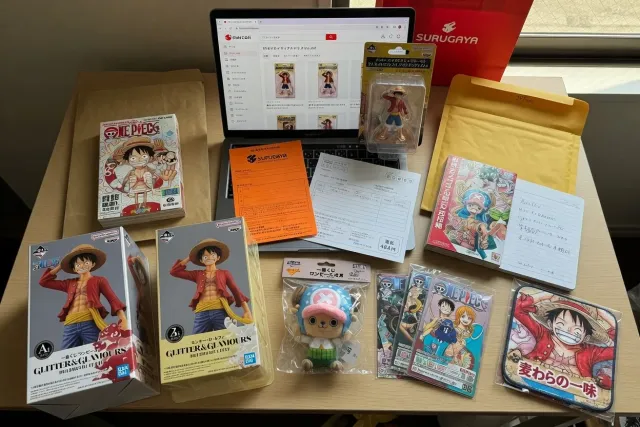
To buy One Piece collectibles from Japanese marketplaces, search Japanese listings for the exact character, series, manufacturer, and condition you want, then use JPFinds to purchase items from stores and person-to-person platforms in Japan. Japanese marketplaces are especially useful for prize figures, limited event goods, older releases, manga, plush, acrylic stands, and character merchandise that may be difficult to find internationally.
Why Japanese marketplaces are useful for One Piece collectors
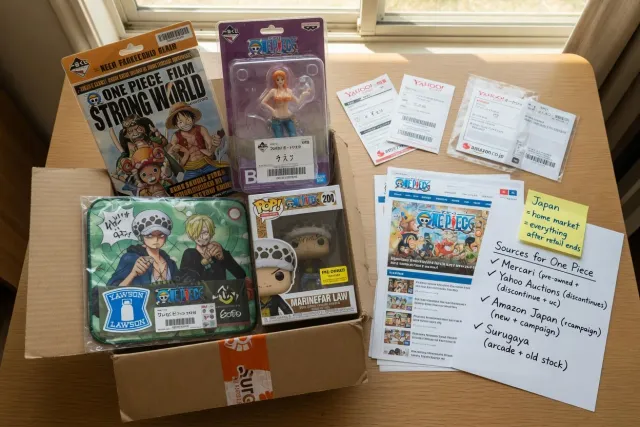
Japan is the home market for One Piece merchandise, so collectors can find a wider mix of official releases than is usually available through overseas retailers. This includes current products, discontinued items, store-exclusive bonuses, arcade prizes, magazine supplements, campaign merchandise, and pre-owned collectibles from past story arcs.
The official ONE PIECE website is a helpful reference for following the franchise and recognizing current projects, but Japanese marketplaces are where collectors often locate merchandise after its original retail period has ended.
Shopping across several Japanese sources matters because each platform tends to have different strengths:
- Mercari: Often useful for individual listings, bundles of character goods, opened figures, promotional items, and collector cleanouts.
- JDirectItems/Yahoo Auctions: A useful place to watch for older items, larger lots, discontinued releases, and merchandise that appears less frequently.
- Amazon Japan: Convenient for currently available books, new figures, official merchandise, and recent releases sold by Japanese retailers.
- Surugaya: Known for a broad selection of pre-owned hobby goods, including figures, anime merchandise, books, CDs, and character items.
- Minne: Best approached for fan-made or handmade accessories and display-related items. Read listings carefully and distinguish unofficial creations from licensed goods.
Because listings are live, availability can change quickly. Saving several search variations gives you a better chance of finding the item you want without relying on a single listing.
Choose the kind of One Piece collectible you want first
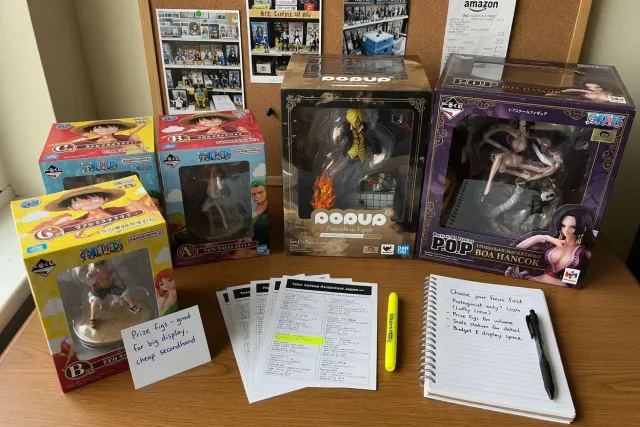
One Piece merchandise is vast. Defining your collecting focus before searching makes it much easier to compare listings and avoid buying items that do not fit your display, budget, or preferred era.
Figures and statues
Figures range from accessible arcade prizes to highly detailed scale figures and display statues. Prize figures are commonly released through Japanese crane-game channels and are widely available second-hand. They can be a practical way to build a large character display. Scale figures and premium lines typically have more elaborate sculpting, paintwork, bases, and packaging.
When searching for a protagonist, a character-specific collection can be more productive than a broad franchise search. For example, explore the Monkey D. Luffy collectibles selection for figures, apparel, keychains, and goods centered on Luffy. Searching by alternate outfits, transformations, or story arcs can reveal very different product lines.
Character goods for shelves, bags, and ita displays
Acrylic stands, clear files, badges, keychains, plush, towels, shikishi boards, bromides, and small mascot figures are common Japanese character goods. These items are often issued for collaborations, exhibitions, cafés, theatrical releases, pop-up shops, and anniversary campaigns. They are ideal for collectors who want variety without needing a large display cabinet.
Small goods also appear frequently in bundles. A listing may include several badges or acrylic stands from the same event, sometimes at a lower per-item cost than buying them separately. Check every visible item in the listing photographs, particularly when a seller uses a general title such as ·anime goods set.·
Manga, books, and printed collectibles
Japanese editions of manga volumes, art books, databooks, magazines, posters, and promotional booklets can be meaningful additions to a One Piece collection. For printed items, pay attention to edition details, included extras, and whether detachable supplements remain present. A listing marked 初版 indicates a first printing, while a standard later printing may be more suitable if you simply want a readable or displayable copy.
Search Japanese listings with better keywords
Auto-translation makes Japanese marketplaces easier to browse, but using a few Japanese search terms can uncover more listings. Start with the franchise name, then add the character, product type, manufacturer, or release line. Japanese sellers do not always use English character names, so search variations are valuable.
Useful starting terms include:
- ワンピース · One Piece
- フィギュア · figure
- 一番くじ · Ichiban Kuji lottery merchandise
- プライズ · prize item
- ぬいぐるみ · plush
- アクリルスタンド or アクスタ · acrylic stand
- 缶バッジ · pin badge
- クリアファイル · clear file
- ジャンプ · Jump-related merchandise or publications
Add a character name to narrow results. For example, collectors focused on the swordsman can browse the Roronoa Zoro collection and then refine searches with terms such as フィギュア, アクスタ, or 缶バッジ.
For specific releases, search the maker and line name as well as the character. Figure boxes, listing descriptions, and manufacturer labels often contain the exact terminology needed to locate comparable items. If the English translation looks unclear, inspect the Japanese title, photos, stated size, and included accessories before placing an order.
Read condition notes and listing photos carefully
Japanese pre-owned listings can be detailed, but condition labels are not identical across sellers and stores. Treat the description and photographs as the main source of information, especially for collectible items where packaging and included parts matter.
Common terms include:
- 未開封 · unopened. The outer box may still show storage wear, so inspect photos and notes.
- 開封済み · opened. This does not automatically mean damaged; it simply means the package has been opened.
- 美品 · generally a very good-condition item, though this remains a seller assessment rather than a universal standard.
- 箱なし · no box. This can be suitable for display collectors but may be less desirable if original packaging matters to you.
- 現状品 · sold in its current condition. Read closely because parts, packaging, or functionality may be uncertain.
- キズあり · scratches or marks present.
- 欠品 · missing item or missing accessory.
For figures, compare the image to the expected contents: base, support parts, effect pieces, alternate faces, weapons, instructions, and original box. For acrylic goods and badges, look for surface scratches, discoloration, bends, protective-film notes, or missing backing cards. For plush, check for stains, loose seams, fading, and whether tags are included if that is important to you.
Do not assume a sealed item is necessarily flawless or that an opened item is necessarily poor. A carefully displayed opened figure can be an excellent collecting choice, while an unopened box may have dents or aging from storage.
Recognize official merchandise and set realistic expectations
Japanese marketplaces carry both licensed products and unofficial items. Official merchandise usually identifies a manufacturer, publisher, or rights notice somewhere on the box, tag, backing card, or product label. Familiar brands and clear product photography are positive signs, but collectors should still read the full listing.
Be especially careful with listings that use vague phrases such as ·style,· ·inspired,· ·type,· or ·for display only· without showing labels. Extremely low pricing, stock photos only, incomplete descriptions, and inconsistent branding are also reasons to slow down and compare the item with known official releases.
Fan-made products can be enjoyable when you specifically want independent artwork or handmade accessories, but they should not be confused with official One Piece merchandise. This distinction is particularly important when searching handmade platforms or browsing custom display goods.
For a broad starting point, visit the One Piece hub on JPFinds to explore live Japanese listings across multiple categories. Then use product titles, visible labels, and Japanese terms to refine your search.
Plan an efficient order through JPFinds
JPFinds lets international shoppers buy from Japanese marketplaces without needing to arrange domestic payment or shipping themselves. Once you find an item, submit the order through JPFinds. The service purchases the item in Japan, receives eligible purchases at its warehouse, and lets you consolidate items before selecting an available international shipping method.
The two-payment structure is important to understand when planning a One Piece haul. The first payment generally covers the item cost and relevant Japan-side charges. The second payment is requested after the items are ready for international dispatch and covers international shipping and related final shipping charges. This is useful for collectors because the final parcel size and weight depend on what has actually arrived and how many items are combined.
Consolidation can be particularly useful for small character goods, manga volumes, and several compact figures. However, larger boxed figures, oversized plush, fragile display pieces, and long poster tubes can affect parcel dimensions. Before buying a large collection, consider whether you prefer one bigger shipment or several smaller shipments based on the carrier options available for your destination.
Keep a simple wishlist with the item name, maximum item price, condition requirements, approximate size, and whether packaging is essential. This prevents impulse purchases and makes it easier to decide which finds belong in the same shipment.
Build a focused One Piece collection over time
A strong collection does not need to include every release. Many of the most satisfying One Piece displays have a clear theme: a Straw Hat crew shelf, a favorite character in multiple costumes, a specific saga, an Ichiban Kuji set, manga and art books, or a color-coordinated acrylic stand display.
Consider organizing searches around one of these approaches:
- Character collection: Follow one character across figures, badges, plush, and collaboration goods.
- Arc collection: Focus on a favorite story arc and look for related visuals, costumes, and event merchandise.
- Figure-line collection: Collect a particular prize, lottery, or premium figure series for a consistent display style.
- Print collection: Combine manga, art books, magazine covers, posters, and limited paper goods.
- Compact collection: Build an acrylic stand, badge, or keychain display that uses minimal space.
Check saved searches regularly, since older items may appear unpredictably and individual sellers may list short-lived bundles. A patient, specific search strategy is usually more effective than trying to buy everything at once.
Related guide: if your focus is specifically on the main character, browse Monkey D. Luffy merchandise from Japan.