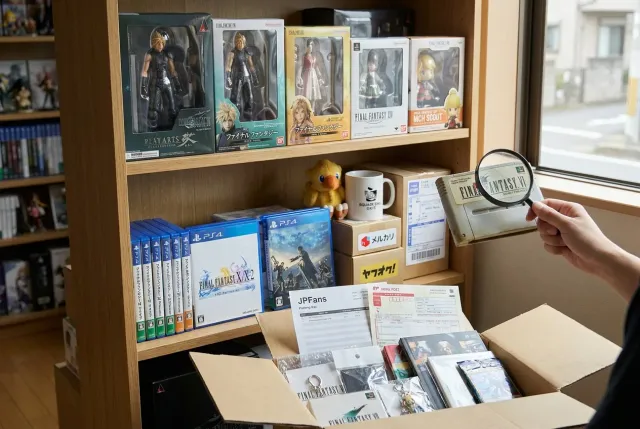
To buy Final Fantasy items from Japan, search Japanese marketplaces and retailers for the exact character, game, or product line you want, review photos and condition details carefully, then order through JPFinds. You can shop live listings from Mercari, JDirectItems/Yahoo Auctions, Amazon Japan, Surugaya, and Minne, combine eligible purchases into one shipment, and choose from available international carriers at checkout.
Choose the right kind of Final Fantasy item to buy
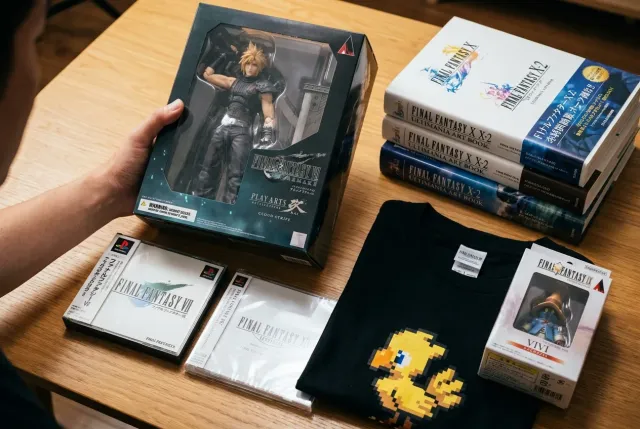
Final Fantasy has been a major Japanese game franchise for decades, so the range of available goods is unusually broad. Before searching, decide whether you are looking for a playable game, a display collectible, an art item, apparel, music, or a practical everyday accessory. This makes searches more focused and helps prevent impulse purchases of items that are expensive to ship or difficult to store.
Popular categories include:
- Game software: Japanese PlayStation, Nintendo, PSP, and other regional releases, including older editions and special packaging.
- Figures and statues: Square Enix Play Arts Kai figures, Bring Arts figures, Static Arts pieces, Trading Arts mini figures, prize figures, and character goods.
- Plush and mascots: Chocobo, Moogle, Cactuar, Tonberry, Fat Chocobo, and character plush in many sizes.
- Music: Original soundtrack CDs, vinyl records, piano collections, orchestral albums, concert merchandise, and promotional discs.
- Books and paper goods: Ultimania guidebooks, art books, manga adaptations, postcards, clear files, posters, and magazines.
- Event and collaboration merchandise: Caf· goods, lottery prizes, store bonuses, capsule toys, keychains, badges, acrylic stands, and limited campaign items.
For official franchise news and current releases, it is useful to compare a listing with information from the Square Enix homepage. This can help identify recent product lines, official naming, and characters involved in a collaboration.
If you are starting broadly rather than hunting one specific item, browse the dedicated Final Fantasy collection to see the types of Japanese listings that are currently available.
Where to find Final Fantasy merchandise in Japan
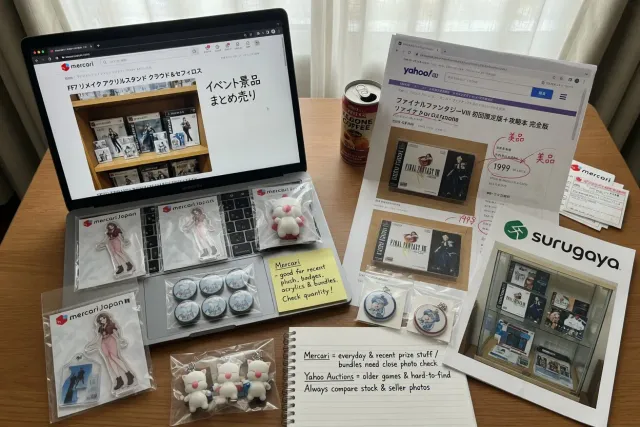
Different Japanese marketplaces are better suited to different types of Final Fantasy goods. Checking more than one source is worthwhile because stock, pricing, listing detail, and seller behavior vary considerably.
Mercari for everyday collectibles and recent merchandise
Mercari is especially useful for acrylic stands, badges, plush, trading figures, prize items, game software, and bundles from recent events. Sellers often list duplicate lottery prizes or collections they no longer display. A bundle can offer good value, but read the quantity and contents closely: a photo may show several designs while the listing is for only one selected item.
JDirectItems/Yahoo Auctions for older and harder-to-find pieces
Auctions can be useful for discontinued figures, vintage game merchandise, rare promotional goods, large collections, and out-of-print books. Watch the auction end time, current bid, shipping within Japan, and whether the seller has described damage. A low opening bid is not the final cost, particularly for sought-after items such as older Cloud, Sephiroth, Lightning, or Final Fantasy VII memorabilia.
Surugaya for used games, books, and character goods
Surugaya is a well-known Japanese retailer with a deep used inventory. It can be a practical place to look for game discs, art books, soundtracks, older trading goods, and character merchandise. Product descriptions may be brief, so pay close attention to stated condition and included accessories.
Amazon Japan and Minne for specific new or handmade goods
Amazon Japan can be helpful for in-print books, newly released official products, soundtrack reissues, and accessories. Minne may have fan-made or handmade items such as display stands, ita-bag accessories, doll clothing, and themed crafts. With handmade or unofficial items, confirm the scale, materials, dimensions, and whether the seller is offering a finished product or a made-to-order item.
JPFinds lets you search live listings across these sources, giving you a practical way to compare availability without limiting yourself to a single Japanese marketplace.
Search Japanese terms for better Final Fantasy results
English searches can find many listings, but Japanese keywords often reveal more stock, especially older merchandise and small event goods. Try the franchise title in Japanese: ファイナルファンタジー. It is commonly shortened to FF, although adding a game number, character name, or product type makes the results much more precise.
Useful product terms include:
- フィギュア · figure
- ぬいぐるみ · plush
- アクリルスタンド or アクスタ · acrylic stand
- 缶バッジ · pin badge
- キーホルダー · key holder/keychain
- クリアファイル · clear file
- ポスター · poster
- サウンドトラック · soundtrack
- 攻略本 · strategy guide
- 画集 · art book
Combine terms to narrow the search. For example, search ファイナルファンタジー 7 クラウド フィギュア for Final Fantasy VII Cloud figures, or FF14 アクリルスタンド for Final Fantasy XIV acrylic stands. Japanese character names are valuable too: クラウド (Cloud), セフィロス (Sephiroth), ティファ (Tifa), エアリス (Aerith), チョコボ (Chocobo), モーグリ (Moogle), and サボテンダー (Cactuar).
For limited-edition or release-specific items, add terms such as 限定 (limited), 特典 (bonus), 非売品 (not for sale), 一番くじ (Ichiban Kuji lottery), or カフェ (caf·). These are particularly useful for event goods and purchase bonuses that may never have had a standard retail release.
Check condition, completeness, and authenticity before ordering
Japanese sellers frequently provide straightforward condition notes, but the meaning of a listing depends on the item category. Read the description, review every available image, and do not assume that a pictured accessory, box, code, or bonus is included unless the listing says so.
Common condition terms include:
- 未開封 · unopened. This usually refers to sealed packaging, though outer packaging can still show shelf wear.
- 美品 · beautiful item/good condition. This is subjective, so photos remain important.
- 中古 · used/pre-owned.
- 初版 · first edition, most relevant for books, manga, and some printed releases.
- 箱なし · no box.
- 欠品 · missing item or part.
- 傷あり · has scratches or damage.
- 動作確認済み · operation tested, useful for electronics and game hardware.
For figures, check for the original base, alternate hands, weapons, face plates, display supports, and packaging. Missing parts can affect display options even if the main figure looks excellent. For plush, examine photos for fading, stains, flattened stuffing, detached tags, or odor notes. For books and paper goods, look for sun fading, bent corners, writing, water damage, and whether an obi strip, slipcase, poster, or insert is included.
Be especially careful with high-value statues, signed items, and unusually cheap listings. Compare sculpt details, logos, product codes, packaging, and seller photos against known official releases. A listing described as ジャンク means junk/as-is and should be treated as potentially damaged, incomplete, or non-functional. It may suit a customizer, but it is rarely the right choice for a collector seeking a complete display piece.
Understand Japanese game editions and compatibility
Japanese Final Fantasy games can be excellent collectibles, but a Japanese edition is not automatically ideal for playing outside Japan. Compatibility depends on the platform, the console region, language options, downloadable content, and whether the product is physical software or a code.
Modern PlayStation and Nintendo Switch physical games are often region-free at the hardware level, but language support differs by release. A Japanese package does not guarantee English text or voices. Check the listing and official product details for supported languages rather than relying on the cover art. Older systems can be more restrictive: many Japanese PlayStation, PlayStation 2, Sega, Nintendo, and handheld releases require compatible Japanese hardware or other region-specific setup.
Avoid assuming that digital benefits will work internationally. Download codes, preorder bonuses, service codes, and in-game item codes may be expired, already redeemed, tied to a Japanese account, or limited by region. Buy them for the physical collectible value unless the listing clearly establishes that they are active and usable for your intended account.
For collectors, Japanese editions can still be highly appealing because they may have different cover art, manuals, inserts, bonus packaging, or launch materials. A complete Japanese release with its original case and inserts can be a distinctive addition even if you plan to play another regional version.
Plan for shipping size, fragility, and consolidation
Shipping is a major part of buying Final Fantasy items from Japan because merchandise ranges from lightweight badges to large boxed statues. Think about the eventual parcel before placing multiple orders.
Small goods such as acrylic stands, pins, cards, keychains, and flat paper items are often efficient to combine. They can make a good companion purchase when you are already ordering a larger item. However, posters, framed art, oversized plush, and large figure boxes may increase parcel dimensions substantially. A figure may be light but still costly to ship because of the box size.
Consolidation can be helpful when you have purchased several items from different Japanese shops or sellers. Combining eligible purchases may reduce the number of international parcels and make it easier to manage a themed collection in one shipment. At the same time, avoid adding fragile or bulky items solely to fill a box; the best approach depends on dimensions, weight, and how well each item can travel alongside the others.
JPFinds uses a two-payment system: the first payment covers the item purchase and applicable domestic costs, while the second payment is made when international shipping is arranged. Available carrier choices and shipping charges depend on the parcel’s final destination, size, and weight.
Build a smarter Final Fantasy buying list
Collectors often get better results by keeping a simple want list rather than searching only when they see a random listing. Divide your list into priorities: must-have items, items worth buying below a chosen budget, and low-priority finds. Include the Japanese search terms, preferred condition, maximum price, and whether original packaging matters.
For example, a focused Final Fantasy VII collector might prioritize a specific Play Arts Kai release in complete condition, then add inexpensive Shinra-themed clear files or caf· badges as secondary purchases. A soundtrack collector may seek first-press CDs with booklets and obi strips, while accepting ordinary jewel-case wear. The criteria should match how you intend to enjoy the item.
Use price comparisons rather than treating the first listing as the only opportunity. Common prize figures and recent character goods regularly reappear. In contrast, discontinued store bonuses, older concert merchandise, and complete vintage boxed items can be genuinely scarce. Save exact Japanese searches, check listings over time, and act quickly when a well-documented item matches your requirements.
Ready to search by character, series, or collectible type? Explore Final Fantasy items from Japan and compare live listings before placing your order.
Related guides: Learn more about Japan shopping and international ordering in the JPFinds Final Fantasy hub.