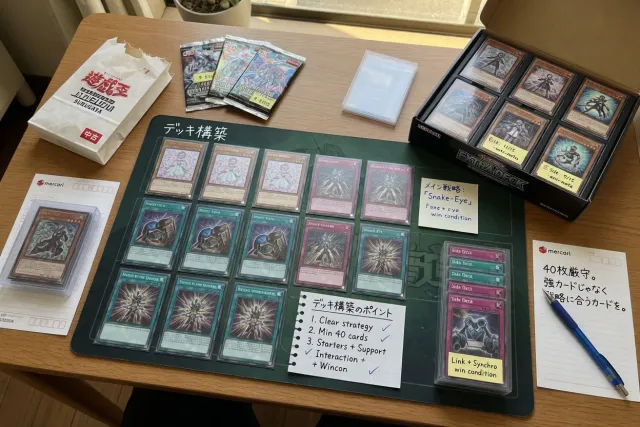
To build a Yu-Gi-Oh deck, start with one clear strategy, use the minimum legal number of cards whenever possible, and choose cards that consistently help that strategy. A legal Main Deck has 40 to 60 cards, while the Extra Deck and Side Deck can each hold up to 15 cards. Focus on reliable starters, useful support, interaction, and a realistic win condition rather than simply adding powerful-looking cards.
Start with a deck strategy and win condition
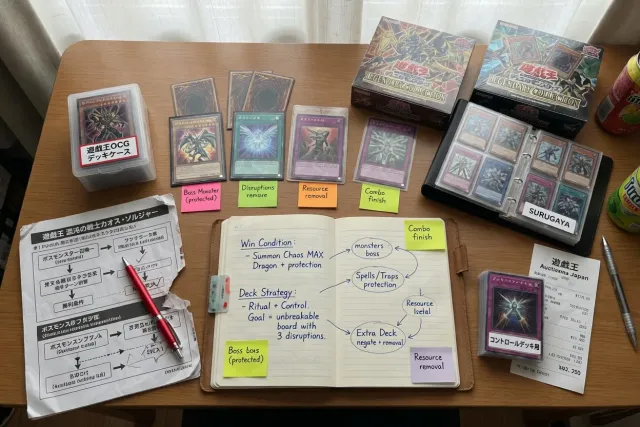
The first decision is not which individual card is strongest; it is what your deck is trying to do. A good Yu-Gi-Oh deck is a coordinated system. Its monsters, Spells, Traps, and Extra Deck cards should work toward the same end result.
Your win condition is the position you want to create that makes winning likely. Depending on the deck, that could mean:
- Summoning a powerful boss monster protected by other cards.
- Building a board with multiple disruptions for the opponent's turn.
- Breaking the opponent's field and dealing enough battle damage to end the duel.
- Using a control strategy that gradually removes resources and limits options.
- Completing a specific combo or alternate victory condition.
Write your plan in one sentence before choosing cards. For example: ·This deck uses Level 4 monsters to make Rank 4 Xyz Monsters, then protects them with traps and recurring effects.· This gives you a standard for every later inclusion. If a card does not start your plan, extend it, protect it, or stop the opponent from interrupting it, it may not deserve a slot.
Archetype-based decks are often the simplest place to begin because their cards are designed to connect. Cards that share an archetype name commonly search one another, Special Summon one another, or provide effects when used as Fusion, Synchro, Xyz, Link, or Ritual material. You can explore card art and Japanese releases through the Yu-Gi-Oh! collection hub while identifying an archetype that suits your preferred style.
Know the legal Yu-Gi-Oh deck sizes
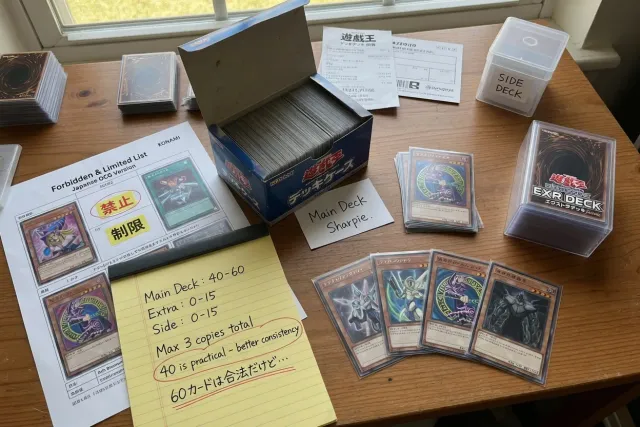
Understanding deck limits is essential before considering card ratios. Under the standard Advanced Format structure, a deck may include a Main Deck, Extra Deck, and Side Deck.
- Main Deck: 40 to 60 cards.
- Extra Deck: 0 to 15 cards.
- Side Deck: 0 to 15 cards.
- Copies of a card: normally up to three copies across your Main, Extra, and Side Deck combined, unless the current Forbidden & Limited List says otherwise.
So, how many cards are in a Yu-Gi-Oh deck? The practical answer for most constructed decks is 40 cards in the Main Deck. Although 60 cards is legal, every additional card lowers the chance of opening your best starter or seeing an important one-card combo piece early. A 60-card build should have a specific reason: perhaps the strategy gains value from a larger card pool, has many interchangeable starters, or needs extra space for several engine packages.
Check the current Forbidden & Limited List and tournament policy before entering an event. Card legality can change, and regional formats may have their own details. The official Yu-Gi-Oh! Card Game website is the best starting point for official format information and announcements.
Build the Main Deck with purposeful card ratios
A successful 40-card deck is not necessarily split evenly between Monsters, Spells, and Traps. The right ratio depends on your strategy. Combo decks may play many monsters and relatively few traps; control decks may rely on fewer engine monsters and more reactive cards. What matters is whether the cards in your opening hand can produce a useful play.
Identify starters, extenders, and payoff cards
Sort every candidate card by job. This exposes hands that look full but do not actually function.
- Starters: cards that begin your main line of play by themselves. A Normal Summon that searches an archetype card, or a Spell that summons a monster from the deck, is often a starter.
- Extenders: cards that continue a play after a starter resolves. They may Special Summon themselves, revive material, or place another body on the field.
- Payoffs: cards that turn your setup into meaningful advantage, a boss monster, removal, or a winning attack.
- Searchers and consistency cards: cards that find a starter or access a needed part of the engine.
- Interaction: cards that negate, destroy, banish, return, or otherwise interrupt the opponent.
- Defensive cards: cards that help you survive, recover, or play through the opponent’s established field.
In many decks, you want a high density of opening cards that lead somewhere. If your deck has 12 cards that each start your core play, you will see one far more often than if it has only six. You do not need to calculate every probability to improve a list, but you should recognize the basic principle: more reliable starters and fewer situational cards usually produce better hands.
Choose one, two, or three copies logically
Three copies are usually correct for cards you want to open often and that remain useful in multiples. Core starters, highly flexible search cards, and essential field spells often belong here. Two copies can fit cards that are important but somewhat awkward to draw twice, or searchable cards you still want to access naturally. One copy is often reserved for searchable targets, cards with hard once-per-turn effects, situational power cards, or Extra Deck-related requirements.
A common beginner mistake is using one copy of every appealing card. This produces variety, but not consistency. If the deck needs a particular monster to begin functioning, play enough copies of that monster or enough cards that reliably find it.
A practical 40-card starting framework
There is no universal recipe, but this framework can help you draft a first version:
- 10·15 starters and cards that access starters.
- 6·10 extenders or engine cards that keep plays going.
- 5·9 interaction or defensive cards, adjusted for your deck’s pace.
- 4·8 utility, draw, recovery, or board-breaking cards.
- The remaining slots for required combo pieces, archetype support, and flexible choices.
These numbers overlap because one card may be both an extender and interaction. Treat them as a diagnostic tool, not a rulebook. If your opening hands regularly contain only high-Level monsters, reactive traps with no engine, or cards that require setup you cannot make, your ratios need work.
Choose Spells and Traps that support the plan
Spells and Traps should solve specific deck-building problems. The best ones either make your deck more consistent, let you answer difficult boards, protect your established position, or disrupt the opponent at the right time.
Normal Spells are often used for searching, drawing, removal, or combo extension. Quick-Play Spells can be especially valuable because they may be activated during either player’s turn when set first, offering flexibility as protection or disruption. Continuous Spells and Field Spells can be central engine pieces, but avoid playing too many cards that do nothing until another card is already in place.
Traps can be excellent in slower decks, particularly when they trade efficiently with an opponent’s card or generate follow-up value. However, they must usually be set before activation, so a trap-heavy list may be less effective at immediately breaking an established board. Consider whether your deck wants to go first, go second, or can adapt to either choice.
Do not add a Spell or Trap merely because it is generically powerful. Ask four questions:
- Can I activate it in the situations I expect to face?
- Does it conflict with my own monsters, attributes, Types, or summoning plan?
- Is it useful going first, going second, or both?
- Would another copy of a starter improve my deck more?
A focused deck often wins more games with a modest but coherent support package than with a pile of unrelated staples.
Build an Extra Deck that your Main Deck can summon
The Extra Deck is not a collection of 15 famous monsters. It is a toolbox that must match the levels, Types, Attributes, and summoning materials your Main Deck can actually produce. Before adding an Extra Deck monster, confirm exactly how you will summon it.
Fusion decks need access to the correct materials and Fusion effects. Synchro decks need Tuners and non-Tuners whose Levels create useful totals. Xyz decks need monsters of the same Level, unless their specific effect says otherwise. Link Monsters need the required number and type of materials, and their Link Arrows can matter when planning later summons. Pendulum strategies may also use face-up Pendulum Monsters in the Extra Deck as a resource.
Start by listing the most common monster combinations your Main Deck produces. If you routinely make two Level 4 monsters, Rank 4 Xyz Monsters are natural options. If you frequently control a Level 3 Tuner and Level 4 non-Tuner, Level 7 Synchro options are relevant. If your engine places multiple effect monsters on the field, Links with appropriate material requirements may be your best bridge into stronger monsters.
A balanced Extra Deck often includes:
- Your main engine bosses or combo pieces.
- One or more cards that extend your standard line.
- Removal options for different threats.
- Cards that help recover after an interrupted turn.
- Flexible choices for unusual boards or game states.
Fill the most frequently summoned slots first. A powerful monster that requires an unrealistic combination is less valuable than an accessible Extra Deck card you can make every game.
Use a Side Deck to adapt without weakening the Main Deck
A Side Deck is used between games in a match, allowing you to exchange cards from it with cards in your Main Deck or Extra Deck. It should not be a random storage area for cards you could not fit. Each Side Deck choice should target a matchup problem that your regular list cannot address efficiently.
For example, you might side cards for back-row-heavy opponents, graveyard-focused strategies, large established boards, or matchups where you expect to go first or second. The key is planning what comes out as well as what comes in. If you side in six cards but do not know which six Main Deck cards are weakest in that matchup, your deck can become unfocused after siding.
Keep notes after testing. If a card is only useful in a narrow matchup but dramatically changes that matchup, it may be an ideal Side Deck card. If it is broadly useful but you never want to draw it in your opening hand, it may be better as a one- or two-copy side option than a Main Deck staple.
Test hands, revise the list, and keep the deck consistent
Deck building does not end when you reach 40 cards. Your first list is a hypothesis that needs testing. Start by drawing sample opening hands and asking whether each hand can make a meaningful play with no ideal assumptions. Do this repeatedly, both when imagining that you go first and when imagining that you go second.
During testing, record patterns rather than reacting to one unlucky hand. Useful questions include:
- How often do I open a starter?
- How often do I open several cards that cannot be used together?
- Which cards are consistently stranded in my hand?
- Can I continue after my first effect is stopped?
- Do I have enough interaction to survive if I cannot complete my main combo?
- Which Extra Deck cards are actually summoned?
Make small changes, then test again. Replacing three cards at once is easier to evaluate than rebuilding half the deck after every duel. Cards that repeatedly underperform should be cut even if they look impressive on paper. Conversely, if you always wish you had drawn a certain starter, extender, or answer card, increase its count where legal.
It also helps to build with your likely environment in mind. A relaxed local group, online simulator, and competitive tournament can reward different levels of speed, interaction, and matchup preparation. The core principle remains unchanged: a strong Yu-Gi-Oh deck performs its own plan reliably while leaving room to respond to the opponent.
Once you have a working list, use the Yu-Gi-Oh! hub to discover Japanese printings, deck themes, and artwork that can complement your deck-building project. For a related topic, see our guide to Yu-Gi-Oh! cards and releases.