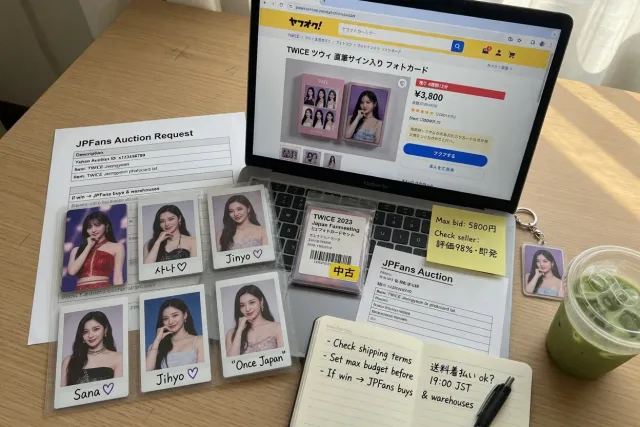
To bid on TWICE items on Yahoo Auctions Japan, find a live auction through JPFinds, check the Japanese listing details and seller terms, set a maximum budget, and place your bid before the auction closes. If you win, JPFinds handles the Japan-side purchase process, then you can consolidate eligible purchases and choose an international shipping method after the item reaches the warehouse.
Understand how Yahoo Auctions Japan bidding works for TWICE collectibles
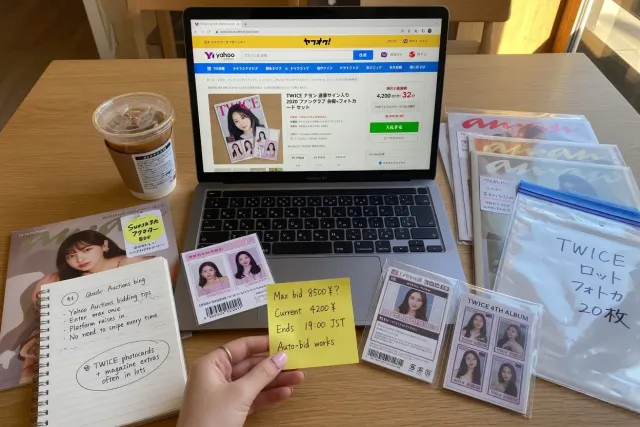
Yahoo Auctions Japan is one of the most useful places to search for Japanese TWICE merchandise because it combines individual sellers, collectors clearing out collections, specialist hobby sellers, and stores selling older stock. You may find current album benefits alongside out-of-print Japanese releases, venue merchandise, fan-club items, trading cards, magazine extras, and large lots of photocards.
Unlike a fixed-price listing, an auction listing has a scheduled end time. Bidders enter an amount they are willing to pay, and the current displayed price rises according to the platform's bidding rules. You do not usually need to manually increase your offer every time another buyer bids: entering your true maximum allows the auction system to bid for you up to that limit.
For example, imagine a Sana Japanese album photocard is currently listed at ·1,200. You decide the most you are comfortable paying for the card itself is ·4,000. If you enter ·4,000, the listing may remain below that amount unless another bidder competes with you. If another buyer's maximum is ·2,500, you may become the highest bidder at the next required increment rather than immediately paying the full ·4,000.
Before bidding, note that some Yahoo Auctions listings use an automatic extension near the end of the auction. When enabled, late bids can move the closing time later. This means a last-second strategy is not always effective, especially for popular members such as Nayeon, Sana, Momo, Mina, or Jihyo. The official Yahoo! Auctions Japan homepage is useful for recognizing the marketplace and its auction format, while JPFinds lets overseas shoppers access listings without needing to buy directly in Japanese.
Search strategically for the right TWICE item
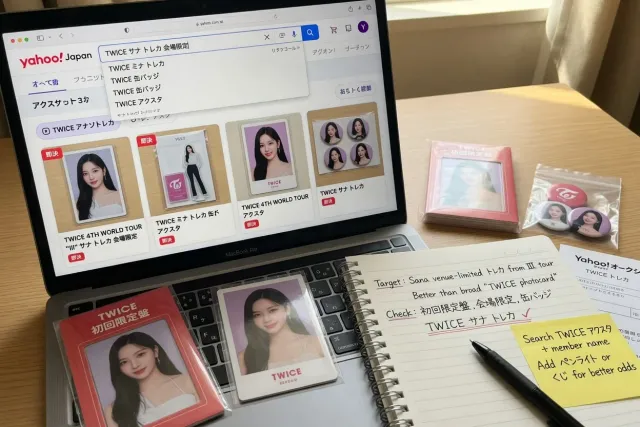
Start with a clear target. ·TWICE photocard· is broad and can return hundreds of results, while a specific search is far more likely to surface the exact version you want. Include the member name, release name, store benefit, event, or Japanese keyword where possible.
Useful search terms for TWICE auctions
- TWICE トレカ · TWICE trading card or photocard.
- TWICE サナ トレカ · Sana photocard.
- TWICE ミナ · Mina items.
- TWICE 缶バッジ · can badges or pin badges.
- TWICE アクスタ · acrylic stands.
- TWICE ペンライト · official-style light sticks and related goods.
- TWICE くじ · lottery-prize merchandise.
- TWICE 会場限定 · venue-limited items.
- TWICE 初回限定盤 · limited first-edition album releases.
Japanese sellers often list official names, release codes, and campaign names rather than English descriptions. If you are looking for a particular album benefit, search the album title in Japanese and add 特典 (bonus), 店舗特典 (store benefit), or the relevant retailer name. For older pieces, add terms such as 廃盤 (out of print) or レア (rare), but remember that ·rare· is a seller description rather than proof of scarcity.
You can browse a wider selection of TWICE items from Japan through the JPFinds TWICE hub, then narrow your search based on the member, era, and merchandise category you collect. Saving a few search variations is helpful because sellers may use different wording for the same item.
Read every listing detail before you place a bid
A low opening price is not enough reason to bid. Read the title, description, condition notes, quantity, photos, and shipping-related information carefully. Auto-translation makes Japanese text more accessible, but collectors should still examine photographs closely because photos often reveal more than a short condition label.
Condition words worth recognizing
- 未開封 · unopened. This is common for sealed albums, random-goods packs, and boxed merchandise.
- 美品 · generally ·beautiful item· or very good condition. It is subjective, so inspect photos for scratches, bends, fading, or discoloration.
- 初版 · first edition or first printing. This matters more for books, magazines, and certain printed releases than for most photocards.
- 中古 · used or pre-owned.
- 傷あり · damaged, scratched, or with flaws.
- 折れ · bent or creased.
- 欠品 · missing parts or accessories.
- 現状品 · sold as-is; assess this wording carefully.
For photocards, zoom in on corners, edges, surface reflections, and the back of the card. Small factory marks can be normal, but obvious dents, deep scratches, bends, stains, or trimmed edges should affect your maximum bid. For albums and DVDs, confirm whether the listing includes the disc, booklet, obi strip, inclusions, original box, or random member benefits. For light sticks and electronics, check whether the listing says it has been tested and whether batteries or accessories are included.
Also confirm whether the auction is for one item or a set. A title containing まとめ, セット, or 大量 may indicate a bundle. A bundle can be excellent value if you want several pieces, but it may include duplicates, mixed member items, or condition variations. Do not assume every pictured item is included if the description says the photo is for reference.
Set a realistic maximum bid before the auction gets competitive
Your maximum bid should be based on the full landed cost, not only the number displayed on the auction page. Consider the bid amount, Japan-side fees where applicable, domestic shipping from the seller to the warehouse, and your later international shipping payment. If you plan to combine several purchases, consolidation can make the overseas shipping stage more efficient than shipping each small item separately.
A practical approach is to create three numbers:
- Ideal price: what you would be happy to pay for the item itself.
- Competitive price: the amount you can justify if the condition and rarity are excellent.
- Hard limit: the maximum you will not exceed, even if another bidder is close behind.
For instance, a common album photocard may have a low ideal price but a strict hard limit because similar copies appear regularly. A discontinued Japanese fan-club benefit with strong condition photos may justify a higher competitive price. The key is to decide before the final minutes, when auction pressure can make an ordinary item feel irreplaceable.
Compare completed-looking listings when possible, but do not treat one unusually high auction result as the universal market value. Prices can rise because of a popular member, a particularly clean copy, timing around a comeback or tour, a seller's strong photos, or two determined bidders. If you lose, save the search and wait for another listing rather than immediately chasing the next auction at any cost.
Place your bid through JPFinds with the right timing
Once you have checked the listing and chosen your hard limit, enter that maximum through JPFinds. JPFinds displays live marketplace listings with auto-translation, helping you review Japanese auction details while using an overseas-friendly shopping workflow.
It is usually better to bid the amount you genuinely authorize rather than repeatedly placing small increases. Proxy-style maximum bidding is designed to keep you in the lead only as needed, up to your cap. Entering an artificially low first bid can leave you unprepared if the auction ends while you are away.
Choose between early bidding and late bidding
Early bidding can be useful when you want to establish a clear maximum and avoid forgetting an auction. It is also sensible for inexpensive items you are happy to win at your chosen limit. However, an early bid can attract attention to a listing that other collectors had not noticed.
Late bidding can reduce the time competitors have to react, but it has risks. Auctions may have automatic extensions, your target may end at an inconvenient time zone, and waiting too long can cause you to miss the closing window entirely. For highly sought-after TWICE goods, the safest approach is often to set a rational maximum well before closing rather than relying on a last-second bid.
Do not bid unless you are prepared to complete the purchase if you win. A winning bid is a commitment, not a placeholder. Review your account balance and the JPFinds payment prompts in advance so that a successful bid does not create avoidable delays.
What happens after you win a TWICE Yahoo Auctions Japan listing
After you win, the transaction moves from bidding to purchase processing. JPFinds manages the purchase from the Japanese seller on your behalf. The service uses a two-payment structure: the first payment covers the purchase-stage costs, while the second payment is requested later for international shipping after your items are ready to send from the warehouse.
This separation is useful for collectors building an order over time. You may win a photocard auction today, purchase an album from another marketplace later, and then consolidate eligible items into one international parcel when you are ready. Your final shipping cost depends on factors such as parcel size, weight, destination, chosen carrier option, and the contents being shipped.
Keep your purchase records organized, especially for multi-item collecting. Label orders by member, album era, or collection goal. This helps you avoid accidentally buying duplicate cards and makes it easier to decide which purchases should ship together. If you are expanding a collection, revisit the TWICE shopping hub for auction listings and fixed-price opportunities across supported Japanese stores.
Avoid common bidding mistakes with TWICE merchandise
The most common problem is bidding from the title alone. Japanese auction titles are short, and sellers may put important information — such as ·card only,· ·damaged,· ·no outer box,· or ·one item selected at random··in the description. Always verify exactly what is being sold.
- Do not confuse a stock image with the actual item. Look for wording such as reference photo or sample image.
- Do not overlook quantity. A listing may be for one card from a displayed group, not every member shown.
- Do not assume unofficial goods are official. Check logos, packaging, printing quality, release details, and seller photos.
- Do not ignore domestic shipping costs. A cheap auction can become less attractive once Japan-side shipping is included.
- Do not bid beyond your total budget. Include later international shipping in your planning.
- Do not chase a loss emotionally. Set alerts and wait for comparable listings when your limit is reached.
Yahoo Auctions Japan can be especially rewarding for collectors who research before bidding. The strongest bids are not necessarily the highest ones — they are the bids placed on the correct item, in the correct condition, at a price that still makes sense after all purchase and shipping costs are considered.