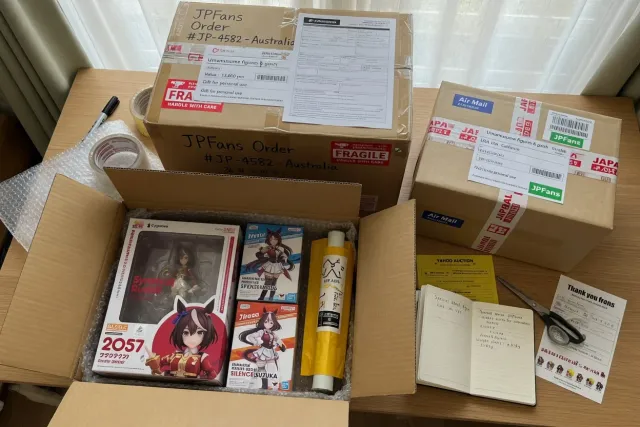
International shipping for Umamusume orders generally happens after your Japan-based purchases arrive, are combined into a shipment when applicable, and have an available carrier selected for your destination. With JPFinds, you pay for the item first, then pay the international shipping charge after your order is prepared for dispatch. The final cost depends on package size, weight, destination, carrier, and customs requirements.
1. Start with the item payment for your Umamusume order
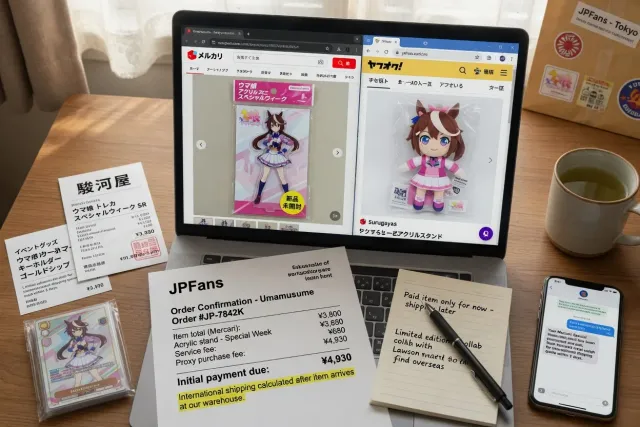
The first stage is purchasing the Umamusume merchandise itself. JPFinds provides access to live Japan listings from marketplaces and stores such as Mercari, JDirectItems/Yahoo Auctions, Amazon Japan, Surugaya, and Minne. This can be useful for fans looking for items that may have had limited Japanese distribution, including acrylic stands, plushes, trading cards, figures, keychains, event goods, apparel, CDs, books, and race-themed collaboration items.
When you place an order, the initial payment covers the item-related amount shown for that purchase, along with applicable service charges. At this point, international postage is not finalized because the eventual shipping price cannot be calculated accurately until the items are available to be packed for export.
That distinction is important for collectors. A single flat item such as a clear file has very different shipping characteristics from a large figure box, a framed art print, or several plush toys. Even when two orders have similar item prices, their overseas shipping charges can differ substantially because carriers calculate rates using physical or volumetric size as well as weight.
To begin browsing, visit the Umamusume: Pretty Derby collection on JPFinds, where you can search across Japanese sources and use auto-translation to understand listing titles and descriptions.
2. Why Umamusume orders use a two-payment system
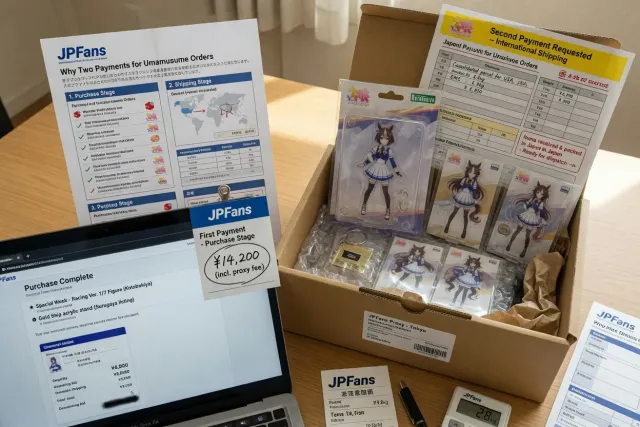
International shipping is handled through a two-payment structure because the exact shipment details only become clear after the purchased items are in Japan and ready to be sent abroad.
First payment: the purchase stage
The first payment is made when you order the item. It allows JPFinds to process the purchase from the Japanese seller or store. For auction-style listings, the total can also depend on the final winning amount and the listing's terms.
Second payment: the international shipping stage
The second payment is requested when your item or consolidated group of items is ready for international dispatch. This shipping payment reflects the actual parcel prepared for your destination. It may include the international carrier charge and any applicable export-handling charges associated with sending the parcel.
This approach is more practical than estimating postage at checkout. Before packaging, it may be unclear whether a seller uses protective outer boxes, how much packing material is needed, whether several purchases will be shipped together, or which carrier services are available for the receiving country.
For example, a fan may order a small acrylic stand, a set of character badges, and a boxed scale figure. Paying for each item first makes it possible to wait until all three are ready, then create one international shipment. The final postage is based on the resulting parcel rather than three separate overseas packages.
3. Consolidation can make a major difference to shipping
Consolidation means placing multiple eligible orders into one international shipment. It is especially useful for Umamusume collectors who find merchandise across several Japanese sources, such as a prize plush from Mercari, a soundtrack from Amazon Japan, and a character item from Surugaya.
Sending purchases together can reduce repeated carrier base charges and simplify customs processing because there is one parcel to receive. It also gives you one tracking flow instead of several. However, consolidation does not always mean the final package will be inexpensive. A combined box can become large, and a carrier may price it according to dimensional weight rather than the number of items inside.
When consolidation is usually helpful
- Small or flat merchandise: badges, cards, keychains, stickers, clear files, acrylic goods, and compact stationery often combine efficiently.
- Several medium-size items: combining books, CDs, towels, or smaller plushes may be more manageable than shipping each item separately.
- Orders from different sellers: consolidation can be convenient when building a themed collection over time.
When package size needs extra attention
- Large boxed figures: original retail packaging can take up significant space even when the item itself is not very heavy.
- Plush toys and cushions: these may be lightweight but bulky, which matters under dimensional-weight rules.
- Posters, display boards, and long items: their shape can limit carrier choices or require special packing arrangements.
A useful habit is to think in terms of the eventual box, not only the item. A collection of ten low-cost prize items may still create a substantial parcel if each has a large retail box. Conversely, several flat character goods may add relatively little to the shipment dimensions.
4. Choose an available carrier for your destination
Once your Umamusume shipment is ready, you can select from the carrier options available through JPFinds for your country or region. Availability can vary by destination, parcel dimensions, parcel weight, local import rules, and current carrier service conditions. A shipping method offered to one country may not be available for another.
Carrier choices normally involve a trade-off among price, tracking, handling features, destination coverage, and service level. Some methods are better suited to smaller parcels, while others can be more practical for larger boxes. The appropriate option depends on the contents and your receiving address, not simply the item category.
When comparing options, consider these practical points:
- Tracking: Check whether the service includes end-to-end tracking or tracking that changes after handoff to a local postal operator.
- Parcel limits: Review size and weight limits before combining bulky merchandise.
- Address requirements: Some services may require a street address and may not accept all address formats.
- Signature or handoff process: Local delivery procedures can differ by carrier and country.
- Customs handling: The receiving country's postal or courier process may affect how import charges are collected.
For general information about international postal services from Japan, consult the official Japan Post homepage. Carrier policies, accepted destinations, and local delivery practices can change, so the options displayed when your shipment is being prepared are the most relevant ones for your order.
5. Understand weight, dimensions, and packing before you ship
International shipping charges are usually influenced by either actual weight or dimensional weight, depending on the service. Actual weight is straightforward: it is what the packed parcel weighs. Dimensional weight reflects the amount of space a package occupies during transport. Carriers use a formula based on length, width, and height, then may charge according to whichever figure is higher.
This is why some Umamusume merchandise can cost more to send than expected. A lightweight plush, a large character cushion, or a figure in an oversized collector box can occupy considerable space in an aircraft or transport network. In contrast, a dense stack of books may weigh more while using less space.
Examples of likely shipping profiles
- Trading cards and paper goods: usually compact, but should be packed carefully to prevent bends or edge damage.
- Acrylic stands and keychains: generally small and easy to combine, although multiple retail boxes add volume.
- Figures: often require a larger carton because the retail box and protective packing need room around them.
- Plushes: may have low actual weight but high dimensional weight.
- Books and media: can be compact but become heavy quickly when ordered in quantity.
If managing postage is a priority, group items with compatible shapes where possible. A parcel made entirely of flat goods is often easier to size than one that mixes rigid boxed items with large soft goods. You can explore the range of possible merchandise on the Umamusume: Pretty Derby hub before deciding which items to collect in the same shipment.
6. Customs declarations, import taxes, and restricted items
International shipping does not end when a parcel leaves Japan. Your country or region may assess import VAT, GST, sales tax, customs duty, brokerage-related charges, or other fees when the shipment arrives. These charges are set by the destination authorities or their designated delivery process, not by the Japanese marketplace listing price alone.
Whether charges apply can depend on the declared value, merchandise category, shipping cost, local low-value thresholds, trade rules, and the recipient's country. A parcel containing collectible goods may be treated differently from personal correspondence, and thresholds can change over time. Before placing a larger Umamusume order, check your country's official customs guidance for current rules.
Accurate recipient information matters. Use your full name, complete delivery address, postal code, telephone number where requested, and any tax or importer identification details required by your destination. An incomplete address can lead to delivery complications, while missing import information can delay customs processing.
Also note that not every product is suitable for every shipping route. Items containing batteries, aerosols, liquids, food products, or other regulated materials can face carrier or country restrictions. Most standard Umamusume collectibles such as books, acrylic goods, cards, and many figures are comparatively straightforward merchandise categories, but the exact item and destination rules still control eligibility.
7. Tracking your shipment and receiving it safely
After international dispatch, use the tracking details associated with your selected shipping method to follow the parcel's progress. Tracking events can include acceptance by the carrier, export handling, transit updates, arrival in the destination country, customs processing, and handoff for local delivery. The wording and frequency of updates vary between postal and courier networks.
It is normal for tracking to be more active at certain handoff points than others. International shipments may move between different carriers or postal systems, and the final-mile provider can use a different tracking format. If customs payment or recipient action is required, watch for notices from the local carrier, postal authority, or customs office.
Before the parcel arrives, make sure someone can receive it if the selected service requires a signature or secure handoff. Keep the tracking number and shipping confirmation available until the order has been delivered. If a package is held for customs formalities, respond through the official local process and provide only the information requested by the relevant authority or carrier.
For collectors receiving display items, retain the outer shipping carton until you have confirmed that all ordered pieces are present. This can be useful for organizing your collection and for documenting the shipment if you need to refer to the carrier's delivery record.
Plan your Umamusume shipment around the collection you want
The simplest way to manage international shipping is to plan the shipment as part of your collecting strategy. Decide whether you are building a small package of compact goods, waiting to combine several orders, or sending a larger centerpiece item separately. Then compare the available carrier options after your items are ready and use the second payment to finalize dispatch.
JPFinds makes this process easier by connecting overseas fans with Japanese Umamusume listings, translating listing information, supporting consolidated shipping, and offering multiple carrier options for worldwide destinations. The key is to allow for the real shipping factors: final packed size, final weight, destination rules, carrier availability, and any import costs charged in your country.
For related collecting options, browse Umamusume merchandise from Japan through JPFinds.