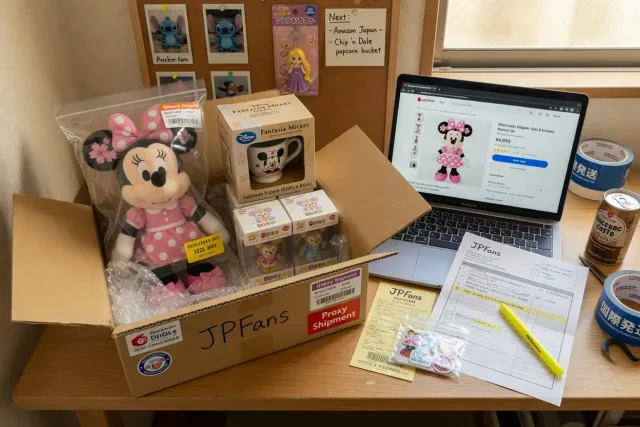
Disney proxy shopping lets overseas fans purchase Disney merchandise listed in Japan without needing a Japanese address, local payment method, or Japanese-language shopping experience. A proxy service places the order on your behalf, receives purchases in Japan, can combine eligible orders into one parcel, and sends the completed shipment internationally after the second payment.
What Disney proxy shopping means
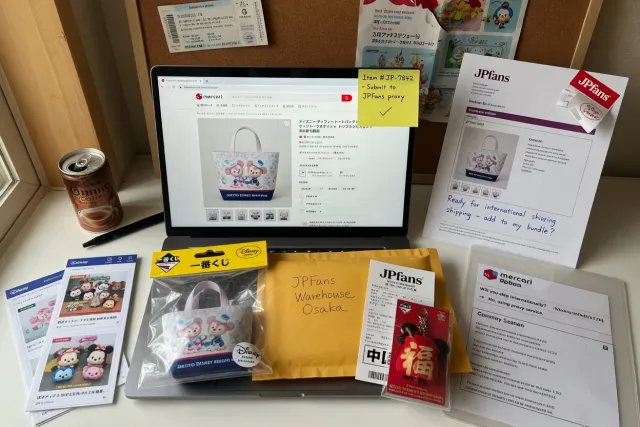
A shopping proxy is an intermediary that helps customers outside Japan access items sold on Japanese marketplaces and stores. For Disney fans, this is especially useful because Japan regularly has region-specific merchandise, seasonal collections, character collaborations, prize goods, and second-hand collectibles that may not be sold internationally.
Rather than asking a seller to ship overseas directly, you select an item from a Japanese listing and submit the order through the proxy. The proxy handles the domestic purchase process in Japan. Once the item has arrived at its warehouse, you can arrange international shipping to your country.
On JPFinds, shoppers can search live listings from sources such as Mercari, JDirectItems/Yahoo Auctions, Amazon Japan, Surugaya, and Minne. Automatic translation helps make Japanese listing titles and descriptions easier to understand, while the original listing details remain important for evaluating the item.
Start by browsing the Disney shopping collection to see the types of Japan-based listings that may be available. Inventory on marketplace platforms can change quickly, particularly for limited releases and popular character goods.
Why fans use a proxy for Disney items from Japan
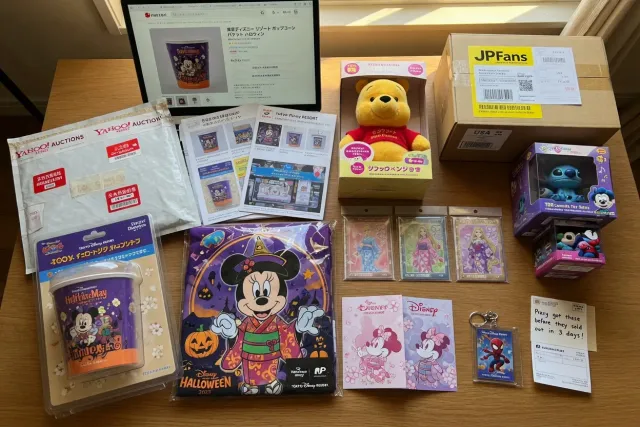
Japan has a large Disney collector market. Some products are made for Japanese retail channels, Tokyo Disney Resort visitors, Japanese department-store promotions, capsule-toy lines, arcade prizes, or local collaborations. Older products also appear regularly on resale platforms after they have sold out at retail.
Common Disney purchases from Japan
- Tokyo Disney Resort merchandise: park souvenirs, seasonal designs, popcorn bucket collectibles, plush, home goods, stationery, and apparel.
- Character goods: items featuring Mickey and Minnie, Disney Princesses, Stitch, Winnie the Pooh, Pixar characters, Marvel, and Star Wars designs released for the Japanese market.
- Seasonal releases: Halloween, Christmas, spring, cherry blossom, anniversary, and themed-event merchandise.
- Plush and figures: new releases, crane-game prizes, display figures, and discontinued collectibles.
- Vintage and pre-owned items: older pins, keychains, bags, kitchenware, promotional goods, and collections no longer available in stores.
- Independent creations: Disney-inspired storage, display, or fan accessories may appear on handmade platforms, though buyers should read descriptions carefully and respect intellectual-property rules.
A proxy expands your options, but it does not turn every Japanese Disney product into an easy international purchase. Availability, seller willingness, product restrictions, size, material, and destination-country import rules can all affect whether an order is practical.
How the Disney proxy buying process works
The exact screens and available options vary by service and marketplace, but the underlying process follows a clear sequence.
1. Search Japanese listings
Use English searches first, then try character names, product lines, and Japanese terms when needed. Automatic translation is helpful, but Japanese listings may use abbreviations or collector shorthand. Searching by a product code, release name, or a distinctive phrase printed on the packaging can be more precise than searching a broad term such as ·Disney.·
For example, a shopper looking for a Duffy seasonal plush may search the character name plus the event name, while someone seeking a retired pin may search the year, park, and ·pin.· Search results may include both current retail goods and individual resale listings.
2. Review the listing before ordering
Read the translated title and description, check photographs, and note the seller’s stated condition. Marketplace photographs matter because they show the actual item offered, while stock photos may not reveal wear, missing parts, or packaging damage.
Useful Japanese condition terms include:
- 未開封 (mikaifu): unopened.
- 美品 (bihin): described as a beautiful or very good-condition item; this is subjective, so review photos.
- 中古 (chuko): used or pre-owned.
- 傷あり (kizu ari): has scratches, scuffs, or damage.
- 箱なし (hako nashi): without the box.
- 初版 (shohan): first edition, most relevant to books and certain printed collectibles.
Also check whether the listing includes accessories, tags, original packaging, a stand, or a specific quantity. A photo containing several items does not always mean every pictured item is included. If a listing is unclear, treat uncertainty as part of the buying decision rather than assuming the best-case interpretation.
3. Submit the proxy order
After selecting the listing, you submit an order request through the proxy platform. The service then attempts to purchase the item from the Japanese seller or retailer. This is important: adding an item to a proxy cart is not always the same as securing it. Marketplace items can sell to another buyer, auctions can end above your budget, and retailers can run out of stock before an order is completed.
For auction listings, set a maximum amount you are genuinely comfortable paying. Consider the item price, domestic charges, proxy-related fees where applicable, and eventual international shipping — not only the current bid.
4. The item arrives at the Japan warehouse
After a successful domestic purchase, the seller or retailer sends the item to the proxy’s warehouse in Japan. Different sellers dispatch at different speeds, and an order containing several purchases will not be ready for a single combined shipment until the selected items have arrived.
5. Choose shipping and complete dispatch
When your purchases are ready, you choose an available international shipping method based on destination, parcel size, weight, cost, tracking preferences, and any carrier restrictions. If you have multiple compatible purchases, consolidation can reduce the need to pay for separate international parcels.
Understanding the two-payment system
Disney proxy shopping commonly uses two payments because the final international shipping cost cannot be known until the order reaches the warehouse and a parcel can be prepared.
- First payment: generally covers the item purchase amount and applicable Japan-side costs connected with obtaining the order, such as domestic shipping when charged by the seller or retailer.
- Second payment: is requested once the items are ready to ship internationally and reflects the selected shipping method, parcel characteristics, and any applicable handling-related charges.
This structure is useful for collectors because a small acrylic stand and a large plush do not create the same shipping cost. Likewise, combining several flat items may be more efficient than mailing them individually, while a large boxed figure or oversized park souvenir may require a larger parcel than expected.
Before placing orders, set a total budget rather than focusing only on the listing price. Include a buffer for Japan-side costs, international shipping, destination-country taxes or import charges, and exchange-rate movement if relevant. A low-priced item can become less economical when it is bulky, fragile, or costly to ship.
How to choose Disney listings with confidence
The best Disney proxy purchase is not necessarily the cheapest listing. It is the one whose identity, condition, completeness, and total cost are clear enough for your collecting goals.
Match the condition to your purpose
If you want a plush for display, minor packaging wear may not matter. If you collect sealed pins, limited-edition packaging, or giftable merchandise, listing condition becomes more important. Pay close attention to phrases that indicate fading, stains, odors, peeling, missing tags, damaged boxes, or parts that have been separated from the original set.
For collectibles, compare several listings before buying. This gives you a better sense of normal price ranges and helps identify whether an item is complete. A listing described as ·rare· is not automatically scarce, and a high asking price is not proof of authenticity or value.
Use photos as evidence
Look for close images of character faces, embroidery, printed logos, tags, backs of pins, serial markings where relevant, and any stated defects. Be cautious with listings using only promotional images, heavily edited photos, or vague descriptions. If an item is a collaboration product, compare its branding and design with information from official Disney channels such as Disney’s official website when possible.
Consider size before buying
Japanese Disney merchandise can be deceptively large. Plush, park popcorn buckets, storage containers, framed art, and boxed sets may cost significantly more to ship than pins, stationery, badges, or flat paper goods. Check dimensions in the listing and remember that protective packing and the outer carton affect the shipment size too.
Consolidating Disney purchases for international shipping
Consolidation means combining multiple eligible purchases that have arrived at the warehouse into one international shipment. It can be a practical option for fans who are collecting several small Disney items from different sellers, such as keychains, pins, postcards, mini figures, or stationery.
Consolidation is not automatically the best choice in every situation. Combining items can increase the parcel’s total weight or size, and some goods may need extra care because of their shape or materials. A large plush alongside compact collectibles, for example, may create a parcel that is governed more by dimensions than by weight.
Plan purchases around a shipping goal. You might collect several small items over a short period and send them together, or ship a high-value or time-sensitive collectible on its own. Review the available carrier options when you are ready to dispatch, because services and restrictions can differ by destination.
For current listings across Japanese sources, return to the Disney category on JPFinds and build a shortlist before ordering. Comparing condition, dimensions, and seller descriptions side by side usually leads to better decisions than buying the first result.
Important restrictions and import considerations
Proxy shopping does not override seller policies, carrier rules, or customs laws. Some Disney goods may be difficult or unavailable to ship internationally due to their contents, dimensions, or destination restrictions. Products containing batteries, liquids, aerosols, food, fragrances, or certain materials can face carrier limitations. Large or unusually shaped items may have limited shipping choices.
Buyers are also responsible for understanding their destination’s customs requirements. Depending on your country and the declared shipment value, import tax, VAT, duty, brokerage fees, or customs documentation may apply. These charges are separate from the marketplace listing price and can be collected by authorities or carriers according to local rules.
For branded merchandise, shop thoughtfully. Favor listings with detailed photographs and clear seller descriptions, especially when buying sought-after or high-priced collectibles. If a listing’s price, description, or images raise doubts, it is often safer to keep searching than to rely on assumptions.
Tips for a smoother Disney proxy shopping experience
- Create a priority list: Separate must-have items from nice-to-have finds so you can act quickly on scarce listings without overspending.
- Search broadly, then narrow: Use character, event, year, product type, and Japanese keywords to find more relevant results.
- Read every condition note: Especially for used plush, pins, bags, paper goods, and boxed collectibles.
- Keep packaging expectations realistic: Older retail boxes and paper tags can show age even when the item itself looks good.
- Budget for the complete journey: Account for purchase price, Japan-side costs, international shipping, and possible import charges.
- Group compatible items: Several small purchases may make more sense together than as separate shipments.
- Choose the shipping service deliberately: Compare available options when your parcel is ready rather than assuming one carrier suits every order.
Disney proxy shopping is most rewarding when you treat each listing as an individual purchase decision. By checking condition, size, completeness, and total landed cost before ordering, you can access Japanese Disney merchandise with a much clearer plan.
Can I buy Tokyo Disney Resort merchandise through a proxy?
Some Tokyo Disney Resort merchandise may appear on Japanese marketplaces through individual sellers. Availability varies, and a proxy can purchase eligible listings from supported sources when the seller and item can be ordered.
Why do I need to pay twice for a Disney proxy order?
The first payment covers the purchase stage in Japan. The second payment is made after items are ready for international dispatch, when shipping can be calculated based on the completed parcel and your chosen carrier option.
Can I combine Disney items from different Japanese sellers?
Eligible purchases that arrive at the warehouse can generally be consolidated into one international shipment. Whether consolidation is cost-effective depends on the final parcel’s weight, dimensions, and shipping method.
How can I tell whether a used Disney item is in good condition?
Read the condition description, study all photographs, and look for notes about stains, fading, scratches, missing tags, missing accessories, or box damage. Terms such as 未開封 and 美品 can be useful signals, but photos and full descriptions remain essential.
Are Japanese Disney listings always authentic?
No marketplace listing should be assumed authentic solely because it is listed in Japan. Review seller information, images, branding details, pricing, and the description carefully, particularly for high-demand collectibles.