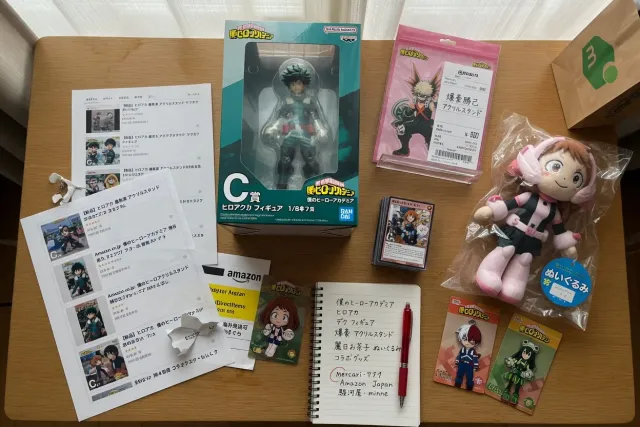
To find My Hero Academia items on Japanese marketplaces, search with the Japanese title 僕のヒーローアカデミア, common shorthand such as ヒロアカ, and the Japanese names of individual characters. Combine those terms with the item type you want — figure, acrylic stand, plush, manga, card, or collaboration goods — then compare live listings across Mercari, JDirectItems/Yahoo Auctions, Amazon Japan, Surugaya, and Minne.
Start with the Japanese names fans and sellers use
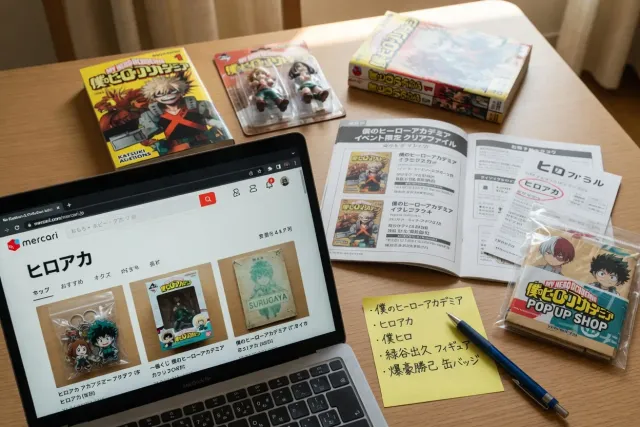
The single biggest advantage when searching for My Hero Academia merchandise in Japan is using Japanese keywords. English searches can return some results, especially for internationally marketed figures, but many individual sellers list only in Japanese. Searching in Japanese opens up more secondhand character goods, event merchandise, prize figures, store bonuses, and older releases.
The full Japanese title is 僕のヒーローアカデミア (Boku no Hero Academia). The much more common shorthand is ヒロアカ. Use both: the full title may bring up formal listings and manga-related products, while ヒロアカ is widely used for casual listings and bundles.
Core My Hero Academia search terms
- 僕のヒーローアカデミア · the full franchise title.
- ヒロアカ · the standard short form used by fans and sellers.
- 僕のヒーローアカデミア グッズ · My Hero Academia goods/merchandise.
- ヒロアカ まとめ売り · a bundle or lot of My Hero Academia items.
- ヒロアカ セット · a set; useful for multiple related items.
- ヒロアカ 限定 · limited edition or exclusive merchandise.
- ヒロアカ コラボ · collaboration merchandise.
For the broadest view of current options, begin at the My Hero Academia collection page. It is a useful starting point before narrowing your search to a character, product line, or event.
Search by character name, including Japanese spellings
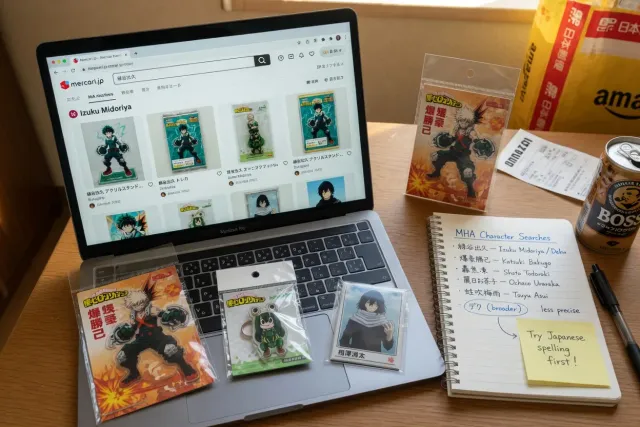
Character searches are often more efficient than franchise-wide searches. A seller may title an item with only a character name and product type, especially when listing an acrylic stand, trading card, keychain, or single figure. Search the Japanese spelling rather than relying solely on romanized names.
Popular character keywords to try
- 緑谷出久 · Izuku Midoriya / Deku
- 爆豪勝己 · Katsuki Bakugo
- 轟焦凍 · Shoto Todoroki
- 麗日お茶子 · Ochaco Uraraka
- 飯田天哉 · Tenya Iida
- 蛙吹梅雨 · Tsuyu Asui
- 切島鋭児郎 · Eijiro Kirishima
- 相澤消太 · Shota Aizawa / Eraser Head
- オールマイト · All Might
- 荼毘 · Dabi
- 死柄木弔 · Tomura Shigaraki
- ホークス · Hawks
Some names create broader results. For example, デク is a useful Deku keyword, but it can be less precise than 緑谷出久. For Todoroki, searching both 轟焦凍 and 轟 may help, but the shorter surname can also bring unrelated listings. Start specific, then broaden only if results are limited.
Try combining a character and the franchise shorthand: 爆豪勝己 ヒロアカ. Add an item term when you know what you want, such as 轟焦凍 フィギュア or 緑谷出久 アクリルスタンド.
Use Japanese item-type keywords to find the right merchandise
My Hero Academia has a very large merchandise catalog, ranging from mass-market prize figures to short-run event items. The Japanese word for the product type is usually the key to filtering out irrelevant results. If you are collecting a particular format, put that format directly after the franchise or character keyword.
Figures and display collectibles
- フィギュア · figure; the essential general term.
- スケールフィギュア · scale figure, typically a higher-detail collector release.
- プライズフィギュア · prize figure, originally distributed through crane games.
- 一番くじ · Ichiban Kuji lottery prize merchandise.
- ラストワン賞 · Last One Prize, the final-draw prize in an Ichiban Kuji campaign.
- ねんどろいど · Nendoroid.
- POP UP PARADE · the product line name, best searched exactly as written.
For figures, include the maker or line when possible. A search such as ヒロアカ 一番くじ フィギュア can surface lottery prizes, while 爆豪勝己 ねんどろいど is more focused. Box art, release names, and prize tiers vary, so check listing photos and text rather than assuming similarly named releases are identical.
Smaller character goods and everyday collectibles
- アクリルスタンド or アクスタ · acrylic stand.
- 缶バッジ · can badge or pin button.
- クリアファイル · clear file.
- キーホルダー · keyholder/keychain.
- ぬいぐるみ · plush.
- マスコット · mascot plush or small character charm.
- タオル · towel.
- ポストカード · postcard.
- ブロマイド · character print or photo-style collectible.
- 色紙 · shikishi card or illustration board.
Acrylic stands and can badges are especially common on Japanese secondhand marketplaces because fans often purchase blind-pack items, keep favorites, and list duplicates. Search ヒロアカ アクスタ or add a character name for a much more manageable result set.
Look for Japanese exclusives, events, and collaboration merchandise
Some of the most interesting My Hero Academia items are tied to Japanese retail campaigns, pop-up shops, exhibitions, cafés, theaters, convenience stores, or seasonal collaborations. These products may have artwork that was never used for standard international releases. They can also be listed without the word ·exclusive,· so campaign and retailer keywords are valuable.
Useful terms include 原画展 (original art exhibition), 展覧会 (exhibition), ポップアップ (pop-up), ジャンプショップ (Jump Shop), アニメイト (Animate), and 特典 (bonus or purchase benefit). A listing marked 特典 may be a store-exclusive postcard, illustration card, clear card, or other bonus rather than the main product, so read the description carefully.
My Hero Academia also appears in character-themed collaborations. Search ヒロアカ コラボ, then add a retailer, seasonal phrase, or character name if known. If you are trying to identify official art or campaign branding, compare it with announcements on the official My Hero Academia website. Official promotional images are particularly helpful when distinguishing a collaboration design from fan-made art.
For handmade fan creations, Minne can be relevant, but use precise search terms and examine materials, dimensions, and the creator’s description. Officially licensed merchandise and handmade fan goods are different categories; do not assume a character-inspired item is an official release.
Read Japanese listing condition terms before choosing an item
Finding an attractive listing is only the first step. Japanese marketplace descriptions often communicate condition concisely, and small wording differences matter for collectible goods. Machine translation is useful, but recognizing a few common terms helps you quickly understand what is included and whether the item suits your collection.
- 未開封 · unopened. For boxed figures and sealed packs, this generally indicates the seller says the item has not been opened.
- 美品 · item in very good condition; this is subjective, so always confirm with photos and detailed notes.
- 中古 · used/pre-owned.
- 初版 · first printing/first edition, most relevant to manga and printed items.
- 箱なし · no box.
- 本体のみ · item only; accessories, packaging, or bonus parts may not be included.
- 傷あり · has scratches or damage.
- 汚れあり · has marks, stains, or dirt.
- 欠品 · missing item or missing part.
- バラ売り不可 · seller will not split a bundle.
For blind-pack items, confirm whether a listing is for the actual opened character item or an unopened random pack. Terms such as ランダム (random), コンプリート (complete set), and 全種 (all types) are useful clues. If a listing is a bundle, count the pictured items and check whether duplicates are included.
Search each marketplace with a different goal
Japanese marketplaces do not all have the same strengths. Searching across several sources increases your chance of finding the exact character, artwork, or release you missed.
- Mercari often has individual character goods, opened blind-box items, bundles, clothing, and recently released collaboration merchandise.
- JDirectItems/Yahoo Auctions can be useful for collections, discontinued figures, large bundles, and competitive auction-style listings.
- Surugaya is helpful for catalog-style browsing of secondhand anime merchandise, including older character goods and figures.
- Amazon Japan can be useful for currently available books, newly released merchandise, and product-line searches.
- Minne is a place to look for handmade, character-inspired accessories and fan creations rather than standard licensed goods.
Use the same Japanese query across sources, but adapt it to the marketplace. On a fast-moving peer-to-peer listing site, a broad term such as ヒロアカ 轟焦凍 can reveal newly listed goods. On an auction-focused source, add まとめ, セット, or a specific figure line to locate collections. On Surugaya, use exact item names and character names to narrow a larger catalog.
JPFinds brings live listings from these Japanese sources into one shopping-proxy workflow with automatic translation. That makes it easier to compare listings without repeatedly switching between Japanese sites, while consolidation can help organize multiple purchases for international shipping with available carrier choices.
Build precise searches and revisit them regularly
The best My Hero Academia search is usually a layered one: franchise + character + item type + release or event. Begin broad enough to discover the vocabulary sellers use, then create more exact searches from the terms you find.
For example, a collector looking for Bakugo display pieces could try these searches in order:
- ヒロアカ 爆豪勝己
- 爆豪勝己 フィギュア
- 爆豪勝己 アクスタ
- 爆豪勝己 一番くじ
- 爆豪勝己 原画展
If a query produces too many results, remove the franchise name when the character’s Japanese name is distinctive, or add a product word such as 缶バッジ. If it produces too few, switch from a formal item term to a common shorthand·アクリルスタンド to アクスタ, for instance. Also try alternate spacing and spelling: Japanese listings may use English line names, Japanese katakana, abbreviations, or no spaces at all.
Fresh listings matter for popular characters and limited goods. Revisit searches, sort by newly listed items when available, and compare several listings before deciding. The My Hero Academia marketplace hub can help you return to a broad selection whenever you want to discover new items beyond a single saved query.
Check photos, inclusions, and official identifiers
When several listings appear to be the same item, use photos and included accessories to identify the best match. Look for the character pose, artwork version, package design, stand base, bonus card, and any stated campaign name. A figure listing can differ substantially depending on whether it includes its original box, alternate parts, or a bonus accessory. For acrylic stands and badges, distinguish between the regular version and an event, theater, or store-benefit design.
Official Japanese products commonly show copyright text, manufacturer information, product branding, and Japanese retail packaging. These signs do not replace careful judgment, but they are useful comparison points. Be cautious with listings using stock images only, unusually vague descriptions, or photos that do not clearly show the offered item. For fan-made products, evaluate them as handmade goods rather than expecting official branding.
By combining Japanese franchise and character names with item-specific vocabulary, reading condition notes, and comparing live listings across marketplaces, you can find everything from a single favorite character badge to a focused My Hero Academia display collection.
Related guide: Visit the My Hero Academia hub to browse current Japanese marketplace listings.