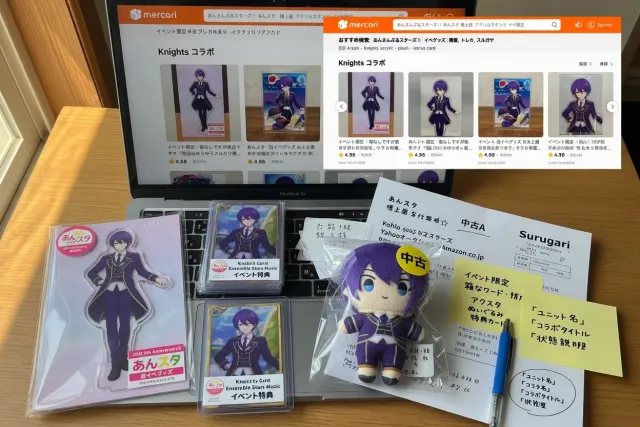
To find Ensemble Stars!! merchandise on Japanese marketplaces, search with Japanese character names, unit names, product-type terms, and event or collaboration titles rather than relying only on English keywords. Check several listing types, compare photos and condition notes, and use saved searches for popular characters. Japanese resale listings are especially useful for discontinued event goods, trading items, bonus cards, and older releases.
Start with the official name and Japanese search terms
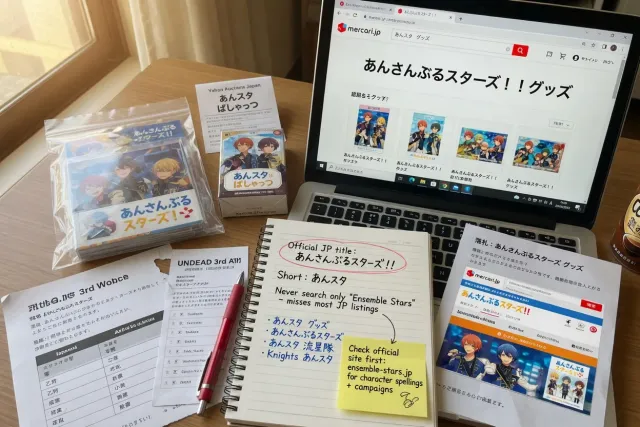
Japanese marketplace search works best when you use the franchise’s Japanese title: あんさんぶるスターズ!!, often shortened to あんスタ. Searching only ·Ensemble Stars· may return fewer results, unrelated overseas listings, or listings whose Japanese titles do not include the English name.
Use the official franchise website to confirm current character spellings, units, projects, and releases before building searches. The official Ensemble Stars!! website is a useful reference when a character has an uncommon spelling or when you are looking for merchandise from a specific campaign.
A broad first search can be as simple as:
- あんスタ グッズ · Ensemble Stars goods
- あんさんぶるスターズ グッズ · full franchise name plus goods
- あんスタ まとめ売り · bundle or lot listing
- あんスタ 大量 · large quantity or bulk listing
- あんスタ レア · rare item
Then narrow the search with the character, unit, item type, or event name. Many sellers use the short form あんスタ in the listing title, while others use the full title, so it is worth searching both. For current browsing ideas and available listings across Japanese stores and marketplaces, visit the Ensemble Stars!! collection page.
Search by character, unit, and idol name
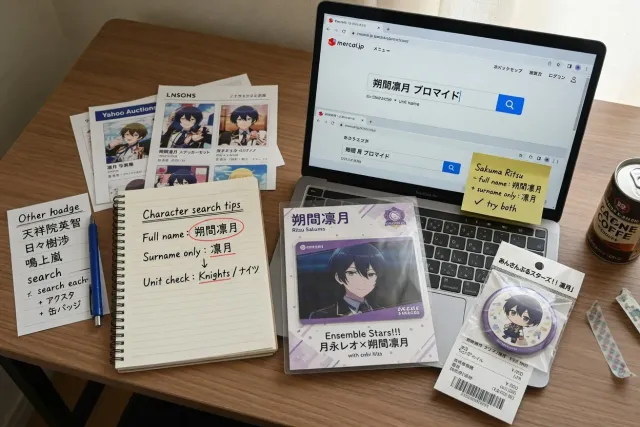
Character-based searching is the most reliable way to find targeted merchandise. Japanese listings may not mention the franchise in every title because sellers assume that the idol’s name is enough. Searching the Japanese name plus the product type usually produces more relevant results than a broad franchise search.
Use full names and surnames separately
Start with the full Japanese name, then repeat the search with only the surname. For example, a seller may write 朔間凛月, while another may simply write 凛月. A surname-only search can uncover listings that would otherwise be missed, but it may also produce unrelated results if the name is common.
For popular characters, add a product keyword immediately. Searches such as 朔間凛月 ぱしゃっつ, 天祥院英智 アクスタ, or 影片みか ぬいぐるみ are more useful than a single-name query with hundreds of mixed results.
Search by unit when character names are not listed
Group merchandise is frequently titled with a unit name rather than every individual idol. Use Japanese unit names such as Trickstar, fine, UNDEAD, Knights, 流星隊, ALKALOID, Crazy:B, Eden, Valkyrie, Ra*bits, Switch, Mam, and 2wink.
Unit searches are particularly effective for clear files, visual boards, bromides, exhibition merchandise, and trading-item sets. They also help locate duo or group artwork where a seller has not tagged every featured character.
Include aliases, project names, and themes
Some goods are associated with a special project, song, event, stage play, collaboration, or seasonal campaign. Add the Japanese campaign name when you know it. If you are unsure, begin with the character and product type, examine a few relevant listings, and note repeated wording in Japanese titles. That repeated wording is often the exact campaign term you need for a narrower search.
Use Japanese product-type keywords to find the right goods
Ensemble Stars!! has a wide variety of collectible formats. Product names are often abbreviated on Japanese listings, so learning the common terms helps you find both individual items and bundled lots.
- アクスタ / アクリルスタンド · acrylic stand
- 缶バッジ · pin badge; often shortened to 缶バ
- ぬい / ぬいぐるみ · plush or plush mascot
- もちマス · Mochi Mochi Mascot plush
- ぱしゃこれ · Pasha Colle collectible card
- ぱしゃっつ · Pashatts card
- 箔押し · foil-stamped version
- クリアカード · clear card
- ブロマイド · bromide photo print
- カード · card; useful but broad, so add a name
- クリアファイル · clear file
- タペストリー · tapestry
- 色紙 · shikishi art board
- 特典 · bonus item or purchase benefit
For trading goods, one listing may contain several copies of the same character or a complete mixed set. Add セット for a set, まとめ for a grouping, コンプ for a complete collection, or バラ売り when sellers indicate items may be separated. A complete set is not always a complete release: read the listing description and count the visible items rather than assuming that コンプ guarantees every variation.
If you collect a specific illustration, include the item series or event wording along with terms such as 開花前 and 開花後 when applicable. This can help distinguish different visual versions in card-related listings.
Find older, limited, and event-only Ensemble Stars!! goods
Japanese resale marketplaces are particularly valuable for merchandise that is no longer carried by standard retailers. Older prizes, early acrylic stands, anniversary goods, collaboration bonuses, caf· items, and store purchase benefits may appear unpredictably. The key is to search by release context, not simply by the character.
Build searches around where the item came from
Use terms that describe the original distribution method. For example:
- 限定 · limited edition
- 受注 · made-to-order or preorder production
- 特典 · bonus item
- 購入特典 · purchase bonus
- コラボ · collaboration
- カフェ · caf· collaboration
- ポップアップ · pop-up store
- 一番くじ · Ichiban Kuji lottery prize
- プライズ · arcade prize item
These words are useful because limited merchandise is often described by its source rather than by a formal product title. For example, a listing may say ·Knights 〇〇 特典· but omit the broader franchise name. When searching for bonus cards, add the retailer, event, caf·, or campaign name if it is known.
Search seasonal and anniversary terms
Anniversary items, birthday goods, and seasonal campaigns often have dedicated artwork that collectors seek long after release. Add terms such as 周年 (anniversary), 誕生日 (birthday), バースデー (birthday), ハロウィン, or クリスマス. If a listing appears to be part of a series, inspect the seller’s other items and use the printed series name from packaging or photos in your next search.
Read Japanese listing details and condition terms carefully
Photos are essential, but Japanese condition wording gives important context about packaging, display history, and included parts. Always compare the description with the images. A sealed outer bag does not automatically confirm the condition of every item inside, especially for trading products that were opened to identify the character.
- 未開封 · unopened. This usually refers to the item or its outer package, but check whether the seller specifies the exact item.
- 新品未使用 · new and unused. It may have been opened only for confirmation, depending on the product.
- 美品 · very good condition. This is subjective, so inspect photos for scratches, bends, fading, or stains.
- 開封済み · opened.
- 中古 · used or pre-owned.
- 傷あり · has scratches or damage.
- 汚れあり · has marks or staining.
- 欠品 · missing item, part, or accessory.
- 台座なし · acrylic stand base is missing.
- 初版 · first printing or first edition, most relevant to print goods and some collectible releases.
For acrylic stands, look for the character piece, base, protective film, and any original backing card shown in the listing. For plush, check the tag, stitching, surface condition, and whether accessories are included. For cards and paper goods, inspect corners, edges, foil areas, and whether the seller stored them in sleeves. Small defects can be difficult to see in compressed photos, so clear condition wording matters.
Be cautious with terms such as 現状品 (sold as-is), ジャンク (damaged or non-working/for repair), and 訳あり (has an issue). These are not necessarily bad purchases, but they require a close reading of the description and photos.
Compare listings without overlooking bundles and duplicates
It is easy to focus on the lowest displayed price, but the best find depends on the exact item, condition, quantity, and inclusions. A low-priced set may contain duplicates, while a higher-priced listing may include a desired bonus card, original packaging, or multiple items from the same event.
Before choosing a listing, make a quick comparison checklist:
- Is the item the exact character, artwork, edition, or event release you want?
- How many pieces are included, and are any duplicates visible?
- Does the description mention damage, missing bases, missing tags, or missing packaging?
- Is it an official product, a prize item, a collaboration benefit, or fan-made merchandise?
- Does the photo show the front and back of cards, or only a stock image?
- Are you comparing a single item with a lot, or like-for-like quantities?
Bundles can be excellent for collectors who want several characters from one unit, need multiple trading items, or are building a collection from scratch. Search まとめ売り, セット, and 引退品 (collection sell-off) for larger lots. However, do not assume that a bundle is automatically cheaper per item. Divide the total by the number of pieces you actually want, not by every item included.
For individual cards, badges, and acrylic stands, it is also wise to check whether the item is being sold as a single or as part of a matching pair or set. Sellers may list related items separately under nearly identical titles.
Use saved searches and browse more than one Japanese source
Popular Ensemble Stars!! merchandise can appear and disappear quickly, especially for high-demand characters, limited bonuses, or discontinued plush. Instead of repeating broad manual searches, create a short set of focused search variations and revisit them regularly.
A practical saved-search pattern is:
- Character name + product type
- Character surname + abbreviated product type
- Unit name + event or campaign term
- Character name + 特典
- Franchise short name + まとめ売り
Try the same query across live listings from Mercari, JDirectItems/Yahoo Auctions, Amazon Japan, Surugaya, and Minne. Each source has a different inventory pattern: individual resale listings may be useful for single trading goods, auction-style listings can surface older lots, retail inventory may include remaining stock, specialist stores may list pre-owned character goods, and creator platforms can carry fan-made items. Read titles closely so official merchandise and unofficial creations are not confused.
JPFinds can help you search and combine eligible purchases from Japanese stores and marketplaces into one international order flow. The service uses a two-payment system: the first payment covers the item-related cost, while the second payment is requested after packing when international shipping options are available. Explore current Ensemble Stars!! marketplace results to begin with character, unit, or product-type searches.
Refine your search after every useful listing
The fastest way to become better at finding Ensemble Stars!! goods is to treat each good listing as a source of new Japanese vocabulary. Note the exact series name, campaign title, packaging wording, or retailer bonus label shown in photos. Then use that language in your next query.
For example, if a broad search finds a desired acrylic stand, the listing may reveal an abbreviated series name. Search that series name with the character’s Japanese name and アクスタ. If you find a bonus card, copy the Japanese retailer or campaign term and add 特典. This gradual refinement is more effective than trying to translate every possible English phrase in advance.
Keep searches specific, compare condition and included parts, and remain flexible about formats. A collector looking for one illustration may find it as a card, badge, coaster, clear file, or bonus print. With the right Japanese terms, Japanese marketplaces can become a detailed archive of Ensemble Stars!! merchandise from current releases to long-sold event items.