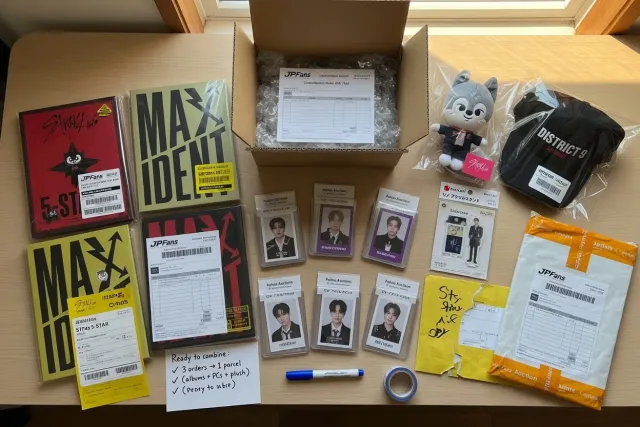
To combine multiple Stray Kids orders, place the items you want from Japanese stores and marketplaces, allow them to arrive at the JPFinds warehouse, then select the available orders together when you are ready to create an international shipment. Consolidation lets you send albums, photocards, apparel, plush, and other purchases in one parcel rather than paying international shipping separately for each order.
What it means to combine Stray Kids orders
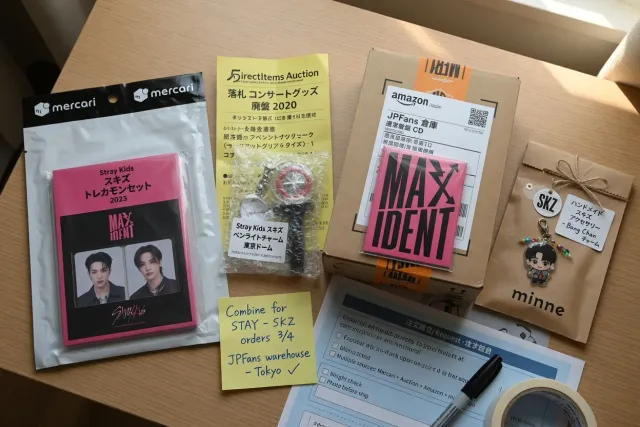
Combining orders is also called consolidation. Instead of shipping each purchase individually, you group eligible purchases that have reached the warehouse into a single outgoing parcel. This is particularly useful for Stray Kids collectors because a single collection often comes from several places: a Japanese Mercari listing for a photocard set, a JDirectItems Auction listing for a discontinued concert item, an Amazon Japan release, and a handmade accessory from Minne.
JPFinds gives shoppers access to live listings from several Japanese shopping sources, so it is possible to buy different kinds of Stray Kids merchandise in separate transactions and bring them together later. Browse current Stray Kids listings from Japan when you want to compare items across sources before building your order plan.
Consolidation does not mean that every item is purchased as one store order. Each seller or retailer transaction remains separate at the buying stage. The combination happens after the orders have been received at the warehouse and before you choose international shipping.
- Separate purchases: You can order from different sellers, different marketplaces, and different Japanese stores.
- One outgoing parcel: Available orders can be selected for a single international shipment.
- One international shipping charge: Shipping is calculated for the final combined parcel, based on its actual characteristics and your selected carrier.
- More control: You decide when your group of purchases is ready to ship instead of treating every find as an isolated delivery.
Understand the two-payment process before you start
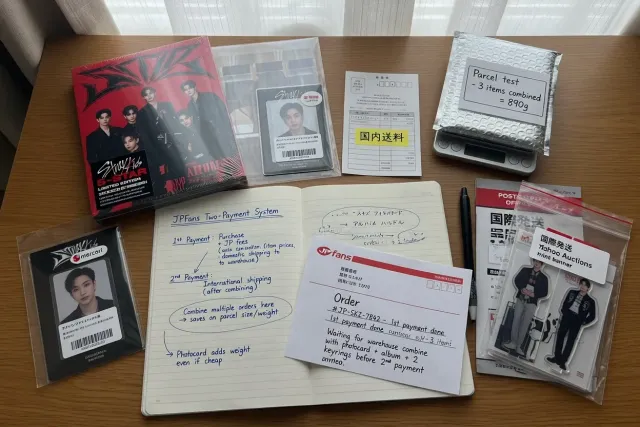
Planning is easier when you separate the cost of buying your items from the cost of sending them abroad. JPFinds uses a two-payment system. The first payment covers the purchase side of an order, such as the item price and applicable Japan-side costs. The second payment is made when you arrange international shipment after your selected purchases are available to be sent together.
This structure matters for collectors combining several orders. A low-priced photocard, for example, may be inexpensive to purchase but still adds size, weight, and packaging considerations to your eventual parcel. Conversely, a large album bundle can be efficient to combine with small goods, but it may influence which shipping carrier or service option is practical for the finished package.
Keep a total budget, not just an item budget
Before buying, set aside funds for both stages. Track the listed item price, any domestic shipping stated by the seller or store, and the later international shipping payment. This is especially important when you are collecting across multiple sources, because each purchase can have its own Japan-side charges even though you intend to dispatch everything in one parcel.
A simple spreadsheet or note can prevent surprises. Use columns for item name, source, seller, listed condition, purchase price, domestic shipping, order status, and whether it should be included in your first combined shipment. For high-demand collectibles, also record exactly what is included in the listing: a single photocard, a full set, an album with inclusions, or an item sold without its original outer packaging.
Plan which Stray Kids items belong in the same shipment
The best consolidated parcel is not always the one with the highest number of items. It is the one that fits your collecting priorities, budget, and preferred shipping option. Start by separating your intended purchases into groups: release items, paper goods, apparel, character merchandise, and bulky display pieces. This makes it easier to see what should ship together and what may be better saved for another dispatch.
Good combinations for many collectors
- Albums plus photocards: Albums provide a structured base in a parcel, while cards, postcards, and small inclusions can be grouped with them.
- Small merchandise from several sellers: Acrylic stands, keychains, badges, and fan-made goods are often sourced individually. Consolidating them avoids creating several separate international shipments.
- One larger item plus smaller purchases: A concert towel, light stick accessory, or plush can be combined with smaller goods when it suits the final parcel.
- Release-focused orders: Collectors who are assembling a specific era can group albums, store benefits, and related merchandise once all targeted purchases have arrived.
Take extra care with listings that use condition language. 未開封 means unopened, 美品 generally means an item described as being in beautiful or very good condition, and 初版 means first edition or first printing. These terms describe the seller's listing, not a universal grading standard. Read the translated title, description, photos, and included-item details before placing an order, especially when collecting limited editions, trading cards, or older releases.
For release information and official group news, compare your item research with the official Stray Kids website. It can help you distinguish official release names from fan-made shorthand used in secondhand listings.
Place orders in a sequence that supports consolidation
When several desired listings are available, buying order can affect how smoothly you can combine them. Marketplace listings are often one-of-one and can disappear once another buyer completes the purchase, while retailer items may have different availability patterns. Prioritize the pieces that are genuinely hard to replace, then add readily available items around them.
For example, suppose you want a rare Japanese-store bonus card, a used album bundle, a current CD release, and a handmade fan accessory. The bonus card and used bundle may deserve priority because they are unique listings. The currently stocked CD and handmade item can be added if they remain available. After each transaction, update your order list so you know which purchases are still in progress and which have reached the warehouse.
Avoid treating auction wins and store orders as identical
JDirectItems/Yahoo Auctions purchases and fixed-price store purchases can move through their respective transaction steps differently. An auction must first be won, while a fixed-price item can generally be ordered immediately if it is available. Keep this distinction in mind when deciding when to create your international shipment. The key is to wait until the specific orders you want to combine are available for selection rather than assuming all purchases will become ready at the same point.
For Mercari and other secondhand sources, carefully check whether a listing is for the exact member, unit, version, or bonus you intend to collect. A title may mention several members while the item photo or description confirms that only one card is included. Auto-translation is useful, but photos, quantities, and Japanese condition notes remain essential context.
Create your combined international shipment
Once the relevant purchases have arrived and are available in your account, choose the orders you want to send together and proceed to the shipping request. This is the point where you turn separate Stray Kids purchases into one outgoing parcel. Review the selected order list before confirming so that you do not accidentally exclude a priority item or include something you planned to save for a later shipment.
A useful final check is to compare the selected orders against your original tracking note. Confirm the item count, identify which album versions or card sets are represented, and make sure any high-value or difficult-to-replace pieces are part of the intended dispatch. If you have several nearly identical listings, use the listing titles and order references rather than relying only on memory.
Think about parcel size as well as weight
Collectors often focus on weight, but dimensions matter too. A stack of standard albums, a rolled poster, a plush, or boxed concert merchandise can shape the final parcel differently from a group of photocards. Consolidating orders can reduce repeated outer packaging and make the overall shipment more efficient, but the exact cost and available services depend on the completed parcel and destination.
If your order includes delicate paper items, keep their presence in mind when choosing what else to combine. A bulky item may be worth sending separately if you prefer not to mix it with a carefully assembled photocard order. There is no single best strategy: the right grouping depends on what you collect and which pieces matter most to you.
Choose a carrier option for your consolidated parcel
After you create the shipment request, select from the carrier options available for your destination and final parcel. Different services can have different price structures, tracking features, destination coverage, size limits, and handling rules. Compare the options shown in your account rather than assuming the same carrier is best for every order.
For a compact order containing a few cards and small accessories, the available options may differ from those for a parcel containing multiple albums or a large plush. If you are combining several purchases, it can be helpful to decide in advance whether your priority is a smaller number of outgoing parcels, a particular carrier feature, or separating a bulky item from your paper goods.
Remember that customs rules, taxes, duties, and import restrictions are determined by the destination country. Review your local import requirements before requesting shipment, particularly when ordering a large quantity of merchandise or items that may be treated differently by local customs authorities.
Avoid common consolidation mistakes
The main advantage of combining orders is control, but that control works best when you stay organized. The following habits help collectors avoid preventable problems.
- Do not ship before your key orders are available: If a rare card or auction win is central to your planned parcel, wait until it is ready before finalizing the shipment selection.
- Do not assume versions are interchangeable: Check Japanese edition, member, event, album version, and included benefits before purchasing.
- Do not forget the second payment: Budget for international shipping from the beginning, even when each item price looks modest.
- Do not combine by item count alone: Consider the physical profile of albums, boxes, plush, paper goods, and framed items.
- Do not overlook order notes: Save screenshots or translated listing details for rare items so you can match each order to your collection plan.
When you are ready to start a collection-focused order, explore the current Stray Kids shopping hub and build a shortlist before purchasing. A deliberate shortlist makes it easier to group items by era, member, format, and parcel priority.
FAQ: Combining multiple Stray Kids orders
Can I combine Stray Kids items from different Japanese stores?
Yes. Consolidation is designed for separate purchases that have reached the warehouse, including items sourced from different supported stores and marketplaces. You can select the available orders you want to include in one international shipment.
Do I pay for every order separately when I combine them?
You make the purchase-side payment for each order, then make the international shipping payment when you create the combined shipment. Combining purchases means you can send selected orders in one outgoing parcel instead of arranging separate international shipments for each one.
Should I combine albums and photocards in the same parcel?
Many collectors do, especially when the albums are part of the same release-focused order. Consider the final parcel's size and the types of goods involved. If you prefer to keep paper collectibles apart from bulky items, create separate shipments instead.
Can I combine auction wins with fixed-price Stray Kids purchases?
Yes, provided the purchases have completed their transaction process and are available to include in your shipping request. Since auction and fixed-price orders can progress differently, track each order before creating the combined shipment.
How do I know whether a listing is unopened or in good condition?
Read the translated description and examine the listing photos. Japanese terms such as 未開封, 美品, and 初版 can be useful clues, but always check the seller's full description and the exact contents shown in the listing.