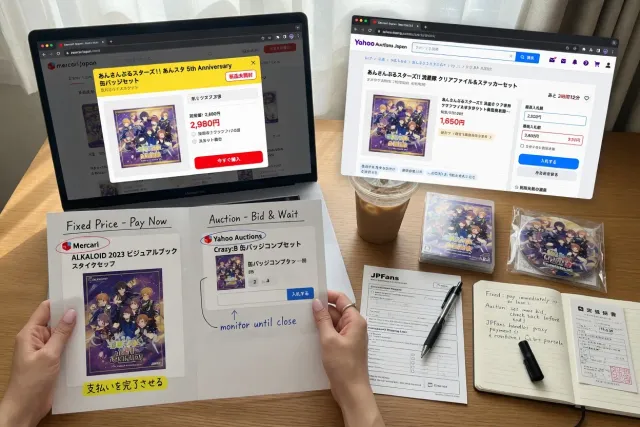
To buy fixed-price listings, select an available item and complete the required item payment before another buyer purchases it. To bid on auctions, enter the highest amount you are willing to pay and monitor the auction until it closes. With JPFinds, you can browse live Japanese listings, use auto-translation, pay for items first, then pay international shipping after your orders are consolidated.
Understand the Difference Between Fixed-Price Listings and Auctions
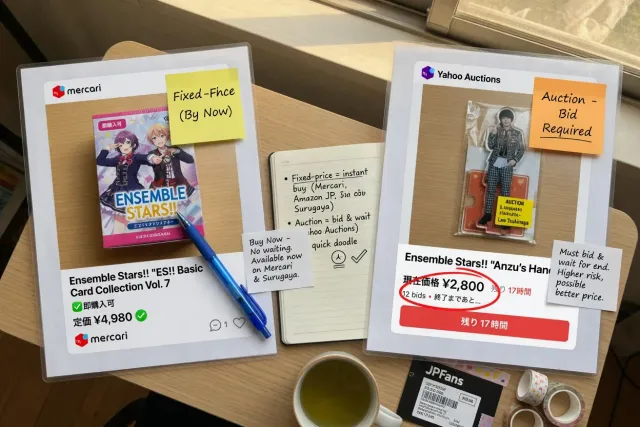
Japanese shopping sites commonly use two listing formats: fixed-price listings and auction listings. Knowing which format you are viewing is the first step toward buying successfully.
Fixed-price listings: buy now at the listed amount
A fixed-price listing has a set purchase price. If the item is still available, you can request or complete the purchase without competing through a bidding period. This is the standard format on Mercari, many Amazon Japan listings, Surugaya listings, Minne, and some JDirectItems listings.
Fixed-price listings are usually the better choice when:
- You want the item quickly and do not want to wait for an auction to end.
- The price is acceptable compared with similar listings.
- The item is rare enough that waiting for another copy is risky.
- You want a specific condition, edition, bonus, or version.
For collectibles, read the Japanese condition notes carefully. Terms such as 未開封 mean unopened, 美品 generally means the seller considers the item to be in very good condition, and 初版 means first edition. These descriptions are useful, but the photos and the complete listing details remain important.
Auction listings: compete until the closing time
An auction begins at a current bid, but the final price is determined by bidder activity before closing. You set a maximum bid that reflects what the item is worth to you, including expected domestic charges, international shipping, and any optional services you may choose later.
Yahoo Auctions listings accessed through JDirectItems are a common example of this format. An auction can be excellent for out-of-print goods, limited releases, bulk lots, character goods, and listings that do not appear often at fixed prices. However, the lowest visible price is not necessarily the amount you will pay. Other bidders may raise the final price, and some auctions receive activity close to the end time.
How to Buy a Fixed-Price Listing Through JPFinds
Buying a fixed-price item is straightforward, but speed and careful review matter. Live listings can sell out, be deleted, or become unavailable while you are deciding.
1. Search across Japanese marketplaces
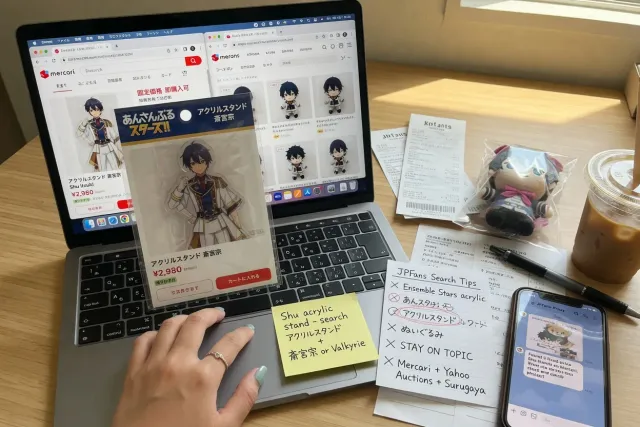
JPFinds provides access to live listings from sources including Mercari, JDirectItems/Yahoo Auctions, Amazon Japan, Surugaya, and Minne. Search with the English title, Japanese title, character name, product line, manufacturer, or catalog number when possible. Japanese search terms often reveal more results than English-only searches.
For example, a collector looking for character acrylic stands may search the franchise name plus アクリルスタンド. For plush items, try ぬいぐるみ; for trading cards, カード; and for clear files, クリアファイル. Visit the Ensemble Stars!! shopping hub to browse relevant merchandise categories and search ideas.
2. Review the complete listing before ordering
Check the following details before you submit a purchase request:
- Price: Confirm the listed item price and distinguish it from shipping or handling charges that may be shown separately.
- Quantity: A listing image may show several goods, while the sale may be for only one item.
- Condition: Look for scratches, stains, missing packaging, damaged boxes, discoloration, or incomplete sets.
- Included items: Verify whether bonus cards, stands, straps, inserts, and original packaging are included.
- Photos: Compare all photos with the description, especially for used figures, signed goods, bundles, and high-value collectibles.
- Seller notes: Auto-translation helps make Japanese descriptions easier to understand, but unusual wording should be read in context.
If a listing says まとめ売り, it is usually a bundle sale. If it says バラ売り不可, the seller does not intend to split the set. If it says 即購入可, immediate purchase is permitted. These terms can affect whether the listing suits your needs.
3. Place the order promptly
Once you have decided, submit the order and complete the first payment required for the item. Because fixed-price listings may be purchased by someone else at any time, a delayed payment or request can mean the item is no longer available. Do not assume that placing an item in a cart reserves it.
After the purchase is completed, the order becomes part of your JPFinds account. If you plan to buy several items, you can continue shopping and later combine eligible orders into one international shipment.
How to Place an Auction Bid Strategically
Auction bidding is less about chasing every price increase and more about setting a realistic limit before the auction becomes competitive. Decide your ceiling first, then bid with a plan.
Set a true maximum bid before you bid
Your maximum should be the highest item price you are genuinely comfortable paying, not merely the amount you hope to win for. Consider the item’s condition, rarity, completeness, comparable listings, domestic costs, and the weight or size that may affect later international shipping.
For example, if you would be happy to pay up to ·8,000 for a limited acrylic stand bundle, do not set a ·12,000 maximum simply because the current bid is ·4,000. A higher ceiling can win the auction, but it can also result in a final price you later regret.
Know how maximum bidding works
Many auction systems use an automatic bidding approach. You enter your maximum amount, and the system may raise your active bid in increments only as needed to compete against other bidders, up to your limit. The exact displayed price can therefore be lower than your maximum until another bidder challenges it.
Entering a maximum bid does not mean you will necessarily pay that full amount. It means you authorize bidding up to that amount if competition requires it. If another bidder’s maximum is higher than yours, you can be outbid even if your bid was above the visible price at the time.
Watch the deadline, but avoid emotional bidding
Some auctions receive late bids, and certain platforms may handle closing-time activity differently. Check the listing’s displayed end time, current bid, bid history where available, and any rules shown on the auction page. Avoid repeatedly raising your maximum in small, emotional increments. Instead, decide whether the item is worth more to you than your original limit.
If the answer is no, let the auction go. Another listing may appear later, especially for common goods. If the answer is yes, raise your ceiling only after reassessing the total cost rather than reacting to the competition.
Read Listing Conditions, Fees, and Seller Restrictions Carefully
Whether you are purchasing at a fixed price or bidding on an auction, the listing itself determines what is being offered. A low price does not automatically mean good value if the item is incomplete, damaged, or subject to substantial domestic delivery charges.
Condition language to look for
- 新品: New.
- 中古: Used or pre-owned.
- 未使用に近い: Like new or barely used.
- 傷や汚れあり: Scratches or stains are present.
- 箱なし: No box.
- 欠品: Missing parts or components.
- ジャンク: Junk condition; may be damaged, incomplete, untested, or intended for repair/parts.
Be particularly cautious with character lots and mystery bundles. A photo may include display props, background items, or goods that are not part of the sale. Read phrases such as 画像のものが全て (·everything shown in the image is included·) and 現状品 (·sold as-is·) closely.
Factor in domestic and international costs
The item price or winning bid is only one part of the final expense. A Japanese seller may charge domestic shipping, and different marketplace listings may handle shipping differently. Once purchases are ready to send internationally, shipping costs depend on the selected carrier, destination, parcel size, parcel weight, and shipment options.
Bulky boxes, large plush toys, posters, and figure packaging can cost more to ship than small paper goods even when their purchase price is low. Buying several small items together can be more practical than shipping each one separately, but consolidation choices should still reflect the size and weight of the combined parcel.
Use JPFinds· Two-Payment System and Consolidation Options
JPFinds uses a two-payment structure so you can purchase items first and arrange international delivery after your purchases are ready. This is useful when shopping from several Japanese sources or when you want to combine multiple orders.
First payment: the item purchase stage
The first payment covers the purchase stage, such as the item price or auction amount and applicable purchase-related charges. For auction orders, make sure your bidding funds and limit reflect the amount you are prepared to commit if you win.
For fixed-price goods, acting quickly at this stage is important because the seller can sell the item to another buyer before the order is completed.
Second payment: choose international shipping
After your items are available for shipment, you can select an international shipping method from the carrier options available for your destination. This is the point at which you review the shipment cost and choose how you want your orders sent.
If you have bought several related goods — such as badges, albums, acrylic stands, or books — consolidation can help you manage them in one shipment. The Ensemble Stars!! marketplace collection is a useful place to return to when building a combined order from multiple Japanese listings.
Common Mistakes to Avoid When Buying or Bidding
Most disappointing purchases come from rushing, overlooking a translation detail, or focusing only on the initial price. Use this checklist before you confirm an order or bid.
- Do not bid more than your planned maximum. Auction excitement is temporary; the winning obligation is not.
- Do not assume a bundle includes every pictured item. Read the description and quantity field.
- Do not ignore condition labels. ·Junk,· ·as-is,· and ·missing parts· can materially change an item’s value.
- Do not wait too long on a desirable fixed-price item. Availability can change without notice.
- Do not compare only the item price. Account for domestic charges and eventual international shipping.
- Do not confuse a bid with a casual offer. Treat every bid as a serious commitment up to your maximum amount.
- Do not forget item dimensions. Large packaging may affect shipping choices later.
A disciplined approach makes Japanese marketplace shopping much easier: verify the listing, decide your all-in budget, act promptly on fixed-price items, and use a firm ceiling for auctions.
When to Choose Fixed Price Instead of an Auction
Choose fixed price when certainty matters more than the possibility of saving money. If you find the exact item in the right condition at a price you are happy to pay, purchasing it can be safer than waiting for an auction that may become expensive or end above your budget.
Choose an auction when the item is difficult to find, offered as a collectible lot, or priced attractively enough that you can bid within a sensible limit. Auctions can create opportunities, but only when you remain comfortable with the potential final total.
For either format, search broadly, compare condition and inclusions, and keep a record of your preferred price range. That preparation turns buying from Japan into a repeatable process instead of a last-minute decision.